Posted by admin on August 24, 2011 under Vietnam Destinations, Vietnam attractions, Vietnam beauty |
Talking about Quang Nam province, probably many people would think about Hoi An street or My Son holy city; however, the beautiful landscape in the west of Que Son town, at the headwaters of Thu Bon River is also a very attractive destination.

Tay Vien hot spring brings enjoyment and relaxation
Distant from My Son vestige about three kilometers towards the west is Tay Vien hot spring. This place is taken form from some earthquakes in the entrails of the earth millions of years ago.
The water in these two streams is very clear, with the average temperature of about 85 degrees.
This is an ideal place for tourist to steam bath. The stream’s water contains many precious mineral substances such as calcium, potassium, sulphur and iron.Tourists can also have a mud – bath here, which can help them to relax and cure some sickness.
At a distance of about five kilometers from Tay Vien towards the east, there is a very beautiful stream, named Fairy Stream. This is one of the most beautiful streams in the Central region.
Located in two sides of the stream are the rocky mountains. In the afternoon, the sunset contrasts and creates miraculous colors, and makes the landscape become a natural painting, which is so beautiful and impressive.
About 2.5 kilometres from Tay Vien hot spring towards the west, there is a cultural village, Dai Binh village. It is located nearby Thu Bon River.
Coming there, tourists can totally feel comfortable when relaxing in the ancient houses and enjoy the countryside fruits. The gardens here are just like ones in the South with so many kinds of fruit such as durian, mangosteen, rambutan, langsat, orange and grapefruit.
There is also ferry – boats for tourists to enjoy the scene along Thu Bon River. On the two sides of the river, people grow many mulberry. Tourists would be very impressed with the immense green of these mulberry gardens.
Tourist can stop their ferry – boats at any white sand – banks along the river to enjoy the beautiful landscape around as well as swimming, catching fishes and the delicious baked fishes.
The flow crosses two mountains. The cliffs look just like the huge dykes that divide the water into two parts. The scene is just so imposing.
When the ferry – boat floats downstream, tourists would have chance to visit Le Pass, with a beauty that is not very different from Fairy Stream. On this way back, Que Chau village would welcome tourists with the traditional Vietnamese opera and Non village would make tourists interested with the process of making “non la” (conical hat)- the traditional hat of Vietnamee people.
(Source: SGGP)
Posted by admin on August 13, 2011 under Vietnam Travel Stories, Vietnam beauty |
The Thu Bon River basin covers an area of over 10,000 square kilometers in Quang Nam Province and is ranked fourth for hydropower potential in Vietnam. But to the local people, the river is considered the lifeblood that has helped raise many generations of residents on both banks.
 |
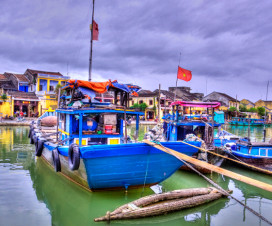
| Part of the Thu Bon River with cloud-covered mountains in the background |
Originating from Ngoc Linh Mountain in Dak Glei District, Kon Tum Province, the Thu Bon River flows into the sea via Cua Dai Estuary in Hoi An Town in Quang Nam Province. A tributary runs to the Vinh Dien River to pour water into the Han River in Danang City. And before going to the sea, part of the Thu Bon River courses through the Truong Giang River to pour into An Hoa Tam Quang Bay in Nui Thanh District.
From Vinh Dien up to Giao Thuy T-junction, one can see mulberry fields along the river banks. A folk art was born here, using literary figures to show the intelligence, optimism and sentiments of the locals.
For a long time, the Thu Bon River has been famous for the craft of raising silkworms and weaving fabric, and for the endless green mulberry farms stretching along its banks. Along the banks are many well-known craft centers such as Thanh Ha for pottery, Phuoc Kieu for bronze casting, Kim Bong for carpentry, Tra Que for vegetables, Ma Chau for silk, Phu Chiem for rice paper and Que Minh for conical hats.
Along the banks are numerous wharves and markets reflecting the rural lifestyle, and simple villages steeped in memories. The Trung Phuoc floating market is the busiest trading place in the region.
The Thu Bon River is likened to the Ganges River in India because it is a silt source forming the delta. Strangely, despite cultural interchange, the very northern and southern banks of the Thu Bon River have their own cultural differences characterised by voices, routine activities, festivals and even relics from each area. In the southern bank, the Champa culture still figures in daily activities, customs and festivals for local residents.
The Thu Bon Goddess Festival falls on the 12th day of the second lunar month, and is held solemnly in My Luoc Village, where a water procession is the most important part of the ceremony. Locals scoop water from the Thu Bon River and pour it into the jars, then carry them on their heads back to the village in deference to the river.
In the upstream district of Hiep Duc, locals set up a long house with an altar on the top to suspend a boat. The rituals around the boats aim to honor the “river mother” in the spiritual lives of locals.
For tourists who are interested in a river tour or an eco-tour to the countryside of Vietnam, taking a boat ride on the Thu Bon River may be their most enjoyable experience when they come to Quang Nam-Danang.
They can also visit Dai Buong, an orchard village similar to those found in the southern region with rambutan, durian and mangosteen. Tourists will have the chance to enjoy durian wine, which has an unforgettable flavor.
In Hon Kem-Da Dung area, where the river is narrowed by the cliffs on either bank, novelist Thai Ba Loi stood and gazed at the Thu Bon River and regretted: “On the river, hydropower dams were built, thousands of hectares of forest have been destroyed. Sand is exploited excessively. With such unethical behavior toward nature, people must reap what they sow.”
If the Thu Bon River, a water mother who opens her arms to hold the holy land which is home to the epic legends of Quang Nam, a traditional cultural stream filled with the colors of the central region’s countryside, and an attractive tour itinerary, is not protected from being destroyed by humans, it cannot retain its beautiful images in the minds of people who love the land.
(Source: SGT)
Posted by admin on July 30, 2011 under Vietnam Destinations, Vietnam beauty |
Despite it is in summer or winter, and the days are foggy or full of sunshine, Moc Chau Plateau is always attractive with its dreamlike beauty.

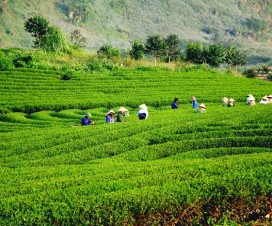
Tea hill with fresh green in Mock Chua Plateau
Located in Son La province, at a distance of 200 kilometers from Hanoi, Moc Chau Plateau is 1,050 metres above the sea level, with an area of about 80 kilometres in length and 25 kilometres in width.
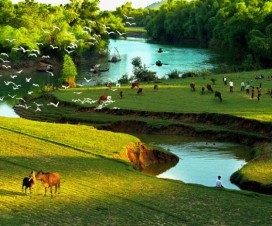
Moc Chau Plateau is famous for a large herd of milk cows, immense tea hills, big gardens of plum and apricot – tree, and large pastures of about 1,600 hectares.
The milk cow in Moc Chau is the black and white cow race of Holland. From this large herd of cows, Moc Chau has developed the experience tourism so that tourists can feed the cows and do the milking themselves.
This kind of tourism also offers tourists to enjoy the fresh pure cow’s milk and have camping over night right in the pasture.
It would be totally relaxing and comfortable to walk on the hill slope of green and soft grass and enjoy the fresh cool air around. Scattered everywhere are the white flowers and in the distance are the green hills hiding in the shadow of the clouds. All those things just make the landscape here so dreamlike.
Tourists can also prepare meat or buy some from the small restaurants in town to have a roasting meal at night just like nomadic people.
Climate is a special tourism resource of Moc Chau Plateau. Usually, the medium temperature is just 200C, with cool summer and dry winter. The autumn and spring in Mo Chau is the season of tea and pine tree. That is the time when the whole plateau will be covered with a beautiful and fresh green color.
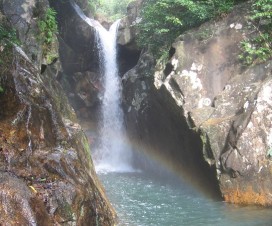
One more outstanding point of this place is the Dai Yem Fall. From Pa Hang border gate in Long Sap commune, Moc Chau town, go along the main road about 4 kilometers, there is a junction of two streams, where the fall starts.
Going through the forest, down to a short and sloping section, tourists would see the two streams pour water down from the height of about 100 meters.
Dai Yem Fall stays below the road surface. The lake under the fall is always clean and clear all year round. The scene around is very natural and wild, which makes its beauty so impressive.
A trip to Moc Chau Plateau will promisingly refresh travelers with joyful and peaceful feelings.
(Source: SGGP)
Posted by admin on July 22, 2011 under Vietnam Destinations, Vietnam beauty |

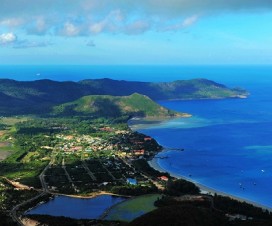
Tropical almond trees stand firm on a seaside road in Con Dao
Quiet yellow-sand beaches and historical sites may lure visitors to Con Dao but it’s the old tropical trees that protect them from the scorching sunshine in the archipelago off the southern province of Ba Ria-Vung Tau.
There are a number of cay bang trees which are over 100 years old and hang over Ton Duc Thang and other roads in Con Dao to provide respite from the heat for tourists, who ride past on their motorbikes or stroll around.
Strong winds and sunshine may be not be your idea of a nice break but these noticeable characteristics have turned out to contribute to shaping the trees into distinctive bonsais. The trees are spread out over two lanes of the seaside roads and they shield pedestrians taking a leisurely stroll on the pavement between the tree lines and mossy yellow walls of the old prisons,

A beautiful view of an old tree and the sea from Con Son
from the sun.
From tourists resorts, beyond the lines of tropical trees in the esplanade, you can witness the calm of the sea, with fishing boats bobbing on the water and the distant mountains.
At a little coffee shop called Con Son, you can sip a cup of coffee and rest after a long trek at the seaside or in the forests.

A giant banyan tree’s roots cover the wall of a historical site in Con Dao - Photos: Mong Binh
Breaths of wind blow in from the ocean sending red leaves of the tropical trees down onto your table as drops of coffee are slowly seeping through the filter, and whet traveler’s appetite for more adventure in the quiet town of Con Dao.
Inside and outside this small town there are other types of ancient trees including the banyan whose roots cover the ruins of historical sites. Underneath these roots contain untold stories about the bravery of revolutionary fighters who shed blood for the independence of Vietnam.
(Source: SGTO)
Posted by admin on July 20, 2011 under Vietnam Beaches, Vietnam Destinations, Vietnam beauty |
When the sun is about to cast its last beams over ranges of mountains and hills surrounding Nha Trang Bay and the central coastal city, the Altitude Bar has soft music mixed with the sound of gentle waves slapping against the ocean shore beneath.

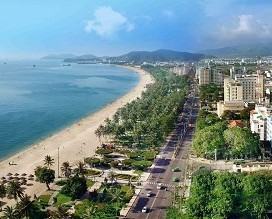
Nha Trang Bay at sunset taken from the Altitude Bar
Then as the afternoon breezes from the world-recognized bay come in, they awaken and breathe new life into the Altitude on the five-star Sheraton Nha Trang’s 28th floor.
Considered the highest bar in Nha Trang, it offers an incomparable spot for visitors to have a bird’s-eye view of Nha Trang bay and the city.
The Altitude is open to both hotel guests and visitors from 4 p.m. to 10 p.m. daily, but the hotel’s director of food and beverage Michiel de Kleer says the best time to visit the bar is from around 5 p.m. to 5:30 p.m. when the sun is going down behind the mountain ranges and hills in the west, leaving a lot of beautiful colors in the sky as dusk settles.
As darkness comes, we see the city at night. From the Altitude, guests can spot the Ponagar tower, the giant statue of Buddha and other city attractions lit up in all their glory.
The neon lights along the seaside street of Tran Phu point hungry travelers towards the restaurants that serve a wide selection of seafood and specialties of the city and the central region as a whole.
The moon appears in the clear, summer night, radiating its light all over Nha Trang Bay, which has been called one of the most beautiful bays in the world.

The sunshine of Nha Trang Bay viewed from the Altitude - Photos: Mong Binh
Under the moonlight, tourists and locals swim in the calm sea of summer, stroll hand in hand or chat in groups along the arch-shaped beach with some sitting down on the white sand to take it all in.
And you can see it all from the Altitude Bar. Guests can order a cocktail, mocktail, fruit juice, wine, champagne, beer, coffee and other drinks as they look onto the bay. Or they can sit indoors and immerse themselves in the music and enjoy their beverages. For more information and reservations, call (058) 388 0000.
(Source: SGTO)
Posted by admin on July 19, 2011 under Vietnam Destinations, Vietnam attractions, Vietnam beauty |
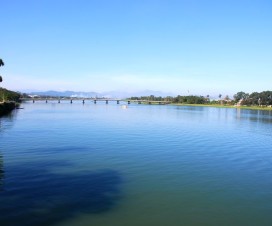
For a long time, Hue has been famous for many beautiful and ancient landscapes, and one of them is the Perfume River.

Perfume River flows mildly like a silk range and leads to Vy Da garden, Thien Mu pagoda, Bach Yen River and Huyen Khong pier one after another. All of these four destinations are magnificent, peaceful and ancient.
Along with those beautiful and romantic scenes, Hue is also famous for many pleasure activities, which are very interesting such as “Releasing boat”, “Playing with the moon”, “Hue singing”, “Sleeping on boat ”and“ Playing with verse All these activities are associated with Perfume River and only have in Hue city.
“Sleeping on the boat” is just a name, since nobody come to the boats for sleeping but only for enjoying the cool wind, watching the moon and the sky and listening to the beautiful songs.
“Playing with verse” is a literary gamble, which enquires players to be very intelligent as well as to have good plans and strategies. The interesting point of the game is that players cannot only make use of all knowledge about literature that they have but also learn many new things from others.
Hue singing is originated from the combination of traditional music and royal music. This elegant and attractive kind of music is really worth listening. Tourists would have a chance to sit on the imperial boats that kings and lords used to be seated in the old time.
In the hold of the boat, there is an imposing orchestra includes nearly all kinds of Vietnamese traditional musical instruments.
The bandsmen as well as the singers are still very young, and they all wear “áo dài”, the Vietnamese traditional clothes. On the prow of the boats, there is a wide and airy space for enjoying the moonlight and the fresh air.
When the night falls down, Perfume River becomes more fantastic. The lamplight spreads on the river just like silver. The winds blow softly and the boat floats slowly. Everything makes travelers feel so peaceful.
In the distance across the river, Thien Mu pagoda appears vaporously, Phuoc Duyen tower looks like being laminated with the moonlight. The scene is so charming and romantic.
Having a night on Perfume River, listening to Hue singing and enjoying the fresh cool air along with the beautiful scenes around, tourists would discover some feelings that could only be found in Huế.
(Source: SGGP)
Posted by admin on July 18, 2011 under Vietnam beauty |
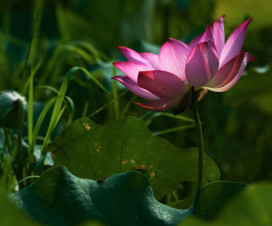
Pho Rang, in the northern mountainous province of Lao Cai, has become adorned by a great deal of summer lotuses.
The flowers create a rainbow of colours, and also attract tourists to the ares.
Residents in Bao Yen Township’s Pho Rang have grown lotus for years. Fresh lotus seed cups are often sold in Bao Yen’s market.


(Source: dtinews)
Posted by admin on June 14, 2011 under Vietnam Culture, Vietnam beauty |
Village life in Vietnam is the richest form of ancient culture tinged in modern times. Vietnam is located in South East Asia and is an “S” shaped country. About 3.77 million people visit the country every year and the main tourist attraction for the country is its village life. Vietnam has beautiful highlands and glimmering green rainforests.
The face of the country is made of its societal forma and structures. The interaction amongst the social agents and other socio-economic organs, craft the cultural heritage and reform legacy with sustenance of the original roots of development. Villages are the basic units of Vietnam society. Most villages have typical architectures like village gates made of bamboo and wood, bamboo hedges around the houses, common wells for all, expanded greenery of fields, pasture lands to roam, chirping birds, cattle and the masters’ shout, alleys and enchanting fresh air to breathe in. Village life in Vietnam is characterized by the ancient form of religion. In every village there is a temple and the tutelary God is worshiped there.
Village life in Vietnam has distinctive features of robust people, hard work, agricultural activities and ancient form of handicraft. The finest beaches grace this country. The ocean waves kiss the white sand beaches in all laziness, creating a melodic atmosphere during dawn and dusk. The gentleness of the environment has blessed village life in Vietnam with purity of thoughts and cooperation. It is hard to believe that even in this era of bloodshed, genocide, war and rages, nature has still nurtured a natural oasis of peace, purity and greenery of innocence.
Village people in Vietnam value social events and traditions like birthdays, temples of forefathers, ancestral fete etc. They live in big families and it is found that most of the village habitats share the same lineage or in some way relate to the same blood connections. There you would find the village democracy with man-woman equality, helping the organization and flourishing of the villages. Nearly all villages are agro-based and hence agriculture and dazzling handicrafts form the very basis of their economic activities.
Collected by Vietnam hotels
Posted by admin on June 13, 2011 under Vietnam Festivals, Vietnam Travel Info, Vietnam beauty |
Nha Trang Sea Festival 2011 which will take place from Saturday to Wednesday is a great chance for tourists to admire the city’s stunning beaches and fascinating islands.
Saigontourist Travel Service Company and the Yasaka-Saigon-Nhatrang Hotel, under management of Saigontourist Holding Company, use this occasion to try to attract festival-goers with special events.
The four-star Yasaka Saigon Nhatrang Hotel, located in the center of the city, will hold a number of festival events that promise to leave guests with unforgettable memories.
There will be a parasol display before a doorshow featuring music and dancing at the hotel’s lobby from 6:30 p.m. from Friday to Wednesday.
The hotel will prepare Asian, Vietnamese and Western fare in the Beach Cuisine event which will be held from 5:30 p.m. on Friday.
There will also be a rock balancing competition and on Tuesday the hotel will join the Cyclo challenge and parade at April 2 Square and along Tran Phu and main streets of the city.
Meanwhile, Saigontourist will offer trips, including a five-day tour to Nha Trang-Dalat priced at VND3.2 million, departing on Sunday, a four-day tour to Hon Mun Island-Wonder Park priced at VND2.9 million,
departing on Saturday, a four-day tour to Nha Trang-Hoa Lan Stream-Doc Let Beach priced at VND2.5 million, departing on Sunday, a six-day tour to Phan Thiet-Nha Trang-Dalat priced at VND4.7 million and a five-day tour to Phan Thiet-Nha Trang priced at VND4.2 million both departing on Saturday.
Saigontourist Travel Service Company is located at 45 Le Thanh Ton Street, HCMC’s District 1.
The Yasaka Saigon Nhatrang Hotel is at 18 Tran Phu Street, Nha Trang City, Khanh Hoa Province.
Other nha trang hotel information, you can visit the website http://Vietnamhotels.net
Posted by admin on May 28, 2011 under Vietnam Destinations, Vietnam beauty |
Fansipan is the highest mountain in Vietnam and Indochina, at 3,143 meters. It is located in Lao Cai province in northwest Vietnam, 9km southwest of Sa Pa Township in the Hoang Lien Son Mountain Range.
Fansipan is dubbed “the Roof of Indochina”. It is also one of the very few ecotourist spots of Vietnam, with about 2,024 floral varieties and 327 faunal species.
The topography of Fansipan is varied. Muong Hoa Valley, at the lowest altitude (950 to 1 000m), is created by a narrow strip of land at the base on the east side of the mountain. It can be climbed in a steep and fairly strenuous hike.
“Hunting clouds” on the Roof of Indochina has been always an interesting tour for adventurers. The feeling of bobbing on clouds to see the grandiose landscape of the nature is worthy for their efforts to conquer this 3,143m peak.
How to get there?
The most popular means of transport chosen to save your time and money is train. From Hanoi, you can get the train at Tran Quy Cap railway station to Lao Cai, then get a bus to Sapa and start your adventure.
You should book train tickets 1-2 weeks before the trip, especially if your trip is scheduled at the weekend. The ticket price may be different if you book it directly at the railway station or through travel agents. You should also book the return ticket early at your hotel or travel agents in Sapa or Lao Cai.
To adventure the Fansipan, you need the license granted by the Hoang Lien Son National Par to get into the park. You can take the license in the morning, when you start to visit Fansipan.
There are many ways to the peak of Fansipan. There are four major roads. The first way is from Cat Cat to Sin Chai. This is the most difficult road in Lao Cai to conquer Fansipan. Those with good physical strength and want a long trip often choose this road to adventure the Roof of Indochina.
The second way is from Cat Cat to Tram Ton. This road is good to see Fansipan clearly. However, it is quite long.
The third way is from Sapa to Tram Ton: This is the shortest and most simple road for everyone. You can hire a car of a travel agent to go from Sapa to Tram Ton. You should book the return.
From Tram Ton, you will get into the jungle at around 10 am. You will pass many streams and stop at Bai Soi for lunch at around 12.30-1 pm. From Bai Soi, the road will be more sloping. After two hours of walking from Bai Soi, you will reach a camp at the height of 2,200m and you will rest there.
The next day you will continue the trip to the camp at the height of 2,900m and then to the peak. This is a long and sloping road so you should walk slowly to maintain their breath. You can have lunch on the peak and return to the camp at the 2,900 or 2,200m for a night rest and return the next morning.
The route to Fansipan doesn’t require so-good physical strength but endurance. You should practice exercises on a daily basis at least one week before the tour.
Pictures of Fansipan:


The road to Fansipan


Wild flowers on the Fansipan


Thuy Thom (photo: quycoctu.multiply.com, phuot.com)
Collected by http://Vietnamhotels.net