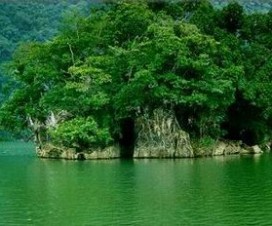
Ba Be National Park registered in Ramsar List
Posted by admin on November 25, 2010 under Vietnam Travel Info, Vietnam World heritages, Vietnam attractions | Be the First to Comment

Deputy PM Nguyen Thien Nhan agreed to allow the Ministry of Natural Resources and Environment to register the Ba Be National Park in the Ramsar List of Wetlands of International Importance.

Ba Be National Park is recognized as an ASEAN Heritage Park in 2004.

The national park in the northern province of Bac Kan has an area of 500 ha with primeval forests home to 417 species of plants, 299 species of vertebrates, and 49 species of freshwater fish.

The park has met 7 out of 9 criteria for being included in the list.

In 1995, Ba Be Lake in the national park was recognized by the World Lake Conference as one of the world’s 20 special freshwater lakes in need of protection.

In 2004, the national park was recognized as the ASEAN Heritage Park.

Vietnam is proposing UNESCO recognize the park as a world natural heritage.

The Ramsar List of Wetlands of International Importance is the keystone of the Ramsar Convention. Its chief objective is to “develop and maintain an international network of wetlands which are important for the conservation of global biological diversity and for sustaining human life through the maintenance of their ecosystem components, processes and benefits/services.”
Vietnam participated in the Ramsar Convention in 1989.

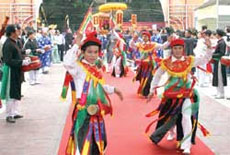
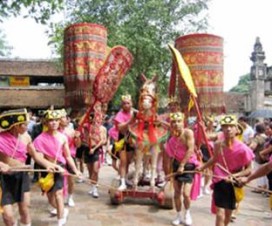
Vietnam’s Saint Giong festival in waiting list for intangible cultural heritage
Posted by admin on November 13, 2010 under Vietnam Festivals, Vietnam World heritages | Be the First to Comment

Vietnam’s Saint Giong Festival has been put among 47 nominations for recognition as the world intangible cultural heritages by the UNESCO. The list was announced by the UNESCO on Nov. 9.

At present, 166 heritages of 77 countries have been recognised as world intangible cultural heritages. Vietnam has 4 heritages in this list, including the Hue royal court music, the Gong space of Tay Nguyen (Central Highlanders), Ca Tru singing and the Bac Ninh love duet singing.

Saint Giong festival is a unique traditional event in Vietnam, held annually from the 6th-12th of the fourth lunar month in many places in Vietnam to commemorate the legendary national hero who grew from a 3-year-old child into a giant overnight to help drive out invaders from the country.

The 9th of the fourth lunar month is the major day for the biggest Saint Giong festival at Phu Dong village in Gia Lam district of Hanoi where this national hero was born.

The festival is a chance for visitors to watch the performance of traditional rituals and artistic activities which have been handed down from generations to generations.

Phong Nha-Ke Bang, National Park – a fabulous Heaven Land
Posted by admin on November 8, 2010 under Vietnam Destinations, Vietnam World heritages, Vietnam attractions, Vietnam beauty | Be the First to Comment

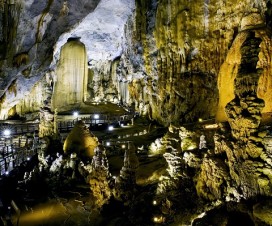
The Nature has awarded Vietnam a fabulous Wonder with grandiose green tropical jungles, nice & mysterious caves & grottoes, and the Asia’s oldest limestone mountains.., that is, Phong Nha-Ke Bang National Park.

Phong Nha – Ke Bang is a huge national park located in Bo Trach and Minh Hoa Districts of central Quang Binh Province in north-central Vietnam. Like the North-central (or Bac Trung Bo) in general and Quang Binh Province in particular.

Formation History

Formation: The Phong Nha–Ke Bang karst has evolved since the Paleozoic (some 400 million years ago) and so is the oldest major karst area in Asia.Like much of Vietnam, it has been subject to extensive tectonic changes, thus the limestones of Phong Nha are inter-bedded with a number of other rocks.

Historical name: The park deprives it name from Phong Nha cave, the most beautiful of all, containing many fascinating rock formations, and Ke Bang forest. One has explained that Phong Nha means “Wind and teeth” based on Chinese transcription, which expresses the blowing wind inside the cave and teeth-like rough stalagtites.

Rivers & Streams

Phong Nha is such a beautiful landscape that you may have to hold your breath on contemplating. Here are the charming Son and Chay Rivers – the two longest underground rivers in the Phong Nha-Ke Bang, gently flowing in the middle of the two sides’ reed and green bamboo rows. Most of the caves here have been shaped by those two rivers.

Limestone Mountains

The Park also contains two dozens of mighty limestone mountains with over 1,000 m in height. Some of the most noteworthy peaks are the Co Rilata Peak with the height of 1,128 m and the Co Preu Peak with a height of 1,213 m. Non-karstic topograhical area accounts for a low percentage, distributing mainly in outer circle of limestone in the north, northeast and southeast of this national park. The height of these summits varies from 500-1000  m with the deep divisions. The grandiosity and uniqueness of the limestone mountain ranges that only can be found in Phong Nha-Ke Bang is of great attraction to tourists.

Flora-Fauna

It’s now time to explore the zone in its rich Flora-Fauna composition. The Ke Bang primary jungles have been home to 98 families, 256 genera and 381 species of vertebrates, many of which are listed in the Vietnam and World’s Red Book.

Visiting Phong Nha Cave

Penetrating to a distance of 1,500 m inside Phong Nha Cave, tourists may go from surprise to surprise! Phong Nha – Kẻ Bàng is also named “Kingdom of Caves”. Up to now, there are more than 300 caves that have been discovered, and still continuously shaped by the Chay River.

The Son River flows into the mouth of the cave and keeps flowing underground, where it is referred to as the Nam Aki River. The main Phong Nha cave comprises 14 chambers, connected by an underwater river that runs for 1.5km. Notable caves and grottos of Phong Nha are Phong Nha Cave (Hang Phong Nha), Dark Grotto (Hang Tối), E Grotto (Hang E), Cha An Grotto (Hang Chà An), Thung Grotto (Hang Thung), En Grotto (Hang Én), Khe Tien Grotto (Hang Khe Tiên), Khe Ry Grotto (Hang Khe Ry), and Khe Thi Grotto (Hang Khe Thi). The most famous one is Phong Nha cave, which has been considered as “First-ranking Cave Wonder” for its world’s most beautiful stalactites and longest rivers by the Brishtish Royal Geography Association.

Some typical pictures at Phong Nha – Ke Bang National Park:

Phong Nha – Ke Bang

Phong Nha – Ke Bang Cave Mouth

Magnificent and miraculous stalactite

The widest and most beautiful sand & rock

The nation’s longest underground river

The longest water cave

Stalagmite

Eagle-shaped Stalagmite

Magical mystery tour

Posted by admin on November 2, 2010 under Vietnam Destinations, Vietnam World heritages, Vietnam attractions, Vietnam beauty | Read the First Comment

Heaven or Paradise cave is Vietnam’s longest cave and filled with magical and mysterious formations, no wonder Quang Binh province hope to entice tourists into the dark.

On a train from Hanoi station, my friends and I travel south into the night. Our destination is Quang Binh province, but ultimately we are heading for Thien Duong (Paradise) Cave, which is, we are told, the most spectacular cave in Vietnam.

Quang binh heaven cave

At 31km, Thien Duong is certainly the longest dry cave found in Vietnam so far. Discovered in 2005 by the British Cave Research Association, the cave runs through the Phong Nha – Ke Bang Park’s conservation area. It is said that the cave’s beauty is reminiscent of an imperial palace and it’s hoped that the cave can become a substantial tourist site.

Currently a 500m section is open to tourists and Truong Thinh Group has already invested over VND40 billion ($2 million) into a tourist project that aims to “draw visitors from all over the world.”

On a train from Hanoi station, my friends and I travel south into the night. Our destination is Quang Binh province, but ultimately we are heading for Thien Duong (Paradise) Cave, which is, we are told, the most spectacular cave in Vietnam.At 31km, Thien Duong is certainly the longest dry cave found in Vietnam so far. Discovered in 2005 by the British Cave Research Association, the cave runs through the Phong Nha – Ke Bang Park’s conservation area. It is said that the cave’s beauty is reminiscent of an imperial palace and it’s hoped that the cave can become a substantial tourist site. Currently a 500m section is open to tourists and Truong Thinh Group has already invested over VND40 billion ($2 million) into a tourist project that aims to “draw visitors from all over the world.”

A national symbol

The cave is in the heart of a limestone mountain range, surrounded by the pristine forests of Phong Nha-Ke Bang national park. It’s a pleasant trek to the mouth of the cave. Inside there are stunning four-metre-long stalagmites and stalactites, thousands of years in the making.

Quang binh heaven cave

In the opinion of Phuong, our 24-year old tour guide, the system of stalactites and stalagmites is as beautfiul as Vietnam’s cultural symbols from north to south such as terraced fields of Sapa, the communal houses or gongs from the Central Highlands, or the Champa towers found throughout the southern half of the country.

“The stalactites here have a lot of quartz which is why they’re sparkling,” says Phuong. The magnificent structure of the cave and the magical beauty within left those first-time explorers flabbergasted. Here is a majestic underworld and so the British explorers called it “Paradise” (Thien Duong). If size is beauty, the stats are certainly alluring: the cave boasts a width of 30m to 150m and a height of up to 80m. The British spelunkers immediately declared Thien Duong as “the largest and most beautiful cave in the Phong Nha-Ke Bang area.”

Opening the cave up to the world

Prior to 2005, scientists believed the cave was no longer than 5km but on their return, they discovered the remaining 26km section.

Unlike Phong Nha or Tien Son caves, which are also within the Phong Nha – Ke Bang area, the atmosphere in Thien Duong is always cool and moist with an average temperature of 20-21 degrees. Sitting in front of the cave you can feel a cold blast of air; a pleasing respite from the 30-35 degree heat outside. At the beginning of the cave, there is a huge arch which is said to symbolise the Mountain Genie who will defend the prevailing peace inside.

Quang binh heaven cave

Compared to Phong Nha Cave, the stalagmites in Thien Duong are more various in shape and size – there are some which stretch for up to 60m, some which are said to look like the three Vietnamese gods of Happiness, Fortune and Longevity. Others are said to look like tigers, elephants and fish.

Along with Thien Duong, Phong Nha, Tien Son caves, Quang Binh province also wants to add the recently-discovered Son Doong cave to its tourism development strategy. That cave was found in 2008 and is estimated to be five times larger than Phong Nha Cave, previously considered the biggest in Vietnam.

Just a few kilometres away from Thien Duong you can make your way down the mountain to visit Tam Co (Eight Ladies) Cave. This is where eight young female volunteers and five soldiers died in November, 1972.

At that time, Quang Binh was carpet bombed during the US-Vietnam war as the US military sought to obliterate the Vietnamese supply line, which connected the north to the south – part of the so-called Ho Chi Minh Trail. The eight women and five men trapped in a cave after a bomb landed on the mountainside by Quyet Thang road. For nine days people tried to save the people inside but all efforts were in vain. It wasn’t until 25 years later that the cave was reopened and the remains were removed and exhumed.

Quang Binh on the rise

Away from the magic of the cave, Quang Binh is an impoverished area. It is the authorities’ great hope that the caves can prove to be a boon for tourism in the locality. There is also a stretch of unspoiled beach, the spectacular Truong Son Mountain range, and of course, the UNESCO reognised National Park of Phong Nha-Ke Bang. All of these natural attributes, together with the expanding Sun Spa Resort, can help the province attract all kinds of tourists – surfers, adventurers, nature-lovers, hill walkers and pleasure-seekers.

Source: english.vietnamnet.vn

Thăng Long–Hà Nội’s ten-day millennium starts
Posted by vietnamtravelblog on October 5, 2010 under Vietnam Destinations, Vietnam Festivals, Vietnam Travel Info, Vietnam World heritages, Vietnam attractions | Be the First to Comment

VGP – The 10-day celebration was officially opened today at the King Lý Thái Tổ Garden, kicking off a series of large-scale activities to mark the 1000th birthday of Thăng Long-Hà Nội.

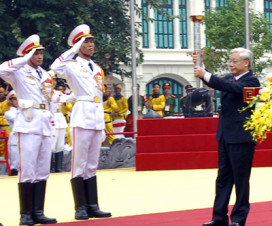
Vietnamese National Assembly Chairman Nguyễn Phú Trọng burns the torch to launch the grand anniversary of Thăng Long-Hà Nội, October 1, 2010

The opening ceremony will be followed by cultural and art activities which are conducted between October 1-10 at many locations within Hà Nội and throughout the country.

The inauguration of the “Pottery Mural along the Red River,” is scheduled on October 5. It is reported that representatives from the Guinness World Records will grant the certificate of “World’s Longest Ceramic Mural” at the inauguration.

The most important event will be a national-level military march, the biggest ever organized so far in Việt Nam, on October 10 morning at the Ba Đình Square.

UNESCO Director-General Irina Bokova (L) confers the certificate recognizing the Imperial Citadel of Thăng Long-Hà Nội as a World Heritage site to Chairman of the People’s Committee of Hà Nội Nguyễn Thế Thảo, Hà Nội, October 1, 2010

At the opening ceremony this morning, UNESCO Director-General Irina Bokova handed over the certificate recognizing the World Heritage of the Imperial Citadel of Thăng Long-Hà Nội.

By Hương Giang

Natural Wonders: Vietnam National Parks
Posted by vietnamtravelblog on September 7, 2010 under Vietnam Culture, Vietnam Destinations, Vietnam Travel Info, Vietnam Travel Tips, Vietnam World heritages, Vietnam attractions | 2 Comments to Read

I usually think about how people draft their trips and vacations. Things like choosing a destination, selecting airlines and planning entertaining activities. Most times, I am kind of a random traveler. Living in Taiwan for such a long time, my travel pattern is that if the airfare looks right and the place sounds fun, I wouldn’t mind pay it a visit. Reading about Vietnam, I would choose Vietnam as a destination because it means a mysterious cultural discovery.

Although Vietnam is a quite well known country because of its media coverage in films, news and television programs, Vietnam did not open its gate to the rest of the world until the end of the Vietnam War. The media exposure did not ensure an accurate report of Vietnam, and not many travelers’ found the way to share their indescribable experiences.

For a long time, Vietnam was occupied by various countries: Chinese Empire, France and Japan. During the Cold War, the North was controlled by China, and the South was supported by United States. Since the Vietnam War ended in 1975, Vietnam has been shaping its new identity. Under the influences of many other cultures, Vietnam blended them into their ancient traditions and made their own personality. Today Vietnam is welcoming visitors to show off its unique traits and share its national treasures.

National parks in Vietnam are one of the country’s most valuable resources. From north to south, there are 87 national parks scattering around. They are nature reserves, historical sites and natural areas. The common issues among the national parks are the illegal hunters and traders. They endanger the nature cycles of Vietnam. The Vietnamese government and international organizations are doing the best they can to stop these harmful actions and to educate the public the importance of preserving the lands.

Cat Ba National Park
Cat Ba Island is the largest island in the Cat Ba Archipelago in Ha Long Bay. About 16 kilometers away from Cat Ba Town, there is the Cat Ba National Park. The park’s headquarter is located in Trung Trang. One-third of the park is the marine zone, and the rest is the forest. Although there are many wild animals such as wild boars, macaques, deer, white-headed langurs, bird species and reptile species and over 600 plants in the park, they are not well protected. Some local people hunt them or make traps to capture them for their high prices in the market.

Cat Bat is a great place for hiking and outdoor activities. However, if you are not an experienced hiker, trails at Cat Ba might be quite a challenge for you. In this situation, a sophisticated tour guide is highly recommended for the purpose of safety. Exploring Cat Ba, you will see one of the most beautiful landscapes in Vietnam and the copious ecosystem. Oriental pied hornbill, a very rare species in Northern Vietnam, can be seen in the park. Other attractions include limestone formations, numerous waterfalls, caves and grottoes. Human history dates 6,000 to 7,000 years back, and the entire Ha Long Bay region was listed as the World Heritage Site by United Nation Educational, Scientific and Cultural Organization (UNESCO) for its biological significance.

Cuc Phuong National Park
Cuc Phuong National Park was founded in 1962 in Hanoi. It is the first national park of Vietnam. The park is about 100 kilometers southwest of the capital. 90 percent of the park is covered by forests, and about 2,000 plant species grow in the park. More than 60 mammal species are in the park and the special residents inc the park are the Red-Bellied Squirrels. The highest mountain is 648 meters above the sea level.

Cuc Phuong is where the Endangered Primates Rescue Centre is located; the Center rescues the animals from illegal trading. Cuc Phuong National Park is also a main attraction for botanists. Researched done by United Nations Development Program (UNDP) and Flora and Fauna International (FFI) distinguished the complexity of the tropical forest and the monsoon influence on Southeast Asia in Cuc Phuong National Park.

At the park’s surroundings you will see limestone cliffs, plenty of plants and mammals. The summit May Bac (silver cloud) is 656 meters in elevation. The limestone caves in the park are eminent attractions and include Thang Khuyet Cave, Con Moong Cave, Pho Ma Cave, and Nguoi Xua Cave. Quen Voi Cave presents diverse aspects of the limestone after its long-term weathering process. The best time to visit the park is during the dry season from April to November.

Phong Nha-Ke Bang National Park
The Phong Nha-Ke Bang National Park situated at the north of Truong Son range in Quang Binh, is one of the world’s two largest limestone regions. It is called “the paradise of researchers and explorers of grottoes and caves.” Over 95 percent of the park is limestone formations, grottoes and caves and forest. Vietnamese and British scientists have surveyed the 20 limestone formations in the park.

The karst formation of Phong Nha-Ke Bang National Park has evolved since 400 million years ago, and it is also the oldest major karst area in Asia. The formations of underground rivers and caves also extend to the border of Laos. The rock formations, underground rivers, large caves, passageways and sand bank all possess world-class beauty. The many marvelous rocks in the park own charismatic names such as Lion, Fairy Caves and Royal Court. Phong Nha-Ke Bang is also an archeological and historical location. The government officials recognize its value and plan to make it a major tourist destination of the nation in the near future.

Accommodations can be arranged at the parks, please contact the tourist center to obtain more information. Read more about the national parks in Vietnam; go to the official Web site: Vietnam Tourism.

(Source: BootsnAll)

Halong bay – wonderful beauty of creator
Posted by vietnamtravelblog on August 30, 2010 under Vietnam Beaches, Vietnam Destinations, Vietnam Travel Info, Vietnam World heritages, Vietnam attractions | Be the First to Comment

Halong Bay (Water Gulf where the dragon land) is an inlet of the western coast of the Gulf of Tonkin in northeastern sea area of Vietnam, including the sea islands of Ha Long City, Cam Pha Town and part of Van Don island district.

Is the center of a large area there are many factors at similarities in geology, geomorphology, landscape, climate and culture, with Bai Tu Long Bay northeast of Cat Ba Island and the southwest, Ha Long Bay is limited to an area of about 1.553km ² including 1960 islands, mostly limestone islands, which are the core of the Bay area of 334km ² clustered dense 775 islands. Tectonic history of the limestone geology of the Bay has undergone about 500 million years to the ancient geographical circumstances are very different; and Karst evolution fully experienced over 20 million years with a combination of factors such as thick limestone floors, hot and humid climate and tectonic processes improve the overall slow. The combination of environment, climate, geology, geomorphology, Ha Long Bay has made to become clustered biodiversity of forest ecosystems, including closed moist tropical evergreen rain and marine and coastal ecosystems banks with more sub-ecosystems. 14 plant species endemic and about 60 endemic species of animals  have been detected in thousands of plant and animal populations in the Gulf residents.

In 1994 the core of Ha Long Bay was recognized as a UNESCO World Natural Heritage with aesthetic value, and re-recognize the 2nd value Premier global geological-geomorphological in 2000. Together with Vietnam’s Nha Trang bay, Halong Bay is one of 29 Bay Club is the world’s most beautiful bays ratings and officially recognized in July 2003
Below pictures about Halong Bay :
Imposing landscape of Halong bay
Imposing landscape
Sunrise on the Halong bay
Sunrise on the  Halong bay
Bo Nong cave
Bo Nong cave
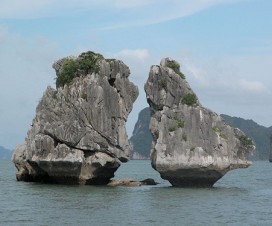
The Kissing Cocks - nice symbol of Halong bay
The Kissing Cocks – nice symbol of Halong bay
Sung Sot cave - Stalactite cave largest in Halong bay
Sung Sot cave –   Stalactite cave largest in Halong bay
Halong bay view at the top

Boats moor on Halong bay
Boats moor
Sunset on Bai Tu Long bay

Welcome to discovery Halong bay – Vietnam !

(Source: http://www.blogcatalog.com)

A look at Vietnam’s newly-recognized World Heritage Site

Posted by vietnamtravelblog on August 16, 2010 under Vietnam World heritages | Read the First Comment

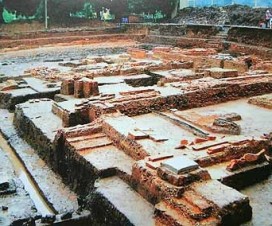
Located in the center of Hanoi, the ancient Thang Long Royal Citadel holds the remains of historical, cultural, and architectural artifacts of many feudal dynasties in Vietnam.

The citadel is a complex full of relics closely associated with the history of Thang Long – Hanoi capital city. It was built by the Ly, Tran, Le and Nguyen dynasties. The citadel is surrounded by Tran Phu – Dien Bien Phu – Doc Lap – Hoang Van Thu – Hoang Dieu – Phan Dinh Phung – Nguyen Tri Phuong roads.

The royal palaces and most of the structures in Thang Long were destroyed in the late 19th century, and today ruins from the Thang Long Imperial City are still being excavated.

The central section of the imperial citadel, including the Flagpole, Doan Mon, Kinh Thien, Hau Lau and Bac Mon, were recognized by UNESCO as a World Heritage Site o­n July 31, 2010 during a session in Brazil.

Remains were found o­n the site of the former Ba Dinh Hall, which was ripped down in 2008 to make way for a new parliament building. Various archaeological remains were found and these artifacts were brought to the National Museum to be exhibited. It is assumed that just a very small fraction of the citadel has actually been excavated.

(Dtinews)

The 5 Must-See Beaches In Vietnam

Posted by vietnamtravelblog on August 12, 2010 under Vietnam Beaches, Vietnam Destinations, Vietnam Travel Info, Vietnam Travel Tips, Vietnam World heritages, Vietnam attractions | Read the First Comment

The 5 Must-See Beaches In Vietnam

Your guide to the five must-see beaches in Vietnam.

By Justin Calderon

Vietnam, a country reminiscent of a war-torn epic that rang of rock-and-roll, decadence, and destruction­ was, up until recently, visited by only the adventurous traveler. Though late in its arrival as a member of part of the Southeast Asian travel belt, today this crescent-shaped land with innate tropical beauty has attracted international appeal, leading to an influx of budget tourists and luxury travelers alike from across the globe.

Cheap, tropical, mysteriously alluring — Vietnam’s climate provides the perfect beach vacation, while offering ample opportunity to peek down one of history’s infamous alleyways. Travelers will find a gamut of beaches dotting the coast including chill backpacker hangouts, luxurious resort getaways and sleepy fishing villages. From Central Da Nang to the southern capital of Saigon — north to south — lie five beaches every traveler should check out in their quest for the perfect beach in Vietnam.

1) Hoi An

Hoi An is an enclave of beautifully preserved yellow and blue buildings that makes you feel like you just stepped back in time into an 18th-century trading post. Sapphire waters lie on the other side of a 10-minute bike ride north through stagnant rice paddies, old French colonial villas, and the occasional propaganda billboard. The beachfront of the famed China Beach — the beach where soldiers were sent for R&R during the war — makes up the southern stretch. Recently named one of the most luxurious beaches in the world by Forbes, this white sand beach is home to comfy resorts and secluded swaths of sand.

Hoi An, however, has much more to offer than just a beach. Declared a UNESCO world heritage site in 1999, this coastal village was once known as the premier trading post in Southeast Asia for the Chinese and Japanese.

A bike ride around town takes you back to life in a small far-flung trading settlement. However, since the influx of visitors, shoppers are more likely to come across trinkets and “made-to-measure” one-day tailors than authentic goods.

Market life is still prevalent next to the river where you will find fishermen paddling along in their boats, stirring up their catch of the day. For a sense of life before modern times, head into select buildings in the Old Quarter where you can view 200-year-old interiors that have been preserved for public viewing.

2) Quy Nhon, Binh Dinh

If you decide to include Quy Nhon in your itinerary, expect to encounter only a trickle of foreigners stopping by on their way to Nha Trang. In a country besieged by tourism, Quy Nhon can truly be described as an authentic experience. Crowds of Vietnamese gather on the beach to play volleyball at sunset and offer hearty “hellos.” A few large hotels graze the southern beachfront, but since the Vietnamese aren’t keen to sunbathing, you’ll likely find the beach to yourself.

A relatively small coastal city in Central Vietnam, Quy Nhon embodies a relaxed tempo not likely to be found in other Vietnamese cities. Grab a bike and slip along Nguyen Hue Road where a number of grins will greet you from people sitting in colorful plastic chairs. The longer you stay in Quy Nhon, the more you will appreciate the carefree lifestyle here.

3) Doc Let Beach, Nha Trang

This tranquil and secluded beach just north of popular Nha Trang offers a few small, hard-to-find, resorts. As Lonely Planet enticingly puts it, “the resorts on the beach are fairly isolated. If you’re staying here, be prepared to do nothing but lay around.”

When I was there I stayed at Paradise Resort, a small, 25-bungalow resort run by Mr “Chere,” a French expat who has lived in Vietnam for over 20 years. You can rent a bungalow for the night, and the price includes three meals a day. The gregarious owner is very inviting and keen on getting all his guests to have a great time, making this resort seem more like a stay at a friend’s than a hotel.

The resort is flanked by a small fishing village that proves an interesting excursion when not baking on the beach. During the midday you’ll find hawkers rocking in hammocks to escape the sun while children run a-muck between farm animals and the streets.

4) Nha Trang

Nha Trang has always been popular with the Vietnamese, but lately more and more backpackers and affluent travelers have been making their way here. The busy southern strip of the city is crammed with restaurants, SCUBA schools, and tour companies ready to take you out to sea and to one of the numerous islands scattered just off the coast. For those not ready to take the full plunge into the world of SCUBA, snorkeling is a great way to get intimate with the ecological kaleidoscope beneath the surface (and even copious amounts of alcohol found on the boat ride out).

Mama Hahn’s Booze Cruise runs daily tours to four islands under the sails of their two lanky dinghies: the “lazy boat” and the “party boat.” Steadfast swimmers up for socializing with other international miscreants and an accompanying jovial Vietnamese guide should bee-line it to the party boat. As long as you stay buoyant and don’t swallow too much salt water, you’ll be sure to make it back to nurse that lingering hangover by nightfall. Don’t say you haven’t been warned.

5) Mui Ne, Phan Thiet

Mui Ne, in Southeastern Vietnam, is a notable backpacker and resort beach, especially for those interested in kite surfing. On those windy days so common in Southern Vietnam, throngs of kites can be seen making polka-dot patches in the sky. The resort side of the beach is heavily subtitled in Russian to cater to the growing amount of tourists escaping the Russian winters. A manager at one of the multitude of seafood BBQ restaurants that checker Mui Ne road astutely observed, “[The Russians] are coming here a lot. I think it’s because it’s hot and very cheap.”

Though not easy, you can still find budget accommodations on the resort side of the beach for about $10-15, which is great considering that the backpacker side of the beach has lost nearly all its beachfront to erosion. A grey, impending concrete wall is now slammed by waves during high-tide leaving any idea of beach strictly to the imagination. There are a few bars and generic sit-downs here, and the low volume of traffic makes a motorbike tour up the 6-mile street safe and the best way to scope out the rest of what the area offer.

The resort side of the beach, lying on the southern end of Mui Ne, still has its sand, and the restaurants and bars there enjoy a party atmosphere well into the night. Just remember, Vietnam is not nearly as rife as Southern Thailand when it comes to beach parties, bean bag chairs, and fire twirlers — not that you’ll miss any of those things when you’re here.

http://www.theexpeditioner.com

Royal Citadel recognized as World Heritage

Posted by vietnamtravelblog on August 2, 2010 under Vietnam Culture, Vietnam Travel Info, Vietnam World heritages | Be the First to Comment

UNESCO’s World Heritage Committee on August 1 agreed to recognize Vietnam’s Royal Citadel as a World Heritage.

Relics found in the centre of the citadel

The Citadel in Hanoi was recognised because of its three outstanding characteristics: the length of its cultural history, the continuity of the citadel as a power centre, and the variety of relics it contains.

Relics found in the centre of the citadel show that it was influenced by many different cultures, theories, and systems of thought.

The centre of the citadel embodies the enduring cultural tradition of the people of Vietnam’s Red River Delta, a tradition which has existed for 13 centuries

Restoration of the Royal Citadel began in 2006 when it was officially recognized as a special national relic.

UNESCO’s recognition of the heritage is very significant for Vietnam, which is currently making grand preparations for its capital’s millennial anniversary.

(Source: VOV)