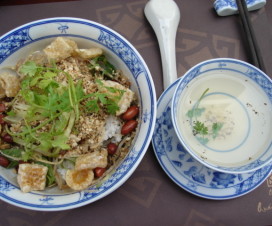
Perfume River mussel cooked rice – Com hen song Huong
Posted by vietnamtravelblog on October 7, 2008 under Food and Drinks | Be the First to Comment

Com hen Song Huong” is a dish served at room temperature, made with mussels and leftover rice. It is a complicated recipe that includes sweet, buttery, salty, sour, bitter and spicy flavors.

Com hen Song Huong (or Com hen in short) is the very simple and low-priced specialty of Hue, the ancient citadel of Vietnam. Accordingly, the way of serving this special kind of food is of great ancience, simplicity and deliciousness.

Com hen has a sweet-smelling flavor of rice, onion, and grease, as well as strange tastes of sweet, buttery, salty, sour, bitter, and peppery-hot. You have to arrive to Hen river-islet in the Perfume River to have the original Com hen. However, you can find out the dish on some streets in Hue City. It requires 15 different raw materials to prepare for the dish, including mussel, fried grease, watery grease, peanuts, white sesames, dry pancake, salted shredded meat, chilly sauce, banana flower, banana trunk, sour carambola, spice vegetables, peppermint, salad, etc.

st1\:*{behavior:url(#ieooui) }

Com hen is always attractive to many customers since it is tasty and, at the same time, economical to anybody.

What makes this simple kind of food popular is revealed in the great endeavor to adopt and process its main ingredient – mussel. Mussels are sea species, which must be dipped in water for a long while before being processed. Accordingly, people often say that com hen somehow expresses the strenuous work of the maker.

Where to find it? Very easy as it is popular everywhere in Hue and these days, elsewhere in Hue restaurants in Vietnam. More favorably, it is a low-priced specialy, thus you could eat it in luxurious restaurants in Hue or even in vendoring mobile shops on the streets.

“Visiting Hue could not miss Com hen, or else you have not come to Hue ever!” is the most common remark of visitors elsewhere to Hue. So, please come and enjoy it yourself!

Source:  Vietnam Food

A time to remember at Thien Mu Pagoda
Posted by vietnamtravelblog on October 6, 2008 under Vietnam Destinations | Be the First to Comment

Though I have been to Hue City many times in my past, a visit to Thien Mu Pagoda always lightens my heart from the concerns of my daily struggles to make ends meet.

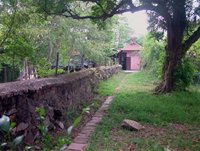
A view of Thien Mu Pagoda’s garden.

A long time ago a small pagoda of the Cham ethnic group stood on the top of Ha Khe Hill, looking towards the romantic Huong River (Perfume River). That is where Thien Mu Pagoda stands now, according to records of Duong Van An in his historical and geographical book O Chau Can Luc released in 1553.

The pagoda was built by Lord Nguyen Hoang when he was appointed governor of Thuan Hoa Region (known as Hue today) in 1601. The Phuoc Duyen Tower, which comes into view when climbing up the hill to the pagoda, was built in 1844 by Thieu Tri King to commemorate the eightieth anniversary of his grandmother and named Tu Nhan (indulgent person) then.

The tower has stood there since, overlooking the Huong River, and has become synonymous with the landscape of Hue and the Huong River. Its impact is such that it has become the unofficial symbol of the city.

The most pleasant way to get to the pagoda is by boat along the Huong River. The river is fresh and the destination is shaded by old trees covering the dock where the boats stop.

After taking some pictures of the tower, I trekked around the pagoda garden which is a collection of plants and flowers donated to the pagoda from pilgrims around the country. Walking inside the peaceful garden, I caught sight of timid rabbits hiding in bushes and heard many kinds of birds singing on the canopies of leaves above. It was like walking in a wilderness forest.

On the right side of the pagoda is a chain of rooms. The first room showcases the historic car which carried Great Monk Thich Quang Duc to the intersection of Phan Dinh Phung and Le Van Duyet streets in Saigon on June 11 of 1963 to burn himself in opposition to the anti-religion policy of Saigon’s regime at that time.

Next to this room is where the monks of the pagoda live, equipped with wooden beds and small personal items under each bed.

In Dai Hung Temple, at the center of the pagoda, is a large censer where visitors can burn incense and pray for blessings. Fragrant incense smoke fills the air there all day long.

On a trip to Thien Mu Pagoda visitors can choose to do many different things, like sit on the wall to observe the special Huong River, or walk around the pagoda to explore the garden. But to me the most impressive thing to do is to listen to the monks reciting the Buddhist scriptures, or watch them as they sweep the yard or go about their daily routines, for those images bring me to a peaceful feeling never achievable in the hustle and bustle of my daily life.

(Source: SGT)

View another article at Vietnam Cities

Pho Hanoi (rice nooddle soup)

Posted by vietnamtravelblog on under Food and Drinks | Be the First to Comment

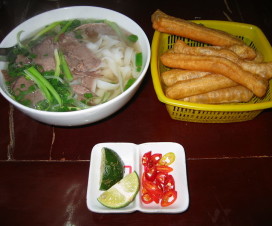
Pho, a typical dish of Hanoi people, has been existing for a long time. Pho is prepered not only in a sophisticated manner but also in the technique which is required to have sweet but pure bouillon, soft but not crasded noodle, soft and sweet smelling meat. Only in cold days, having a hot and sweet smelling bowl of Pho to enjoy would make you experience the complete flavor of the special dish of Hanoi.

The bouillon.

Boil 10 cups water. Burn the whole fresh onions over high heat until golden brown. Add beef spareribs or ox tail into the boiling water. Skim while cooking to make a clear broth. Add browned onion and carrots after 1 hour of boiling. Cook another hour. Then remove meat and vegetable. Strain the bouillon, season it with spices, salt, fish sause as indicated and keep boiling to server very hot soup. Add boiled water, if necessary, to have 6-8 cups of bouillon. This broth is very spicy and a little salty.

Slice tender beef finely and cooked beef coarsely. Soak dry rice noodles in hot water 10 minutes before cooking. Coolk rice noodles sparately until done (about 10-15 minutes), drain in hot water to remove the starch.

Server at once into bowl.

Beef soup, rare: cooked rice noodles 1/3 bowl, raw beef minced on top. Pour over them one cup boiling bouillon. Add bib lettuce, green onion and onion rings.

Beef soup, done: cooked rice noodles, cooked beef, bib lettuce, onion rings, green onion in top. Pour over all ingredients 1 cup boiling bouillon.

Provide the guests with spoons and chopstichs to take the soup.

Source: Vietnam Food

Vietnam Festival – Do Son Buffalo Fighting Festival
Posted by vietnamtravelblog on October 3, 2008 under Vietnam Festivals | Be the First to Comment

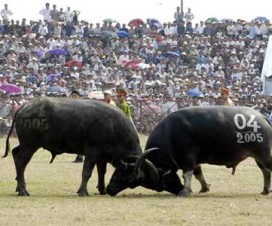
Thousands of people annually gathered at the stadium of Do Son Town, Hai Phong City to witness the attractive performances of buffalos within the Do Son Buffalo Fighting Festival, an outstanding and unique festival one in Vietnam which is associated with different legends.

One of the legends has it that long time ago, one Creator caused a severe drought. All living things looked toward the sea, praying for Creator’s favour. In the most miserable moment, suddenly, people saw two buffalos fighting fiercely on the wave crests and the rains started to pour down, revive all creature. The local people organise the fighting performance annually to show, not only their great gratitude for the Sir Buffalo but also their desire for the immortal vitality and strength of coastal people of Haiphong. Being held officially and annually on the ninth day of the eighth month of the lunar calendar since the 18th century, the festival is a chance for local people to pray for prosperity and happiness.

The preparation for this buffalo fighting festival is an elaborate process, from the 5th and the 6th lunar month itself. The competing buffalos must be carefully selected and methodically trained months in advance of the festival. These buffalos, that had experienced the qualifying round, must be between 4 and 5 years old, with a good appearance, a wide chest, a big groin, a long neck, an acute bottom and bow shaped horns. The selected buffalos, after all the elimination rounds, are fed in separate cages to keep them from contact with common buffalos.

Buffalo fighting performance

The beginning of the worshipping ceremony lasts until lunch time. Do Son Buffalo Fighting Festival takes off with a colorful procession with an octet and a big procession chair, carried by six strong young men. The chosen buffalos, covered with red cloth and red band around their horns, are taken to the fighting ring by 24 young men, from each side dressed in red. The young men dance and wave flags as the two teams of troops take their positions in the fighting ground. The dance was mingled with the ebullient sound of drums and gongs, bringing a hectic atmosphere to the festival. After this event, a pair of buffalos is led to opposite sides of the festival grounds and is made to stand near two flags called Ngu Phung. As soon as the right signal is released, the two buffalos are led into the fighting circle. At the next signal, the two leaders release the ropes that are attached to the noses of the buffalos. With well-practiced movements, the buffalos rush into each other, using their fighting skills to decide the right to enter the next match while the spectators shout and urge the fighting along. Then, the winning buffalo goes to the next round till the final winner emerges. The matches varied in terms of time, depending on the strength and stamina of the buffalos. At the completion of the fight, the spectacle of “receiving the buffalos” is very interesting as the leaders must then catch the winning buffalo to grant it its reward.

The Buffalo Fighting in Do Son is traditional festival of Vietnam attached to a Water God worshipping ceremony and the “Hien Sinh” custom. The ceremony is held in every village and chaired by its patriarch to pray for the victory at the buffalo fight, typically express the martial spirit of the local people in Do Son, Hai Phong. In recent years, this traditional festival attracted not only local residents but also thousands of domestic and international tourists.

Source: Vietnam Culture

Vietnamese Silk Painting

Posted by vietnamtravelblog on October 2, 2008 under Vietnam Culture | Be the First to Comment

Silk painting is the traditional Vietnamese art of silk painting which originates from painting and drawing on home made rice paper. Today this art has become famous around the world for its simple poetic themes and vibrant colors. Vietnamese artists find the technique to be a unique way to create mystique in their paintings.

The Vietnamese style of silk painting emphasizes softness, elegance and has a flexibility of style. The success of a silk painting very much depends on the quality of the silk. Differently with other kinds of paintings, the silk canvas are usually not painted. The Vietnamese traditional silk painting style tends to use the silk canvas directly as the background of the painting.

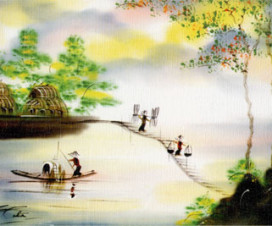
Vietnamese silk paintings typically showcase the countryside, landscapes, pagodas, historical events or scenes of daily life. The colors are used delicately with the canvas to make Vietnamese silk paintings. The delicate white color found in the sky, water, or human portrait, is the color of silk. The color of silk is well known to describe human figure in the paintings of many famous vietnamese artists. Delicate color and silk background give the paintings such an harmony with the nature. Whatever style they follow, silk painters must have an intimate knowledge of the material and fully exploit its shininess and its attractiveness. Painting silk is full of changing and unexpected characteristics, and a wrong stroke of the brush is irreversible.

Silk represents an important language of Vietnamese painting after lacquer. Its capacity of absorption and dilution given to the works an impression of mellowness spreading through the woofs and wefts of silk, adding a certain vibration to the forms and colours.

Vietnamese silk painting has its own unique character and colours that are distinctly different from those from ancient China and feudal Japan. Each painting is a great description of the beautiful nature and talented skills of the Vietnamese. By using contemporary colours, Vietnamese silk painting has won the hearts of many art lovers nationally and Internationally.

Source: Vietnam Beauty

Honeymoon tours for wedding session

Posted by vietnamtravelblog on under Vietnam Travel Info | Be the First to Comment

VietNamNet BridgeThe wedding season is approaching and some tour operators in HCMC are promoting special honeymoon tours. Listed below are some romantic honeymoon vacations offered by Ben Thanh Tourist in central and northern Vietnam.

Nha Trang Beach.

Couples seeking a beach holiday should consider the tours to Hoi An, Nha Trang, Dalat and Halong Bay, while those who prefer the cooler weather will enjoy the Dalat tour.

Discover the charming ancient city of Hoi An with its small streets and traditional craft villages where one can buy colorful lanterns made by artistants of the ancient city. Just 4 km away is the beautiful beach of Cua Dai.

The Nha Trang tour takes in Lo river – Ro island and Ponagar Temple, will include romantic programs such as watching the sunset on Nha Trang Bay, bathing in hot mineral water and hot mud baths. Fun and entertainment can be found at the five-star Vinpearl Land resort.

The capital city of Hanoi boasts numerous scenic and historical sites, including Hoan Kiem (restored sword) Lake, Van Mieu-Quoc Tu Giam (Temple of Literature), the National University, Dong Xuan Market, Quan Thanh Temple, West Lake, Tran Quoc Pagoda, and One Pillar Pagoda. Couples can also visit the World Heritage site of Halong Bay for a romantic dinner on the floating on the boats.

Dalat is one of the most popular destinations for honey moon couples. On the way into the city is the 60-meter-high Damb’ry water fall, one of the most beautiful water falls in the Bao Loc District, Lam Dong Province. Side trips are available to the summer palace of Bao Dai, Vietnam’s last monarch, to Suoi Vang, (golden stream), Suoi Bac (silver stream) and Dankia Lake, and to the campgrounds at the foot of Lang Biang Mountain.

The tours are available for couples who do not want to travel alone rather than with large tour groups, and can be tailored to suit the couples depending on how much time they want to spend with the other tourists and how much time they prefer to spend relaxing and walking at their leisure in the beautiful cities.

Dinner parties with candles, flowers and wine for the guests can be catered and the couple will receive special gifts during their holiday, such as fruit and flowers in their rooms.

To contact the company, tel: 08 520 2020- 829 0212 – 821 8989- 821 5741, or email: domestic@benthanh-tourist.com

Source from: http://english.vietnamnet.vn//travel/2008/09/801834/

View more Honeymoon Destinations on over the world!

Mekong Delta – a friendly destination in Vietnam
Posted by vietnamtravelblog on October 1, 2008 under Vietnam Travel Info | Be the First to Comment

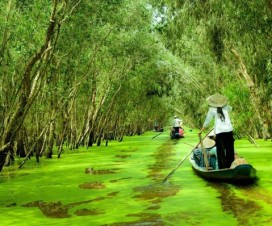
“Mekong Delta can be seen as one of the most attractive tourist destinations in Asia with beautiful natural landscapes, but it may soon lose this advantage due to rapid infrastructure development. And it take years to reinstate those precious values,” said Prof. Ernst Sagemueller, general director of the Europe-Indochina Institute for Tourism, at a recent conference entitled “Potential and Development Opportunity in Mekong Delta” in the city of Can Tho.

Foreign tourists visit Can Tho City, Vietnam

Prof. Sagemueller said that the delta should be developed in a way that is consistent and friendly on the basis of a close connection between green tourism, ecotourism and environment protection activates, preserving and upholding unique local values such as temples, pagodas, cultural festivals and ancient customs.

In recent years, Ho Chi Minh City’s hotels have not been able to meet high demands in the peak seasons, so neighboring provinces like Binh Thuan, Khanh Hoa, Ba Ria – Vung Tau take the opportunity to market their tourism potential. The delta is also a neighbor of Ho Chi Minh City. However it is surprisingly quiet in this competition.

What’s the matter with the delta?

Poor transport links are a major difficulty in the delta. Highway 1A is the only road from Ho Chi Minh City to the delta. A vast canal system supports water transport, but it is not easy to find a stable route for a high-speed boat. Even the boats which are used to carry travelers across the rivers are of low quality.

Aviation is clearly not the best choice since there are few weekly flights to Ca Mau, Rach Gia and Phu Quoc Island while the Can Tho airport, the region’s biggest, is being upgraded.

The delta’s tourist spots do not have their own unique tours. Most of them are fairly similar. They feature a fruit garden tour while enjoying don ca tai tu (Southern amateur music).

The lack of riverside premium resorts, professionally skilled human resources and poor customer service are reasons that the delta is not the first choice of wealthy tourists. In addition, there are plenty of festivals around the year, but they have never been properly exploited. Thus, it can be said that the slow development of delta tourism is not due to its resource deficiency, but the inappropriate methods being use.

Targeting the market

Many tourist specialists believe that the delta cannot become an ideal destination for local travelers. But sunny sky, mellow countryside and peaceful breezy canals can be very appealing to foreign tourists.

Mekong River would be the biggest competitive advantage in area where travel agents can organize tours to Cambodia on the river, or investors can find hundreds of kilometers of riverside to build premium resorts. It becomes a friendly natural destination for all travellers. Can Tho airport is to open international routes very soon. It seems that Mekong Delta is being given a chance to develop its tourism advantage.

(Source: SGGP/TT/TBKTSG, URL:http://english.vietnamnet.vn/reports/2008/08/799109/)

Cha ca La Vong (grilled minced fish) – Ha Noi Food

Posted by vietnamtravelblog on under Food and Drinks | Be the First to Comment

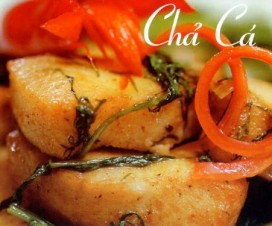
Cha ca La Vong is one of the most delicious spcialities of Hanoi Food. Hanoi now has several stores selling Cha ca La Vong, but none of them can be equal to the Cha Ca Road’s in terms of quality and flavor. As a popular dish, La Vong grilled fish pie is indeed a remarkable culinary invention.

The long history…

In ancient days, there was a street selling paints, called the Paints Street. The Doan family, located at house No, 14 of this street, hit upon a new idea that sold fried fish pie served with soft noodles and seasoning. Encouraged by the appreciation of customers, the family specialized in this trade and the shop was called as “Cha ca La Vong store” as a wooden statue of an old fisherman (La Vong) holding a fishing rod and a string of fish stands at the door. As the specialty grew famous with every passing day, the street was renamed by the people as Cha Ca Street (fried fish pie street).

Imagine that you are one of the guests…

While you sit down at the table, the waiter starts laying there some seasonings includes a bowl of well – stirred shrimp paste sauce mixed up with lemon. After dropping the liquor, he will decorate the bowl with a few slices of red fresh pimento, a plate of grilled ground nuts of gold yellow color, various species of mint vegetables o­nions in small white slices.

To many customers, the sight of such seasoning already greatly stimulates their appetite. A few minutes later, fried fish, yellow in color and flagrant in smell put o­n a plate of anethum vegetable, is brought in. But that is not all. A few seconds more, as soon as a cauldron of boiling fat is brought in, the waiter starts pouring it o­n each bowl of grilled fish, thus producing a white smoke and sputtering noise.

Now, this is the time for picking and choosing what you like from the dishes on the table; sticking them into your bowl. Everything in all dishes should be eaten together. Let’s taste…

In the whole of Vietnam, there are 3 suggested Cha ca La Vong restaurants:

  • N014, Cha Ca street- Old Quarter in Hanoi
  • N087 Nguyen Truong To street, Hanoi
  • N03 Ho Xuan Huong street, Ward 6, District 3, HCMC

Source: Vietnam Beauty

Beauties with conical hats, glasses and fashion

Posted by vietnamtravelblog on under vietnamese clothing | Be the First to Comment

The 30 contestants of Miss Vietnam 2008 pageant practiced on a big stage at the Hoai River Square, Hoi An on August 28, to prepare for the final night this Sunday (August 31). captured the rehearsal.

Photo: S.Ha – Phuc Chu