Posted by admin on July 17, 2011 under Vietnam Culture |
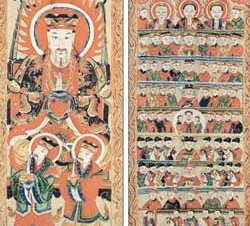
San Diu ethnic paintings, meant for worship and found in the mountainous northern province of Tuyen Quang, owe much of their survival to local collectors.
 |
| Holy relics: Two San Diu paintings, made for worshipping, are preserved in the northern province of Tuyen Quang. |
According to researcher Phan Ngoc Khue, these type of paintings appeared a very long time ago.
“Paintings have always played an important role in the spiritual life of the San Diu people, revealing specific elements of both their culture and lifestyle,” he said.
Traditionally, San Diu paintings were applied on cardboard using only natural colours.
As part of San Diu customs, sorcerers often display different forms of art including Buddha statues, bronze dragons and paintings made to worship, symbolising various spiritual images.
Locals believe that these type of paintings help them see God or Buddha during worship ceremonies.
Tran Van Thang, a Son Duong District resident, said that the paintings reflected people’s conceptions regarding past and present life.
Despite their popularity, only a few old paintings are kept locally.
Collector Bang Xuan Luc, who lives in Son Duong District’s Thien Ke Commune, said: “I’m so lucky to have some of the oldest paintings around, left to me by my parents upon their death. I still use the paintings during ritual ceremonies throughout the year.”
Pham Duc Si, from the Ha Noi Fine Arts College, presides over a 500-painting collection, 200 pieces of which come from the San Diu ethnic group.
“I bought these paintings by chance while travelling through former Ha Tay Province (now Ha Noi) a few years ago. Because of their exquisite colour I started studying their origins with much interest,” Si said.
In order to avoid deterioration, many painters have resorted to working on cement bags and often even on silk using various chemicals.
The provincial Department of Culture, Sports and Tourism is busy drawing up plans for the preservation of traditional paintings.
“We plan to collect traditional artwork and information from among ethnic people, which will take a lot of time and money,” Au Thi Mai, a department official, said.
“Despite the challenges, we will aim to do our best in preserving traditional Vietnamese artwork from around the country,” she added.
(Source: VNS)
Posted by vietnamtravelblog on September 28, 2010 under Vietnam Culture |
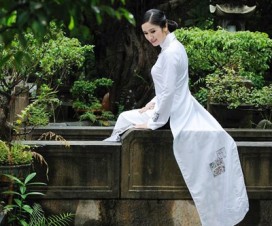
Some of Vietnam’s greatest beauties came together to pose in the traditional ao dai, a symbol of the nation.
Famous actress Thu Ha, Miss Ngo Phuong Lan (Miss Vietnam World 2007), Ngoc Oanh (Runner-up Miss Vietnam 2000) and former Model Hoang Xuan posed for the first time together wearing the ao dai.
The photo shoot was taken in anticipation of the Ao Dai Festival which will take place on October 1, 2010, the opening day of the upcoming events for the 1,000 Year Anniversary of Thang Long – Hanoi.
The ao dai is a Vietnamese national dress worn by women. In its current form, it is a tight-fitting silk tunic worn over pantaloons.
The Ao Dai Festival of the North, Central and South regions will be held at the well-known sight-seeing Thap But (pen tower) – Ngoc Son Temple, in Hanoi. The festival provides an outstanding art activity as part of the programme “The fanciful night by Hoan Kiem Lake”.
Based on an idea of bringing the finest of Vietnamese culture and tradition into the design, organisers designed and created 600 of the traditional dresses for the festival. The festival will include two main themes: One shows the city of Hanoi in the past and the other will show special features of the ao dai from Vietnam’s three regions. From these two themes, organisers have prepared several Ao dai collections such as “Recalling memories”, “Sacred dragon features”, “Hanoi’s streets” and “Sunny flowers”.
Vietnamese beauty stars Miss Ngo Phuong Lan, Ngoc Oanh, Tran Thi Quynh, Dang Thuy Trang and others will perform in the Ao Dai Festival.
The festival will last for 45 minutes with the performance of 100 models. The stage will have very unique design and decorations. Its catwalk will cover 350 metres and the stage will be decorated with flowered mats and conical hats. The show will also include performances on traditional activities of Hanoians in the past.
Below are some photos of the ao dai dresses which will be showcased on October 1, 2010:


Actress Thu Ha


Ngoc Oanh


Miss Ngo Phuong Lan


Former Model Hoang Xuan
Posted by vietnamtravelblog on September 13, 2010 under Vietnam Festivals |
People all over Vietnam have been preparing offerings for their ancestors and attending activities during Vu Lan festival.
The street selling votive paper products have been busier, restaurants offering vegetarian food have been filled with an abundance of customers, and people have been flocking to pagodas to pray for the deceased in honour of Vu Lan Festival.

Which motorbike is better? (Photo by T. Nguyen)
Vu Lan festival, also known as the Amnesty of Unquiet Spirits, is held during the seventh month of the lunar calendar. It is a chance for Vietnamese children to honour their parents and try to help the lost souls of their ancestors find their way back to earth.
Activities during the month include preparing ritualistic food offerings, burning incense, and burning joss paper, a paper-mache form of material items such as clothes, gold, bank notes and other fine goods for the visiting spirits of the ancestors.
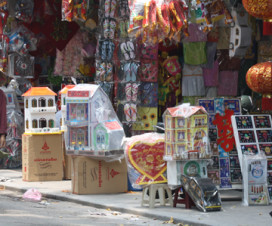
In Hanoi, during the Vu Lan holiday, Hang Ma Street selling votive paper products are the busiest.
From the beginning of the 7th month of the lunar calendar, Thu, came to Hang Ma Street where sells votive paper products in order to buy necessary offerings for her family’s Vu Lan.

Votive paper products sold out on Hang Ma street (Photo by T. Nguyen)
In order to meet various demands of customers, the whole of Hang Ma street displays and sells many kinds of votive paper products ranging from traditional items such as ao tu than (4-part dress), coi trau (Betel chewing kit), non la (palm-leaf conial hat) or horse drawn carts to modern items such as cars, motorbikes, fridges or televisions.
In addition, votive paper multi-floor houses were made in a very sophisticated manner. A good 3 floor house cost about VND180,000-250,000 ($9.1-12.7). A good quality paper car or motorbike sells for about VND80,000-100,000 ($4.1-5.1). A television or fridge might sell for about VND50,000 ($2.5).
A standard offerings kit could cost a total of nearly VND1.2 million ($61). However, according to sellers here, many rich customers were willing to spend dozens of millions of dong on very expensive kits.
A shop owner on Hang Ma Street shared that they had sold out of expensive offerings since the 14th of the month. Now they have only normal offerings left.
In Ho Chi Minh City, goods for the festival varied but the customer demand was not remarkable. In big markets, the number of sellers seemed to be more than buyers.

Many customers go to enjoy vegetarian food during Vu Lan
Nguyen Thi Hien, selling vegetarian food said the prices and demand for vegetarian food during this festival were not so high. She presumed that heavy rains made many people not want to go to markets.
An agent selling votive paper products in Binh Tay market, Ho Chi Minh City said, “The number of customers had increased for this half month but they did not buy much. We expected that they would have many customers buying large offerings kits this year. We did not know that our sales result would turn out like this.”
However, many special programmes for the festival held in restaurants and at tourism sites attracted quite a lot of visitors. Suoi Tien Tourism site received over 1,000 monks from Ho Chi Minh City and its neighbouring provinces, cities as well as thousands of tourists and locals on the opening ceremony of the festival.
In addition, many restaurants offering vegetarian food had lured customers as well.
Thien, living in District 3 said, “On this occasion I want to take my parents to a good restaurant to enjoy vegetarian dishes. They often prepare this kind of food at home but on this day I want them to have time to take rest.”
According to a vegetarian restaurant owner on Road 3/3, District 10, many families here are tending to welcome the festival at vegetarian restaurants because it’s not easy to prepare vegetarian dishes at home.
In Hue City, many young people were excited to visit pagodas, the gravestones of their ancestors or making vegetarian food at home.

Many young people go to pagodas to pray for their ancestors
Nguyen Hoang Nguyen living in Hue City said, “It’s a traditional festival in our country so we should honour and celebrate it.”
Le Thi Dung, studying at Nguyen Hue Secondary School shared, “It’s great because my mother and I will go to the market and buy fruit and food to offer our ancestors and dead grandparents.”
Nguyen Cong, a student said, “I was born in Quang Nam Province but I am studying in Hue City. I went to the pagoda to pray for my parents to have good health.”
In Nghe An Province, Quan Lau, Quang Trung and Ga Vinh markets have been full of customers who out to buy offerings for the deceased. Votive paper products had the best sales.
Nguyen Thi Chau had bought many things such as joss paper, a paper car, a fridge and more. She believes that it’s necessary to give the dead essential items which the living use on earth.
Thai Thi Thuy, a seller in Quang Trung market said she tried to give the dead as many offerings as possible on this day.

There are many kinds of votive paper products (Photo by Nguyen Duy – Thanh Ha)
Posted by vietnamtravelblog on July 14, 2010 under Vietnam Culture |
The dossier for Hat Xoan Phu Tho has been submitted to UNESCO for recognition as an intangible World Cultural Heritage in need of urgent protection as scheduled.
Associate Prof. Le Van Toan, Director of Vietnam National Music Academy told Hanoi Moi Newspaper on April 2 that after more than six months of building, the compilation group has been able to send in the dossier ahead of the deadline on March 31.
As planned, the UNESCO Secretariat will review the dossier, and UNESCO will conduct verifications in October.
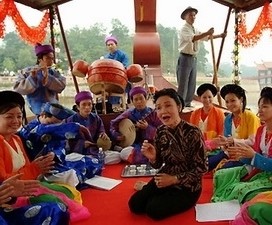
Hat Xoan, a kind of folk song of northern Phu Tho Province, is believed to have been created more than 500 years ago. It is not only popular in 18 communes long the Lo River in Phu Tho Province, but it is also sung in midland and northern regions.
Hat Xoan has some similarities with the lullaby. Like Quan Ho, many of the songs are about love, but it is also a kind of folk music that praises a village genie.
There are many forms of Hat Xoan: duet, group singing accompanied by several kinds of dances.
Xoan Festivals are often held in spring in village temples. On the fifth day of the first lunar month, the artists often sing it at the Hung Temple Festival.
Source: VNA
Posted by vietnamtravelblog on October 21, 2008 under Food and Drinks |
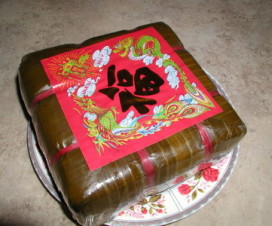
Chung cake is a traditional and irreplaceable cake of Vietnamese people in the Tet Holidays and King Hung’s anniversary (10th March Lunar). For the Vietnamese, making Chung cake is the ideal way to express gratitude to their ancestors and homeland.

Banh Chung
The legend of Chung cake
Chung cake was invented by the 18th Prince of Hung Emperor in the contest of looking for new Emperor. According to the legend, 3,000-4,000 years ago, Prince Lang Lieu, made round and square cakes, the round Day cake symbolizing the sky and the square Chung cake symbolizing the Earth (under the ancient Vietnamese perception), to be offered on the occasion of Spring.
In the ancient conception, the Earth is square, hence Chung cake’s shape is square, too, to reflect the Earth shape. Since the cakes he offered were of special meaning and delicious taste, Lang Lieu was selected to be the next Emperor. Since then, in honor of this 18th Prince, Vietnamese people always make and have Chung cake in the Lunar New Year. Up to now, Chung cake has become the most famous and irreplaceable traditional Vietnamese food in Tet Holiday. This legend aims to remind the next generations of the ancient tradition as well as the primary of Chung cake. Besides, it emphasizes the important role of rice and nature in water rice culture. Read more of this article »
Posted by vietnamtravelblog on October 15, 2008 under Vietnam Culture |
Source: Vietnam Culture
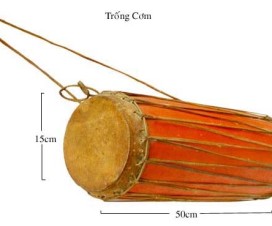
“How joyful to have a Trong Com; and it is an honour for those who can clap it skilfully, oohh ah bong ah bong…”, are beautiful lyrics and melody of a famous song from Vietnamese folklore about Trong Com.
Normally, the song is usually accompanied by a picture of boy or girl drummers with axehead-shaped turbans and long-shaped drums hung loose from the neck down to about the belly. This drum is called Trong Com, which contributes an unique sound – now happy and cheerful, now low, soft and woeful recalling the innermost feelings of one’s native country, one’s homeland...
The history behind
Legend goes that once upon a time, there was a poor Confucian disciple who was very unlucky in competitions and examinations and had to go begging. Everyday, he went past the mansion of a wealthy family where there was always a girl waiting to give him rice. One day, so moved by her good deed, the young man came to thank the girl. However, she said that she had done just what she had been ordered to do by her young mistress. On learning that, the man requested to see the mistress, who was a kind-hearted girl. Seeing the poor scholar bowing with joined hands, the damsel hurriedly bent down to raise him and said: “Never mind, please! I understand and sympathize with your unlucky lot. Since you depart now, I would like to give you a small sum as travelling expenses and this golden hair pin in the earnest hope that one day you will succeed in making a living and come back to the native land, and then…”. The girl left the sentence unfinished, but the scholar had got the message. Fully conscious of his fated misfortune, he decided to turn to music with a determination to achieve success. As time passed, he became famous. Bearing in mind the old promise, he returned to the native village, hoping to meet again his benefactor. Unfortunately, upon arrival, he learnt that the damsel had just passed away due to illness. In his great lament, the young man brought along his musical instrumentalist guild to pay tributes to the deceased and himself created a small, cylindrical drum with rice stuck against both drumheads in commemoration of the ill-fated girl. The strip from which the drum was hung was made of white cloth symbolizing the mourning band. And as he clapped the drumheads, the doleful sounds echoed his deep pain and the loss of his sweetheart.
The description
The Trong Com is held at both ends by a strip hanging over the performer’s neck. It thus lies horizontally against the belly of the drummer who uses both hands to clap the drumheads. In the past, people stuck a handful of glutinous rice to each drumhead. The glutinous rice stuck against the drumhead lends its name to the drum (Trong Com in Vietnamese literally means “Rice Drum”).
The Trong Com gets its name from the practice of placing a pinch of hot steamed rice in the middle of the drum skin to “tune” the instrument. Cylindrical drums are straight-sided. They may have one head, but more often have two heads (one head at each end). One head may have a snare (buzzing string) stretched across it. The body of the drum is made of wood in a tubular shape with the ends slightly tapered. A string is passed through the holes pierced on the edge of each of its faces and strung across it in a zigzag fashion to regulate its tension. The sound obtained from one face is five tones higher than the other. The sound of the trong com is a little dull, somewhat similar to the large-sized dan ho, and it is used to express sadness.
The Trong Com is one of the percussion instruments used in worshipping and various ceremonies, in accompanying Tuong or Cheo drama and in Phuong Bat Am or an octet (a popular ensemble of eight instrumental timbres). Its use has also spread to Cai luong (reformed opera) and other orchestras. The player, when standing, has the Trong Com slung over his stomach. When sitting he rests his instrument on his lap. He strikes the faces of the drum with his fingers with varied style.
Meaningful flow of sound in a rotating cylindricity of Trong Com is so popular in Vietnamese traditional festivals, that always bring about different feelings for the listeners, now happy and cheerful, now low, soft and woeful…
Posted by vietnamtravelblog on October 13, 2008 under vietnamese clothing |
Source: Vietnam Traditional Clothes
The beauty of women dressed in “Ao Dai”always leaves a deep impression on foreign visitors to Vietnam
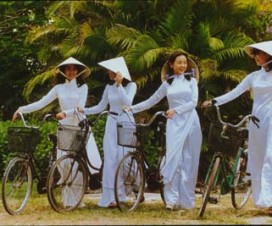
The beauty of women dressed in “Ao Dai”always leaves a deep impression on foreign visitors to Vietnam. Girl students dressed in white long robes take to streets on the way to schools or back home, or gracefully sail on their bikes along streets. Female secretaries in delicate pastels greet you at an office door and older ladies in deep shades of purple, green or blue cut a striking pose at a restaurant dinner. The “Ao Dai” appears to flatter every figure.
Early versions of the “Ao Dai”date back to 1744 when Lord Vu Vuong of the Nguyen Dynasty decreed both men and women should wear an ensemble of trousers and a gown that buttoned down the front. However, not until 1930 did “Ao Dai”appear partly similar to its look today. Now, Men wore it less, generally only on ceremonial occasions such as weddings or funerals. During the 1950s two tailors in Saigon started producing “Ao Dai”with raglan sleeves. This creates a diagonal seam running from the collar to the underarm and this style is still preferred today
“Ao Dai”is made individually to fit each customer’s shape to create the most graceful look. Its body-hugging top flows over wide trousers that brush the floor. The pants should reach the soles of the feet and flow along the floor. Splits in the gown extend well above waist height and make it comfortable and easy to move in.
Comfortability is always taken into account for fashions and beauty. Tailoring must ensure the wearer’s freedom of movements. Despite it is a long robe, “Ao Dai”must be cool to wear. Synthetic or silk fabrics are preferred as they do not crush and are quick drying, making the “Ao Dai”a practical uniform for daily wear.
The color is indicative of the wearer’s age and status. Young girls wear pure white, fully-lined outfits symbolizing their purity. Older but unmarried girls move into soft pastel shades. Only married women wear “Ao Dai”in strong, rich colors, usually over white or black pants. However, “Ao Dai”is rarely seen in places where manual work is practiced. The nineties saw a real resurgence of ao dai. It has become standard and common attire for girl students as well as female staff at offices and hotels. Traditionally, “Ao Dai”has become the most preferred dress on formal occasions.
Today, “Ao Dai”has been a bit modified. Its length is cut shorter usually just below the knee. Variations in the neck, between boat and mandarin style, are common. And even adventurous alterations such as a low scooped neckline, puffed sleeves or off the shoulder designs are appearing as ladies experiment with fashion. Color patterns are no longer rigidly controlled and accesses to new fabrics have generated some dazzling results. However, most visitors to Vietnam have highly appreciated local tailors’ skills when making ao dai. It is hard to think of a more elegant, demure and charming outfit, that suits Vietnamese women of different ages, than ao dai.
Posted by vietnamtravelblog on October 3, 2008 under Vietnam Festivals |
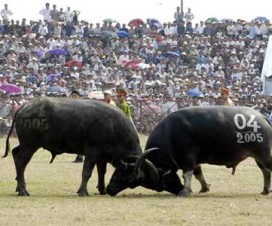
Thousands of people annually gathered at the stadium of Do Son Town, Hai Phong City to witness the attractive performances of buffalos within the Do Son Buffalo Fighting Festival, an outstanding and unique festival one in Vietnam which is associated with different legends.
One of the legends has it that long time ago, one Creator caused a severe drought. All living things looked toward the sea, praying for Creator’s favour. In the most miserable moment, suddenly, people saw two buffalos fighting fiercely on the wave crests and the rains started to pour down, revive all creature. The local people organise the fighting performance annually to show, not only their great gratitude for the Sir Buffalo but also their desire for the immortal vitality and strength of coastal people of Haiphong. Being held officially and annually on the ninth day of the eighth month of the lunar calendar since the 18th century, the festival is a chance for local people to pray for prosperity and happiness.
The preparation for this buffalo fighting festival is an elaborate process, from the 5th and the 6th lunar month itself. The competing buffalos must be carefully selected and methodically trained months in advance of the festival. These buffalos, that had experienced the qualifying round, must be between 4 and 5 years old, with a good appearance, a wide chest, a big groin, a long neck, an acute bottom and bow shaped horns. The selected buffalos, after all the elimination rounds, are fed in separate cages to keep them from contact with common buffalos.
Buffalo fighting performance
The beginning of the worshipping ceremony lasts until lunch time. Do Son Buffalo Fighting Festival takes off with a colorful procession with an octet and a big procession chair, carried by six strong young men. The chosen buffalos, covered with red cloth and red band around their horns, are taken to the fighting ring by 24 young men, from each side dressed in red. The young men dance and wave flags as the two teams of troops take their positions in the fighting ground. The dance was mingled with the ebullient sound of drums and gongs, bringing a hectic atmosphere to the festival. After this event, a pair of buffalos is led to opposite sides of the festival grounds and is made to stand near two flags called Ngu Phung. As soon as the right signal is released, the two buffalos are led into the fighting circle. At the next signal, the two leaders release the ropes that are attached to the noses of the buffalos. With well-practiced movements, the buffalos rush into each other, using their fighting skills to decide the right to enter the next match while the spectators shout and urge the fighting along. Then, the winning buffalo goes to the next round till the final winner emerges. The matches varied in terms of time, depending on the strength and stamina of the buffalos. At the completion of the fight, the spectacle of “receiving the buffalos” is very interesting as the leaders must then catch the winning buffalo to grant it its reward.
The Buffalo Fighting in Do Son is traditional festival of Vietnam attached to a Water God worshipping ceremony and the “Hien Sinh” custom. The ceremony is held in every village and chaired by its patriarch to pray for the victory at the buffalo fight, typically express the martial spirit of the local people in Do Son, Hai Phong. In recent years, this traditional festival attracted not only local residents but also thousands of domestic and international tourists.
Source: Vietnam Culture
Posted by vietnamtravelblog on October 2, 2008 under Vietnam Culture |
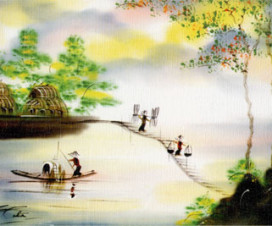
Silk painting is the traditional Vietnamese art of silk painting which originates from painting and drawing on home made rice paper. Today this art has become famous around the world for its simple poetic themes and vibrant colors. Vietnamese artists find the technique to be a unique way to create mystique in their paintings.
The Vietnamese style of silk painting emphasizes softness, elegance and has a flexibility of style. The success of a silk painting very much depends on the quality of the silk. Differently with other kinds of paintings, the silk canvas are usually not painted. The Vietnamese traditional silk painting style tends to use the silk canvas directly as the background of the painting.
Vietnamese silk paintings typically showcase the countryside, landscapes, pagodas, historical events or scenes of daily life. The colors are used delicately with the canvas to make Vietnamese silk paintings. The delicate white color found in the sky, water, or human portrait, is the color of silk. The color of silk is well known to describe human figure in the paintings of many famous vietnamese artists. Delicate color and silk background give the paintings such an harmony with the nature. Whatever style they follow, silk painters must have an intimate knowledge of the material and fully exploit its shininess and its attractiveness. Painting silk is full of changing and unexpected characteristics, and a wrong stroke of the brush is irreversible.
Silk represents an important language of Vietnamese painting after lacquer. Its capacity of absorption and dilution given to the works an impression of mellowness spreading through the woofs and wefts of silk, adding a certain vibration to the forms and colours.
Vietnamese silk painting has its own unique character and colours that are distinctly different from those from ancient China and feudal Japan. Each painting is a great description of the beautiful nature and talented skills of the Vietnamese. By using contemporary colours, Vietnamese silk painting has won the hearts of many art lovers nationally and Internationally.
Source: Vietnam Beauty
Posted by vietnamtravelblog on August 23, 2008 under Vietnam Culture, Vietnam Festivals |
Travel Resources and Partners
>> Vietnam Visa – Apply for Vietnam Visa online.
Every year, on the 15th day of the 8th month in lunar calendar, the children throughout the country in Vietnam are given permission by their parents to march in a procession and carry their lanterns, to eat the Mid-Autumn Festival cakes and to perform the dragon (unicorn) dance, oh, how great and uproarious they are!