Archive | September, 2008

The great lake of Vietnam

30 Sep

VietNamNet Bridge - Looking for nothing but fresh air and sunshine, Duc Hanh drives to Tri An reservoir just outside Ho Chi Minh City.

VietNamNet Bridge – Looking for nothing but fresh air and sunshine, Duc Hanh drives to Tri An reservoir just outside Ho Chi Minh City.

I rise early on Saturday morning with a simple mission in mind: getting the hell out of the city after a long hard working week! As I’m unfamiliar with daytrip locations outside the sprawling metropolis that is Ho Chi Minh City I phone my friend Nguyen Le Khoa.

He immediately suggests heading out to the “Hydroelectric Lake” of Tri An which at first doesn’t sound so appealing. He assures me that this massive reservoir, which his father worked on, is a small sea of tranquillity. To prove his sincerity he promises to drive me there and show me around. On the way he explains that Tri An Reservoir was created for a hydroelectric plant now found on Dong Nai river in Dong Nai province adjacent to Ho Chi Minh City.

The plant was constructed over 20 years ago and it is the main source of electricity for the south of Vietnam. It won’t however be the largest hydroelectric plant, after another one in Son La province, now under construction in northern Vietnam, is completed. The reservoir boasts a water-surface of over 35,000 square hectares and spans across the districts of Vinh Cuu and Tan Phu in Dong Nai province. “It is great fun to go boating on the lake,” promises Khoa. “We can go to the fishing village.

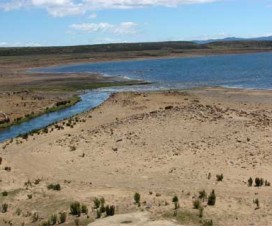
There are also a lot of special fish in this lake, which we can try for lunch!” After a two hour drive, 60km northeast of Saigon, we are standing on Tri An Hydroelectric Dam. Over 20 years ago, we would have been looking at a natural waterfall. Then the river banks were lush and green all year around. Now, I see the riverbanks past the dam are rather arid. On the other side the level of water is also rather low considering it’s been rainy season for the last few months.

Khoa used to come here to try and catch fish himself as a boy and from time to time, when he returns to his old hunting ground, he will try his luck. “Last year, I caught a five-kilo carp!” he says with a proud smile. Khoa has a ball of fishing line and a couple of hooks, so after we prepare two rods we clamber down to see if we can catch something. The water is clear and blue.

We can see right to the bottom. We stand on a large slab in the river and wait impatiently expecting a large carp to suddenly be wriggling on the end of our lines. But, alas, we wait and we wait and nothing comes. Realising that I’m losing patience, Khoa suggests we abandon our mission and head to the fishing village, where hopefully, someone has caught a big fish for us. Much more convenient.

“Before the village was set up over 10 years ago, the lake was full of fish. My family would come here and catch fish easily. We rarely had to buy a fish!” says Khoa. “But, even if you did, a kilo of fish was as cheap as bundle of vegetables in the market.” The fishing village actually sits on the side of the reservoir and looks rather poor and deserted. There are about a dozen fishing boats there but as we arrive most of them are heading out to fish. We find one boat with a small boy.

He is packing fish into a Styrofoam box. The fish looks rather strange and a bit ugly to me. “This is a Sucker Mouth Catfish,” says the boy, who introduces himself as Thang. “There are a lot of them here. They look a strange, sure, but they’re delicious.” According to Khoa, the fish is also called Pleco Fish.

It was introduced to the reservoir and is now a destructive force as it grows quickly and consumes so many of the water weeds that protect the ecology of the lake. Nevertheless, we decide it could make a good lunch! So after negotiating a price for the fish, Thang agrees to row us to a nearby islet we calls Eagle Lake.

The island is said to be a “tourism area” but the buildings are dilapidated or collapsed. Sadly no one takes care of the island. Nature has been allowed to run wild and is perhaps all the more beautiful for that. The paths are covered with velvety rug of green moss. Wild flowers are everywhere. The air is pure and fresh.

It’s a nice little spot I tell Thang. We find a place to sit down in one of the collapsed building while Thang gather dried wood to grill the catfish. As he promised it is truly delicious and of course it’s nice to do our bit for the local environment by eating it!

(Source: VIR)

Retreat north to Do Temple

29 Sep

In 1998 a miracle occurred. As they do every year, thousands of worshippers, many in ancient dress, had marched to Den Do (Do Temple) to honour the eight Emperors of the Ly dynasty. But this year was different.

Wandering around: A dragon dance performance happens in front of Do temple’s Main Hall.

As the festival reached its climax, eight clouds exactly alike sketched a chain across a brilliant blue sky. To the believers, the clouds were incarnations of the Emperors themselves, looking down from on high at the splendid festival taking place in their memory.

But whether you believe this or not, Do Temple is certainly worth the relatively short trip from Hanoi.

Rise and fall

In Buddhist tradition, a pagoda is to worship Buddha and a temple is to worship a revered person of great importance – but just a person none the less.

Do Temple pays homage to all eight Ly dynasty Emperors (the sole Ly Queen – Ly Chieu Hoang – has her own private temple), but at centre stage is the first, Ly Thai To.

Ly Thai To seized control of Vietnam – then known as Dai Viet – in 1010, kick starting the Ly dynasty that was to reign over the country for more than 200 years.

After 1,000 years, Chinese rule of Vietnam had ended in AD938, but the Ly dynasty was the first to bring a stable period of independence to the country. Staunch Buddhists, the Ly Emperors governed with the rule of law rather than the blade of a sword, generating goodwill among the people.

Ly Thai To, who founded Thang Long (now Hanoi) as the capital of Dai Viet, sat on the throne until his death in 1028. In remembrance, his son and the new Emperor Ly Thai Tong had Do Temple constructed in 1030, close to where Ly Thai To was born.

As each subsequent Ly Emperor passed away, their statue moved in with their predecessors, each resplendent above an altar to their person. Last of the Ly leaders was Ly Chieu Hoang, who had the misfortune to preside upon the downfall of the dynasty, forced from power by the upstart Tran dynasty.

Flutter

Do Temple and its surrounding suffered heavy damage in 1952 during the war for independence from French colonial rule. However, in 1989 the temple was reborn, with designs saved from the 17th century used to build again.

The region around Do Temple is famous for its gooey husband and wife rice cakes, given to newlyweds at their wedding. Visitors to the temple have the chance to sample the cakes from the vendors that hang around its entrance.

As the cake traders flutter away, the temple complex reveals itself. Ahead, generous foliage mutes a broad checkerboard path, before the liberal shade ends abruptly at a clay-red crossroads.

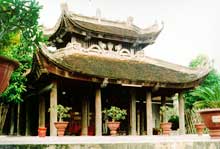
To the left is the Dragons Gate, flanked by plump lion statues baring their canines in a wide grin. And to the right is an island pavilion echoing the classic curled eaves of Buddhist style.

Slink

Celebrate: Do Temple’s lake is known as a popular venue for Quan Ho singers.

Turning left, carved stone dragons slink beneath a smiling roof that shelters the gate’s heavy wooden doors, decorated with meandering dragons.

Past moustachioed guards, of the unblinking variety, is a scorched courtyard in front of the Worshipping House. Two more dragons slither up the sides of an incense burner made to last, their every movement monitored by a pair of kneeling elephants.

Under a flamboyant double-barrelled roof, two exhibitionist soldiers, clad in skimpy loincloths, motionlessly guard the first of many altars. Behind is the Sanctuary House, where the eight Ly Emperors sit on golden thrones in golden robes and before golden ornaments.

Staccato

Back at the crossroads, staccato music floats from the island pavilion, named Thuy Dinh, where a quartet of young women play to a detached audience. They sing local Quan Ho songs in minor key, accompanied by a sparse wooden xylophone.

During French colonial times, Thuy Dinh was so famous that it appeared on money issued by the Bank of Indochina, and nowadays it hosts water puppet theatrics when not a sound stage.

Thuy Dinh sits in the middle of a semi-circle lake, around which harvested rice grains dry in the autumn, destined for the famous cakes.

Do Temple is approximately 16km north-east of Hanoi, and is just outside Dinh Bang Village.

Chris James – Viet Nam News


As National Day nears, travellers check budgets
29 Sep

The number of Vietnamese vacationing for September 2’s National Day hasn’t risen substantially this year, with ticket prices high and budgets tight, travel agents are saying.

Although the number of flight reservations has risen 10 per cent over the norm, no additional flights would occur during the holiday

According to Phung Thi Ly Ha, the vice head of Ha Noi Railway Station, 5 per cent more passengers will travel by train than do during a normal week, a 20 per cent reduction compared with the same period last year.

Most of those passengers are students, labourers and workers who have been employed far from home. Routes in the northern provinces affected by current rains and flooding have received minimal bookings, Ha said.

Nguyen Thu Nguyet, a resident of Doi Can Street, said that her family decided to spend the holiday at a suburban entertainment centre instead of at a luxury resort in Quang Nam Province.

“We’ll use the money for our children’s education, and go by motorbike, so we’ll still have time together during the days off despite high inflation,” said Nguyet.

Nguyen Huu Tuyen, the head of the Transport Department under the Viet Nam Railway Station said no additional trains would run during the national holiday and routes would operate as scheduled.

Nguyen Cong Bang, the head of Ha Noi Bus Station Management Company’s Planning Office said that ticket prices had risen 15 per cent due to the hike in fuel prices, deterring many would-be travellers.

The company, however, has prepared more than 620 coaches operating within 300km and more than 460 buses to ensure service and avoid traffic problems during the upcoming holiday.

Although the number of flight reservations has risen 10 per cent over the norm, no additional flights would occur during the holiday, according to Viet Nam Airlines’ flight control centre.

Around 900 to 1,000 seats on flights to favoured tourism locales like Da Nang and Nha Trang, have been reserved, but the management board said that the number of tickets booked on Viet Nam Airlines had gradually fallen since the middle of August.

Luong Hoai Nam, the director of Jetstar Pacific, said there were 15 per cent more reservations than normal between Friday and National Day, but there would be no flights in addition to the four already operating planes.

Demand increases

However, the number of HCM City travellers has increased 40 per cent over the holiday in spite of higher ticket prices, said travel agents.

“I bought two tickets to Hanoi at VND1,120,000, 10 per cent more than usual. The price is still reasonable,” said Nguyen Duc Binh, a resident of Nam Ky Khoi Nghia Street in District 3, HCM City.

Nguyen Ngoc Thua, the director of Mien Dong Bus Station, said roughly 33,411 people booked tickets for Friday and 28,663 people for Monday.

About 33,000 passengers opted for public transport out of Mien Tay Station for the long holiday. According to Pham Van Thong, the director of the station, transportation companies are required to supply more routes and more buses to meet the high demand during the four day holiday.

Heavy traffic routes include from Hanoi and HCM City to the central cities of Da Nang, Hue and the southern provinces of Da Lat, Nha Trang and Phu Quoc.

Source: Viet Nam News

Shopping tips in Vietnam

17 Sep

Do lots of shopping on your first trip. Everything is cheap. There is nothing you will buy that you will regret later. Everything can either be used for your child, your home or as a gift. It is much easier to deal with extra and extra heavy suitcases on trip #1 when your hands are not busy with your baby.

Bring rubber bands, scotch tape, packing tape, bubble wrap, cardboard tubes, and extra lightweight soft suitcase (e.g. sportsac brand) from home for ease in packing for the trip home. We were able to get 5 conical hats, and much heavy lacquerware home without any damage.

Negotiate, negotiate, negotiate. Very few stores have fixed prices or anything that is unique. Do not be afraid to be firm about your top price and walk away. You will find the item someplace else if the vendor does not then meet your price.

I tried to buy the 54 Ethnic Minorities book near the corner of Dong Khoi and Le Loi in Saigon. The mute vendor disappeared, returned with a copy in poor condition and asked $35. When I declined she started dropping her price: $30, $28, $25. It was difficult to explain that I did not want it at any price because of the condition. But I walked. Then I went into the fixed price book store on Dong Khoi and found a good copy for $17.

Of course, you will not always get the lowest price. You will “win” on some items and “lose” on others. But the bottom line is that none of the prices are really high and if there is anything you really want you should buy it. I have looked in Philadelphia, New York City and the Eden Center and found a very LIMITED selection of Vietnamese crafts. A 24 inch lacquerware platter sells for $200 to $300 at the market in Grand Central Station in NY. It sells for about $20 in Saigon.

You can bring your baby to many restaurants, but there are a few that will be too elegant (but yet not real pricey) for baby. Enjoy these spots on your first trip.

Get out and see the city! For those of you who are not comfortable going around in unfamiliar foreign cities do not hesitate to take a taxi to tourist spots, popular shopping areas and restaurants. Taxis are VERY inexpensive, readily available and metered (i.e. no negotiating necessary). We stayed up near the zoo and the fare plus tip all the way to Ben Thanh market was never more than $1.50.

Visit Ben Thanh (or any other local market) early in the morning when vendors are setting up. We arrived at 6am and could not believe the bustling activity. It was very exciting and a whole different experience than walking through the market at midday.

Explore, explore, explore. Store vendors are very friendly and not pushy at all (very, very different from Morocco where people follow you for 10 minutes to try to get you to go into a certain store). Jim found some interesting books and teapots by going into stores other than the ones recommended to us.

It is not uncommon for people to try to walk off with your bags as they go through the several security conveyor belts. The airports are crowded and the concept of waiting your turn in line is not well understood. People will be crowding you as you deposit your bags on the belt and again when you pick them up at the other end.

For all trips to and from Vietnam, use plastic stretch wrap to seal your already locked suitcases. Write your last name on a large colorful piece of paper and lay it on your suitcase before you wrap the stretch plastic around it. This way your bag will be very obvious and you can keep your eye on it more easily if someone does start to walk away with it. (You can buy rolls of the stretch plastic at U-Haul packing supply locations or Staples.) The product is similar to a very fat roll of Saran wrap but is only about 3 inches wide. I also used some fluorescent masking tape to make my bags VERY distinctive – more so than the usual red ribbon tied around the handle.

Play it safe and hand check your film. We kept our film in a clear plastic bag to make the hand check easier. Most times we were able to pass the film through the security check without anyone even glancing at it.

We had prints developed at a store near Ben Thanh. We thought the processing was good. But once we got home we had an extra set of prints made from the negatives and found that the colors were more true to life in the dupes. I would still develop my film in Vietnam as this way I am sure my exposures are good. If they were really bad, I would buy more film and reshoot because I would be extremely disappointed to come home without any good snaps.

We bought a tripod for our camcorder and thought we would capture the entire visit with Maia. However, we were so excited meeting her that we pretty much forgot about the camcorder and most of the time it is filming nothing or people’s backsides. If I could do that over I would hand carry the camcorder and the camera and just switch off between the two. I think the tripod would be better suited for the G&R where everyone is seated in a room and you can set up the camcorder and let it roll.

The airport is very crowded and busy, especially in the winter/spring. It took a long time to get a cart once the taxi dropped us at the terminal. Then we had to navigate past many, many people some of whom are just sitting on the floor. It also took a long time to go through the numerous check-in and security lines. By the time we got to the gate the plane was boarding. I recommend you plan for extra time for good measure.

By Ellen Curry from adoptvietnam.org

No frills, just flavour at Bun Bo Nam Bo

9 Sep

For what it lacks in frills, Bun Bo Nam Bo compensates with its namesake’s well-crafted taste. Julie Ginsberg confesses to a new addiction.

At Bun Bo Nam Bo, the name says it all. That’s what they do, and they do it well.

One should not visit this tiny establishment, basically an expanded street vendor, seeking a classy meal. One glance at the banana leaves and napkins littering the floor gives that away.

Nor should anyone come to 67 Hang Dieu Street in pursuit of an ambient meal. The cacophonous din from the small TV perched in the corner in symphony with the humming fans makes that quite clear as soon as you sit down.

Couples looking for a romantic dinner had better look elsewhere; the bench seats and long metal-topped tables are in no way suited for intimacy.

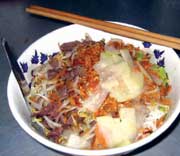
If, however, you would like a warm bowl of bun bo nam bo, a concoction of noodles and beef topped with peanuts, dried onions, bean sprouts, green papaya and a mysterious blend of vegetables and herbs, then you should absolutely try this place bearing its name.

Looks aren’t everything: Bun Bo Nam Bo’s signature dish isn’t your average bowl of noodles and beef.
How can Bun Bo Nam Bo be so bold as to establish a pseudo-restaurant named after one dish and then serve only that dish? Because it’s delicious, that’s why. There’s no need to complicate matters. Just say, “mot” (“one”) to the woman at the entrance sitting behind the table covered with bowls of ingredients and grab a spot on a bench and two wooden chopsticks. When a bowl appears before you moments later, lose yourself in this delightfully crunchy, not quite sweet and slightly sour blend of noodles and tender beef in a little broth. Bottles of vinegar and chilli and soy sauces allow the diner to personalise the dish with an added sour, spicy or salty touch.

Bun Bo Nam Bo’s clientele is a testament to its stellar reputation among Vietnamese and foreign diners alike. At 6.30pm, when the restaurant’s benches are lined with dinner customers, a few foreign faces always dot the crowd.

Bun Bo Nam Bo’s longevity leaves little doubt that the place is an institution in this town. While many Ha Noi restaurants close down within a year or two of popping up, Bun Bo Nam Bo has been around since 1988. Since then, they’ve tweaked their recipe to suit Hanoians’ tastes, as the dish originates in the central provinces and is uncommon in the region surrounding Ha Noi. The small, grey-haired owner, who lives above the restaurant, can often be found sitting by the entrance next to his daughter as she settles customers’ bills.

Though bun bo nam bo is obviously the restaurant’s speciality and its only main course, customers can accompany their meals with gio, a sweet, buttery fried bread for those throwing their diets to the wind. Bun Bo Nam Bo also serves nem chua, fermented pork rolled in banana leaves, then eaten dipped in chilli sauce. According to Vu Ho Chi, my guide to all things Vietnamese, nem chua goes well with beer, the beverage of choice at Bun Bo Nam Bo. Customers can choose from a selection of beers ranging in price from VND10,000-15,000, and soft drinks are also available.

Bun Bo Nam Bo’s decor is nothing to write home about – a lone Tiger beer poster adorns the walls. Nonetheless, the atmosphere is warm and inviting both for groups of friends chatting over beers and for individuals wanting to devour their bun bo nam bo in peace. Alone or with friends, seasoned ex-pats and short-term visitors alike should not leave Ha Noi without trying Bun Bo Nam Bo and forever altering their notions about the value of VND16,000.

Address: 67 Hang Dieu Street

Hours: 7am-10.30pm

Phone: 04-8245352

Comment: A delicious way to spend VND16,000

Why travel to Vietnam

8 Sep

Most people think of Vietnam as a war. But the old history has all gone. Now peace and safety resides. It’s opening to the world as a friendly and exotic place on earth to be.

So why don’t you think of coming. I’ll name some of the reasons why you should:

1. She’s a new place. It’s not touristy like in Thailand and many places you go, people got stunned by your appearance.

2. She’s safe and friendly. The majority of people in Vietnam are farmers, pure farmers. Many of them have never learnt of much apart from the village they were born in. Naturally, they’re almost all friendly and safe to be around. Moreover, the communist government does a good job in ensuring securities all over the country. Nothing of a crime has happened to tourists for the last decades.

3. She has lots to see: A thin country stretching for thousands of Km from North to South. It has beautiful mountains with colorful and rich culture hill tribes. It has beaches and many of those are considered best in the world but still, they’re not touristy. Sound cool enough? Not end yet, she’s home to 7 UNESCO World Heritages. Almost anywhere you go, you’re stumble on a World Heritage.

4. She’s cheap. If you want to, then 1 dollar could buy you a basic lunch or dinner. Wandering around and you want to find somewhere to sit and drink? Mostly you don’t have to pay more than one dollar for it. Cheap accommodations and services are everywhere around the Old Quarter in Hanoi and Pham Ngu Lao street or Bui Vien street – Sai Gon (if you’re traveling on a tight budget). If not a tight budget? Never mind. You have top hotels and resorts of the world in here.

5. Is travel here convenient? Sure, many companies operate the open bus (good quality in general) and they run almost to every capital cities in the country. Moving around is very easy. If ya want to take it easier? Well, lots of tour companies everywhere you go. You don’t have to work on where to go when you wake up tomorrow.

6. After all, traveling is to experience the difference. And Vietnam simply is from any place that you have been.

So, Vietnam? Why not! We wish you a nice time traveling in our charming Vietnam.

Riding the Ho Chi Minh Trail

8 Sep

Written by Cheryn Flanagan
Sunday, 10 September 2006

“You see real Vietnam,” Dung yelled back to me as we sped along the twisting, snaking asphalt of the Ho Chi Minh Trail. The jungle was all around us: a jumble of a million different leaves, grasses, textures, shapes, shadows, and shades of green, all enveloped in the blue hue of morning light. Above us, the heavens were a battlefield of lucent white skies and lead-colored rain clouds, sparking lush green hills and bathing others in shadow. I could feel the wind and hear the place: the roar of a waterfall, the electric chirrup of insects, the caws of birds. Off in the distance, a fine mist smudged the jungle’s timberline and the mountains beyond, consuming the road we traveled, as we wound our way into the heart of the Central Highlands.

Benjamin, my travel partner, and I hadn’t planned to visit the Central Highlands when we arrived in Vietnam. Like many people who journey here, our plan was to travel the country’s eastern seaboard on Highway One, which traverses the length of the country and links Hanoi to Ho Chi Minh City, along with a handful of other tourist haunts along the way. Highway One owes its popularity to the ‘open bus circuit’, which allows tourists to hop on and off the bus at a string of destinations without the constraint of a schedule to keep. It’s a cheap way to travel, considering you can make a trip from Hanoi to Ho Chi Minh City for under $30.00 on an air-conditioned ‘luxury’ bus. But convenience and cost aside, a trip along Highway One feels more like a Disney ride; the cities along its path have been commercialized for the tourism boom and with the numbers of foreign visitors, they have lost a certain feeling of authenticity. It didn’t take long before Benjamin and I found ourselves wishing for a less prescribed way to experience Vietnam.

Enter the Easy Riders. They’re a group of freelance motorbike guides, based in the Central Highlands and South Central Coast, who take travelers on the back of their bikes to see “real Vietnam”. We met Dung (pronounced like Young) in our hotel lobby in the pastel-washed town of Hoi An. He’d just arrived from Nha Trang with an English couple who told us ride was excellent, the roads decent, and that their 4-day ride was, “…incredible; the highlight of our SE Asia travels.” Dung had two bikes and was looking for customers to make the return journey to Nha Trang. We signed up. On a quest to find the real Vietnam, we rode into the Highlands on the Ho Chi Minh Trail, a journey that would span four days and cover almost 500 miles, traveling by motorcycle through some of Vietnam’s more remote areas.

The modern day Ho Chi Minh Trail is more symbolic than exact – it’s not the original tail, but a relatively new highway, which was completed in 2002 to the chagrin of many who believed it to be a foolish endeavor, a colossal waste of money, and a tribute to an artifact of war that represents bloodshed, death, and to some, defeat. And although it’s not the ‘real’ trail, there are plenty reminders of combat, with long forgotten American landing strips and barracks intermingled with Vietnamese cemeteries and war monuments. Blood-red flags emblazoned with a single gold star line the road – a reminder of Vietnam’s quest for unity and harmony, long embroiled in conflict.

Despite the images of war, a journey along this road, as it winds along the Truong Son Mountains, is one of immense beauty, with a diverse population of ethnic minorities and a varied landscape: farm land and bucolic emerald fields; soft, swelling hills; ruddy, rolling rivers; hardwood rainforests, waterfalls, miles of rice paddy, cornfields, black pepper farms, rubber tree forests, and coffee plantations. It was Dung’s habit to stop suddenly, pulling over to the side of the road to take in the views or to traipse through the fields of a farm or plantation. He would pull plants right out of the ground to show us how yams or peanuts or lemongrass grow; tug coffee beans, soybeans, and green beans right from the bush; dip fingers into bowls of rubber tree sap.

Much of our time was spent motoring, and stopping, along the highway in this way. Coiling, curling mountain roads; flat stretches lined with colorful bursts of bougainvillea; rustic villages with homes of rammed earth and wood planks; lively cities with whirling traffic circles and beeping horns; fleeting scenes of life: children returning home from school, women shopping, pigs on their way to the marketplace, farmers harvesting their fields, young boys shepherding herds of cows, businessmen making deals, wedding parties, funeral gatherings… ordinary things that become extraordinary in a foreign land.

We took breaks at roadside stalls and restaurants where we always found government men drinking beer in the afternoon. At times we found more peculiar sights, like a monkey and dog at play, seemingly ignorant of the fact that primates and canines usually don’t get on very well. Once in a while, we’d stop at a restaurant without any customers, and the matrons would devote all of their attention to us, telling Benjamin he is handsome and that he has a beautiful nose, encouraging me to cover my tanned arms to preserve my beautiful white skin – all done with sign language or with Dung’s translation. The curious women inspected our clothes and our faces and touched the hair on our arms. They tried on our sunglasses, and inquired about the use of odds and ends in our backpacks, like hand lotion or lip balm. They always wanted to know where we were from and how we liked their country. They smiled when we told them the Highlands were beautiful, the twinkle in their eye full of pride.

But the physical beauty of the Central Highlands cannot conceal a past and present fraught with conflict. “Many people die here in the war,” Dung told us often. This, his explanation to other admonitions, “I don’t stop there because they no like tourists.” The Central Highlands were an important strategic location for U.S. forces during the American War, and many of the places we passed through along our journey, cities like Kontum, Pleiku, and Buon Ma Thuot, were heavily bombed during B-52 air raids. And, as Dung said, many people died. On occasion, Dung told us to say we are Canadian instead of American. This advice led me to rip up several hotel registration forms with ‘Canada’ written as our country of origin when I realized that we’d have to hand over our U.S. passports to the hotel management for the night. Dung laughed at my folly. “No problem,” he said, leaving me feeling bewildered and embarrassed. It was hard to know when to be American and when it was best not to be. But I never felt unsafe during the course of our travels – I wondered if Dung was not just a bit paranoid.

But perhaps Dung’s caution was not completely unwarranted. The Central Highlands have not always welcomed out-of-towners. In fact, the region was closed to foreigners until 1992 and then again for periods of time in 2001 and 2004. Until the ’90s, the sensitivity stemmed from rumors of secret re-education camps said to be hidden in the area. In 2001 and 2004, travelers were refused entry because of local uprisings over human rights violations and land disputes. The Central Highlands is home to a large population of hill-tribes – ethnic minority groups, or Montagnards, as the French named them. Many of the Montagnards helped the Americans during the war and for this, among other things, they have been victimized. Quite a few have fled to Cambodia, seeking ultimate asylum in the U.S. The issue is ongoing: during our travels in the Central Highlands, the Montagnards were again in the news. 100 people from a group of 700 who escaped to Cambodia in previous years were being sent back to Vietnam.

We met many of the Montagnards as we traveled the Ho Chi Minh Trail; Dung would pull over to the side of the road at a house or a village and suddenly, we were ushered into their world, their homes, and their lives. Our initial encounter took us by surprise. When we left Hoi An, we didn’t know the protocol for such visits. While we did know we’d be meeting hill-tribe people, we didn’t realize it would be so random and impulsive. All it took was for Dung to notice someone was at home.

Our first of such stops was a home occupied by a single family, 20 people and 3 generations, all living together under one roof. Inside, it was dark and cool, with shafts of sunlight streaming in between the bamboo slats of the walls. Numerous animal skulls were mounted to the ceiling, some charred black from the cooking fire; rudimentary hunting tools leaned against a wall; tobacco leaves were hung to dry; chickens pecked and roamed freely; a litter of puppies scampered about; old men and younger men swung lazily in hammocks; a cooking fire smoldered in a corner; old women dressed in traditional garb crouched on the floor; a few children gnawed on fat stalks of sugar cane; a group of teenage girls sat at a table eating a lunch of fish and rice.

“They are Sedang people,” Dung told us, and of the older generation at home that day “they not speak Vietnamese.” Many of the ethnic minorities have their own languages, and while the younger generation learns Vietnamese in school, the old folks are locked in a time warp, unable to communicate with the outside world. The generation gap stretches beyond language, though. The government has done much to assimilate the Montagnards, and the result is a visible divide between the old and the young. In this house, the elder women were dressed in traditional clothes, while the younger girls and boys looked like they could have come straight from the city, with bleach-streaked hair and silk-screened t-shirts. Seeing them all together was like witnessing the past in a collision with the future.

“They very poor, they work for themselves,” Dung explained. “They grow corn and hunt at night with flashlight and gun. Shoot the snake, shoot the pig.” From the array of skulls mounted to the ceiling, it appeared that they eat many animals: cats, dogs, goats, cows. “They have simple life,” Dung continued, pointing to the kitchen, which was nothing more than a fire pit recessed in the bamboo platform. There were no modern-day conveniences, no plumbing or electricity… and upon noticing a small, fluorescent light bulb mounted to a support beam, Dung showed us the power source: an old car battery. And while it was covered in dust and cobwebs, it seemed to be one of the family’s most valued possessions.

We met more Montagnards in Kontum, children left parentless from disease, farming accidents, and, I presume, clashes with the government during ethnic uprisings. Dung described the latter, obliquely, as ‘hill-tribe wars’. There are over 300 orphans at the two homes we visited, with a representation of 10 ethnic minority groups, and ages ranging from newborn to 20-years-old. Outside one of the orphanages, a Catholic church stands next to a traditional Bahar rong house, an odd juxtaposition of steeple and thatched roof. Christianity was brought to the Montagnards in the early 1900s and still remains strong in the community.

Most of the children we met were friendly and affectionate, but some of them bore a haunting countenance of sorrow. The younger children, perhaps in the naivety of youth, seemed less affected by their loss. They approached us with huge smiles, holding their half-eaten lollipops out to us as gifts as they climbed onto our laps, and nuzzled their faces against our shoulders. It was at one of these orphanages that we met Cham.

A man with a humble disposition and a face lined by time, Cham has worked at the orphanage for 6 years as a teacher. He told us he was orphaned himself at the age of 11 – the communists killed his father outside of Pleiku, the body was never recovered. Cham smiled when he learned we were American, saying, “I was a captain on the American side – an advisor to the U.S. during the war.” He can’t have been the only person we met in the Highlands who’d been on the losing side of the war, but he was the only one who talked about it. Cham told us that he’d gone to prison camp in 1975, where he spent more than 2 years upon defeat in the war, and added that if he’d been imprisoned for just a little longer – 3 years – he would have been eligible to immigrate to the U.S. I could tell by the look in his eye and the sound of his voice that he very much wanted for that to happen. Life was tough for Vietnamese on the ‘enemy side’ after the war, and still is today. “I am unlucky,” Cham told us. It is the Vietnamese way to associate the good and bad in life with luck.

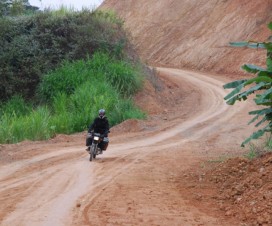
And for the unlucky, traveling the Ho Chi Minh Trail can be dangerous. The highway is lined with spirit houses and graves where people have died in accidents. “33 people die there when the bus went over,” Dung pointed out as we rounded a curve on one of the highways’ many steep mountain passes. And it’s not just the road that can be dangerous, it’s the other drivers, animals, and weather, too. Giant, tank-sized trucks and slipshod drivers ran us off the highway at times; dogs, cows, chicken, and geese wander onto the road; man-eating potholes, unpaved roadway, rickety wood-planked bridges, mudslides, floods, and fallen rocks make the highway an obstacle course of video game proportions. And, we had rain. At times a light mist, but at others, a torrential downpour. Our journey brought us to the Highlands in July, during the wet season. At times we were forced to ride through a storm, chasing the blue sky and rainbows we could see in the distance.

We only saw a handful of other Westerners in our four days on the road, less people than I counted in a single hour at the café where we had breakfast on the morning we left Hoi An. Many of them were also traveling by motorbike, but some of them were also in cars. It might seem safer, or more comfortable, to travel by car. But on a motorcycle, without the barrier of doors and windows and an encasement of metal, you can feel the weather: the hot rays of the sun and the stinging pelt of the rain. You can smell the place: the sweetness of wet earth, the exhaust from belching trucks, the aroma of cooking fires. You can feel the road: the cracks, the composition of the pavement, the curves. And at the end of the day, you can feel it all on your skin, somehow softened by the sun, the wind, the dust, and the grime. Traveling by motorcycle is the ultimate feeling of freedom. It is, Benjamin whispered to me late one night, the best feeling in the world.

At our journey’s end, we again found ourselves in the jungle and I was reminded of Dung, on that first day, yelling back to me, “You see real Vietnam.” I came to understand in the days in-between that like the jungle, Vietnam is a tapestry of textures, shapes, and shadows, all woven together in a cloak of unity. It’s a place scarred from its long history of war, with old wounds that haven’t quite healed and new wounds opening up every day. It’s a place with open arms and closed doors. It’s enigmatic, diverse, and multilayered, with a varied landscape and a rich cultural diversity. It’s a place of beauty and strife, pride and prejudice.

When the road we’d been traveling met up with Highway One, congested with tourist busses on their way to Nha Trang, Dung pulled over one last time at a shack selling sugar cane water. “I show you real Vietnam,” he said after some time of silence. I looked at the bored faces staring out from windows of the tour busses speeding by and replied, “Yes Dung, you did.”

Source: http://www.bootsnall.com/

Vietnam’s Halong Bay a true Asian wonder

5 Sep


By Heather Ramsay

21.03.06
A cruise on Halong Bay is an essential part of any visit to northern Vietnam, claimed our itinerary. Similar statements must be made in every guide to the country, because when we arrived at the embarkation point we felt as if we’d a entered a tourist mill where we’d be sucked in, processed and churned out a day later.

However, we were soon led through the throngs towards the junk-style boat that would be our home for the next 24 hours. After inspecting our cute, wood-panelled cabin, we hastened upstairs to the spacious sundeck, eager to see how the crew would extricate us from the tangle of boats. Miraculously, it happened without a fuss and we were soon floating towards Halong Bay, often described as one of the greatest wonders of Asia.

Soon after casting off we were invited to lunch, which consisted of whole crab, fresh prawns, melt-in-your mouth fish and an unrecognisable but tasty Vietnamese dessert. Oh, and did I mention French wine?

Thus sated, we retired to the deckchairs to watch the panorama of Halong Bay unfold. This Unesco World Heritage site consists of around 3000 precipitous limestone islands jutting out of the emerald-green waters of the Gulf of Tonkin. The name translates loosely as “place of the descending dragon” and legend says that the islands were hewn from the seabed by the thrashing tail of a dragon.

Our junk cruised through narrow channels between towering islands covered in dense vegetation, and navigated slowly past misshapen pillars of rock. The concentration of odd-shaped islands in such a compact area made them seem as if they overlapped, creating a layered effect that stretched into infinity.

Groups of simple houseboats huddled under craggy overhangs, and our junk nudged up alongside one of these floating villages. As well as being the family home, the houseboats are fish farms that provide an income. Large square nets attached to pontoons disappear into the depths, while smaller tanks hold seafood that’s ready for sale.

Our chef purchased a selection of fish and crustaceans, and after we’d watched the sun set over the bay, we settled in for another meal extravaganza, knowing that the seafood couldn’t possibly be any fresher.

Most of the time we didn’t see other tourist boats, but the lights of other boats reflecting on the silken waters imparted a sense of security. There are also a couple of places where tourist boats congregate to disgorge their human cargo for short excursions. The first of these was Sung Sot cave, where we traipsed through a series of limestone caverns lit (rather tastelessly, I thought) by coloured bulbs.

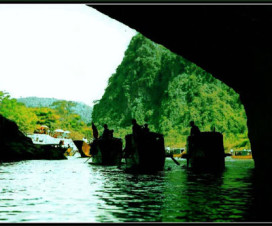
The other was Luong Cave, where we clambered in to a rowboat and headed through a low opening at the base of a rocky island. We emerged into a lagoon encircled by sheer cliffs where we drifted in silence, listening to the shriek of seabirds and the wash of waves against the boat. Our timing was fortunate because as we exited the cave an armada of rowboats was heading our way, but despite the occasional feeling of being on a tourist treadmill, the cruise was a superb travel experience.

For a complete contrast to the seascapes of Halong Bay we headed back to the capital, Hanoi, and took an overnight train to the former French summer retreat of Sapa. Sapa and the surrounding mountain areas are known for their ethnic minority groups (known collectively as Montagnards) who follow a simple rural lifestyle raising animals and growing crops. Many women are skilled at embroidery and stitch-work, producing intricate pieces for their own use and for sale.

Once a week the hill tribe people converge to trade livestock, produce and goods – and once again our timing was fortunate. We arrived in time for the Coc Ly market, which only happens on Tuesdays – and although 17km of the drive was over a rough dirt road, it was worth the discomfort.

Coc Ly market is mainly attended by the Flower H’mong people, whose traditional dress features floral patterns embroidered in ultra-bright colours. Flamboyant headgear seemed to be the rage, with some women sporting large, round hats that resembled 70s-style lampshades, while others opted for folded cloth.

The market carried all kinds of everyday goods but, not surprisingly, the most popular stalls were those offering cloth and fluorescent wool. Meanwhile the men hung around stalls selling mounds of fresh tobacco leaves, which were smoked in a big bamboo bong.

From Coc Ly we took a relaxing boat ride down the Chay River then drove to Sapa via Lao Cai, on the Chinese border. After Lao Cai, the road wound tortuously up through a series of switchbacks, zigzagging towards the distant mountains. Heavily terraced hillsides dropped away below us, sculpted into productive land by hundreds of years of human toil.

Sapa town perches on the slopes of a high valley surrounded by mountains, and its French colonial architecture gives it the feeling of a European alpine village. From our hotel room we could see Fansipan, which, at 3143m, is the highest peak in Vietnam. Keen trampers can make the ascent, while another popular option in this region is multi-day treks with overnight stays in hill-tribe villages.

There are several H’mong, Dsao and Tay villages near town, and once we dragged ourselves away from Sapa’s cosy cafes, we wandered down paths through rice paddies to subsistence communities that still live by the rhythm of the seasons.

With the increase in tourism, canny villagers have seen a way to make extra cash and our rural rambles were often interrupted by women and children selling embroidered goods such as purses, tablecloths, and bedspreads. But it was worth the meagre cost of a couple of colourful pencil cases to be escorted around the villages and given an insight into local lifestyle and customs.

On our last morning we slogged up a steep path to Dragon Mountain, where attractive public gardens have been created among tall, thin spikes of black rock. From a high point known as Dragon’s Awe we looked over the gardens and the town to Fansipan, which, as usual, was draped in clouds.

We made the most of this peaceful vista, knowing that our next destination was hectic Hanoi, which contrasts well with Sapa and Halong Bay to form an interesting tourism triangle in the north of Vietnam.

NEED TO KNOW

Getting there: Flight Centre has return flights to either Hanoi or Ho Chi Minh City ex-Auckland from $1569. Flights can be to Hanoi and from Ho Chi Minh City or vice versa, and can be packaged with Adventure World’s range of Vietnam tours.

These include the 10-day Highlights of Vietnam tour, which is priced from $1270 per person, share twin. Conditions apply to fares and tour packages. Adventure World can also customise itineraries for individual travellers.

Top Ten Travel Items to Bring to Vietnam

5 Sep

Top ten travel items you will want to bring along on your trip to Vietnam, for both safety and comfort.

  1. Carry-on bag. One piece of luggage with all your essentials. Remember it must comply with both Asia and US overhead baggage regulations (no larger than 14″ x 9″ x 22″). Keep you “airplane survival supplies” in it. With our family that includes some “real food” for the flight, such as instant cup of noodles, in addition to snack foods. Ditto on a change of clothes for kids. Lip balm to combat the dry airplane compartment air and a portable DVD player rounds out my list for the carry on bag “survival kit”.
  2. Medication and glasses. Make sure you have your prescription drugs, vitamins and glasses packed in both checked and carry-on luggage. If one gets lost you still function without a hitch. Replacing glasses or prescriptive meds in another country is a waste of valuable time and effort, better spent on the fun sights.
  3. Money belt. Pickpockets are pretty common in Southeast Asia and most Westerners are not aware enough of the subtle ways a pickpocket can nab your valuables. While Asia’s overall crime rate is much lower than the US, pickpockets are more common. A moments’ carelessness can cause great interruption and inconvenience for your trip.
  4. Passport holder. Ditto on the pickpockets interest in a US passport. Carry a small passport purse around your neck, and under a jacket or shirt, for security and easy access. Keep passports and tip or small money amounts there for easy access. You can transfer more money from your belt at discreet moments, and not open up your traveling cash for merchants and pickpockets to notice.
  5. Backpacks are great. I would recommend the padded, double strap for both shoulders, which wear well all day long without straining neck muscles. These are great for keeping your hands free, as well as carrying essentials for adults and activities or a journal for the kids.
  6. Plastic baggies. These little gems have incredible usefulness and not just on an adoption trip. They can save your suitcase from leaky toiletries, pack a snack, organizing dirty clothes or just keeping organized away from home, and a thousand other uses.
  7. Sanitation Supplies. A bottle or two of hand sanitizer and your own supply of Kleenex or toilet tissue are important. If you do have Western-style toilets at all of your stops, you may not find an adequate supply of paper there. With frequent contact with numerous people in tourist areas, you’ll want to make use of hand sanitizer or wipes to keep germs at bay and family members healthy.
  8. First aid kit. A small, but well-stocked travel medical kit can save the day many times. You want to be able to take care of minor scrapes and bruises easily. An obvious list is: bandages, aspirin, antiseptic. A few other items also top the list: bug spray/ointment, tweezers for splinters or other such emergencies.
  9. Door stopper. If you are traveling off the beaten path, or even if you’re not, a simple added security measure is to carry a rubber door stopper. It is light and easy to slip under any hotel room door for that added measure of security for your family. Good tip wherever you travel.
  10. Cameras. This is a very individual choice for families. Something to consider are options to record key moments of your trip without interfering with the experience. Some cameras can take still photos and video; this may be worthwhile to allow all family members to fully experience the trip. Or, if friends or extended family travel, one or two may be designated to capture key moments of the trip.