Cat Ba Island, the World’s Biosphere Reserve

Posted by vietnamtravelblog on October 27, 2008 under Vietnam Beaches | Be the First to Comment

Source: Vietnam Beaches

Cat Ba island, Vietnam’s Pearl Island, a surprising heavenly landscape!

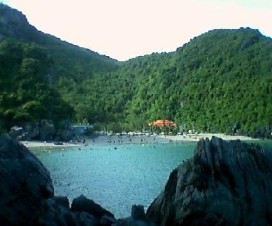
Belonging to Cat Ba Archipelago, which includes 367 islands, in the south of Ha Long bay, Cat Ba Island is only 30 km from Hai Phong city centre and 25 km from Ha Long city. Not at all is it a random thing when Cat Ba is also called Pearl Island (Dao Ngoc in Vietnamese). With a 70m altitude, and the post to overlook Lan Ha lagoon, Cat Ba lures tourists by its heavenly captivation. With an area of 140 km2 and population of 9000 people, it is proud to be the biggest island among the 1,969 islands in Ha Long bay. If you are considering a fresh-air and beautiful place to travel, just pack your stuff, stand up and fly to this magic land of blue Sky and Sea!

The Biosphere reserve of the world!

The archipelago has a global significance thanks to its plentiful species found nowhere else. It is home to the golden-headed langur (Trachypithecus poliocephalus), one of the top ten rare primates in the world due.
Besides, visitors can find several precious habitat types here, including fringing coral reefs, mangrove forest, sea grass beds, willow swamp forest and tropical limestone forest. Many of those are fiercely endangered.
With a major coastal fishing zone, and a karst seascape of outstanding beauty, a tremendous potential for agri-aqua culture and tourism is open to the area. Thanks to the special values, Cat Ba was acknowledged as the World Biosphere Reserve in 2004. So, are you curious to go? Then… Read more of this article »

Shopping in Vietnam

Posted by vietnamtravelblog on October 23, 2008 under Uncategorized | Be the First to Comment

Source: Vietnam Travel Tips

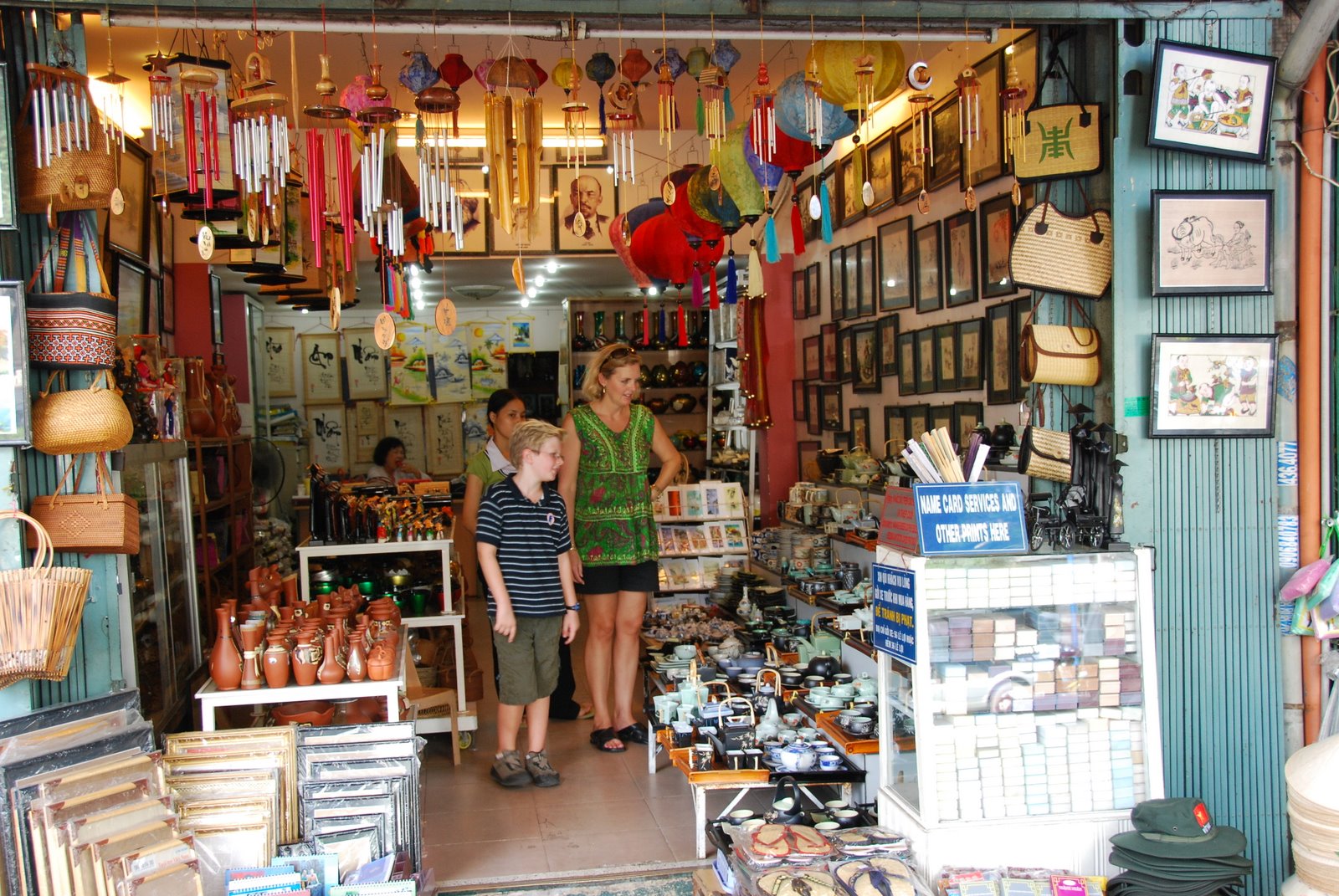
Shopping in Vietnam is a fun and interesting experience, and guarantees good bargains to those who know what to look for. It is true to say that you can find nearly anything in Vietnam. Markets vary from high class shopping malls, supermarkets to bustling open market, galleries, boutiques and street stalls.

It is not recommended that you buy imported, famous branded products such as clothing, perfume or electronics in Vietnam as tax makes these items more costly than neighboring countries.

In terms of shopping for tourists, Vietnam is most famous for its handicrafts, war souvenirs, authentic clothing, art, antiques and gems.

Hotspots include Hanoi, Hoi An and Ho Chi Minh City, each of which has a temping selection of everything from avant-garde art to sumptuous silk suits. Read more of this article »

Green Chung cake – the soul of Vietnamese Lunar New Year
Posted by vietnamtravelblog on October 21, 2008 under Food and Drinks | Be the First to Comment

Source: Vietnamese Food
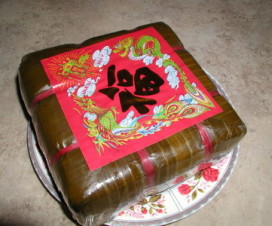
Chung cake is a traditional and irreplaceable cake of Vietnamese people in the Tet Holidays and King Hung’s anniversary (10th March Lunar). For the Vietnamese, making Chung cake is the ideal way to express gratitude to their ancestors and homeland.
Banh Chung

The legend of Chung cake

Chung cake was invented by the 18th Prince of Hung Emperor in the contest of looking for new Emperor. According to the legend, 3,000-4,000 years ago, Prince Lang Lieu, made round and square cakes, the round Day cake symbolizing the sky and the square Chung cake symbolizing the Earth (under the ancient Vietnamese perception), to be offered on the occasion of Spring.

In the ancient conception, the Earth is square, hence Chung cake’s shape is square, too, to reflect the Earth shape. Since the cakes he offered were of special meaning and delicious taste, Lang Lieu was selected to be the next Emperor. Since then, in honor of this 18th Prince, Vietnamese people always make and have Chung cake in the Lunar New Year. Up to now, Chung cake has become the most famous and irreplaceable traditional Vietnamese food in Tet Holiday. This legend aims to remind the next generations of the ancient tradition as well as the primary of Chung cake. Besides, it emphasizes the important role of rice and nature in water rice culture. Read more of this article »

Central Nha Trang city to host int’l regatta
Posted by vietnamtravelblog on October 17, 2008 under Vietnam Travel Info | Be the First to Comment

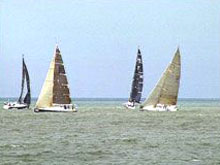
An international sailing regatta will be held in the central coastal city of Nha Trang from October 15-21, said deputy director of the Ho Chi Minh City-based tourism company (Saigontourist) Vu Duy Vu.

Racing boats are scheduled to leave Hong Kong on Oct. 15 and sprint to the finish at Nha Trang on Oct. 18. (Photo: www.jboats.com)

It is the third time the city hosts the competition which is held every two years by Royal Hong Kong Yacht Club, Vina Capital and Saigontourist.

The event is expected to bring together 130 local and foreign competitors with 10 sailing boats from many countries around the world.

Racing boats are scheduled to leave Hong Kong on Oct. 15 and sprint to the finish at Nha Trang on Oct. 18. They then will compete at Nha Trang Sea on the next day.

Nha Trang Beach Festival to take place in 2009

The Nha Trang Beach Festival will take place in central coastal city of Nha Trang on June 6 next year, the organising board said on Oct. 8.

The event, financed by local businesses and the US Rare Antibody Antigen Supply Inc (RAAS), will include cultural, sport and tourism activities such as art performances, masquerades, a kite flying competition, photo exhibitions and cooking contests.

The festival is expected to attract participants from France, Ukraine, the Republic of Korea and Japan, particularly Beauty Queens from a number of countries and territories around the world.

Source: VietNamNet Bridge

Trong Com, a traditional cylindrical drum in Vietnam
Posted by vietnamtravelblog on October 15, 2008 under Vietnam Culture | Be the First to Comment

Source: Vietnam Culture

“How joyful to have a Trong Com; and it is an honour for those who can clap it skilfully, oohh ah bong ah bong…”, are beautiful lyrics and melody of a famous song from Vietnamese folklore about Trong Com.

Normally, the song is usually accompanied by a picture of boy or girl drummers with axehead-shaped turbans and long-shaped drums hung loose from the neck down to about the belly. This drum is called Trong Com, which contributes an unique sound – now happy and cheerful, now low, soft and woeful recalling the innermost feelings of one’s native country, one’s homeland...

The history behind

Legend goes that once upon a time, there was a poor Confucian disciple who was very unlucky in competitions and examinations and had to go begging. Everyday, he went past the mansion of a wealthy family where there was always a girl waiting to give him rice. One day, so moved by her good deed, the young man came to thank the girl. However, she said that she had done just what she had been ordered to do by her young mistress. On learning that, the man requested to see the mistress, who was a kind-hearted girl. Seeing the poor scholar bowing with joined hands, the damsel hurriedly bent down to raise him and said: “Never mind, please! I understand and sympathize with your unlucky lot. Since you depart now, I would like to give you a small sum as travelling expenses and this golden hair pin in the earnest hope that one day you will succeed in making a living and come back to the native land, and then…”. The girl left the sentence unfinished, but the scholar had got the message. Fully conscious of his fated misfortune, he decided to turn to music with a determination to achieve success. As time passed, he became famous. Bearing in mind the old promise, he returned to the native village, hoping to meet again his benefactor. Unfortunately, upon arrival, he learnt that the damsel had just passed away due to illness. In his great lament, the young man brought along his musical instrumentalist guild to pay tributes to the deceased and himself created a small, cylindrical drum with rice stuck against both drumheads in commemoration of the ill-fated girl. The strip from which the drum was hung was made of white cloth symbolizing the mourning band. And as he clapped the drumheads, the doleful sounds echoed his deep pain and the loss of his sweetheart.

The description

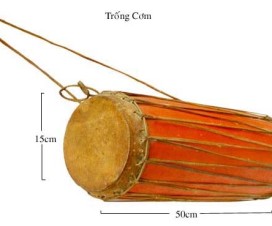
The Trong Com is held at both ends by a strip hanging over the performer’s neck. It thus lies horizontally against the belly of the drummer who uses both hands to clap the drumheads. In the past, people stuck a handful of glutinous rice to each drumhead. The glutinous rice stuck against the drumhead lends its name to the drum (Trong Com in Vietnamese literally means “Rice Drum”).

The Trong Com gets its name from the practice of placing a pinch of hot steamed rice in the middle of the drum skin to “tune” the instrument. Cylindrical drums are straight-sided. They may have one head, but more often have two heads (one head at each end). One head may have a snare (buzzing string) stretched across it. The body of the drum is made of wood in a tubular shape with the ends slightly tapered. A string is passed through the holes pierced on the edge of each of its faces and strung across it in a zigzag fashion to regulate its tension. The sound obtained from one face is five tones higher than the other. The sound of the trong com is a little dull, somewhat similar to the large-sized dan ho, and it is used to express sadness.

The Trong Com is one of the percussion instruments used in worshipping and various ceremonies, in accompanying Tuong or Cheo drama and in Phuong Bat Am or an octet (a popular ensemble of eight instrumental timbres). Its use has also spread to Cai luong (reformed opera) and other orchestras. The player, when standing, has the Trong Com slung over his stomach. When sitting he rests his instrument on his lap. He strikes the faces of the drum with his fingers with varied style.

Meaningful flow of sound in a rotating cylindricity of Trong Com is so popular in Vietnamese traditional festivals, that always bring about different feelings for the listeners, now happy and cheerful, now low, soft and woeful

Phong Nha-Ke Bang national park

Posted by vietnamtravelblog on October 14, 2008 under Vietnam Destinations, Vietnam World heritages | Be the First to Comment

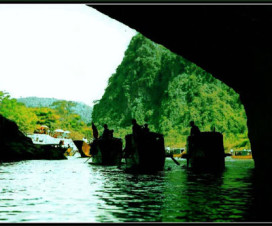
The Park is considered a paradise for researchers and explorers of grottoes and caves and is the home to 140 families, 427 branches, and 751 species of precious plants

Phong Nha – Ke Bang is a national park in the center of Quang Binh province in north-central Vietnam. It protects one of the world’s two largest karst regions with several hundred caves and grottoes. Its name derives from Phong Nha cave, the most beautiful one, with numerous fascinating rock formations, and Ke Bang forest. The plateau is probably one of the finest and most distinctive examples of a complex karst landform in Southeast Asia.

Location:

Geographically, the Phong Nha-Ke Bang National Park (PNKBNP) is located in central Vietnam, about 500km south of the capital, Hanoi, within the Quang Binh Province.

The western boundary of the Park partially forms Laos-Vietnamese border, which is only 42km from the sea. The Park is found within the geographical co-ordinates of 170 20′-170 48′ N and 1050 46-1060 24′ E in Bo Trach and Minh Hoa Districts.

Recognition by UNESCO in 2003

Phong Nha-Ke Bang National Park was first nominated as a UNESCO World Heritage Site in 1998. The dossier submited to UNESCO was for the recognition of Phong Nha nature reserve as a world natural heritage under the name “Phong Nha Nature Reserve”. The reason given for the nomination was that this nature reserve satisfied the criteria of biodiversity, unique beauty and geodiversity (criteria I and iv).

It was recognized as a world natural heritage site at the UNESCO’s 27th general assembly session being held in Paris in June 30thJuly 5th, 2003. At the session, delegates from over 160 member countries of UNESCO World Heritage Convention agreed to include Phong Nha-Ke Bang park and 30 others worldwide in the list of world heritage sites. Phong Nha-Ke Bang National Park meets with criteria viiii in accordance with UNESCO’s appraisal scale since it displays an impressive amount of evidence of earth’s history and is a site of importance for increasing human understanding of the geologic, geomorphic and geo-chronological history of the region.

Physical features:

Criterion (viii): Phong Nha is part of a larger dissected plateau, which also encompasses the Ke Bang and Hin Namno karsts. The limestone incontinuously demonstrates the complexity interbedding with shales and sandstones. This, together with the capping of schists and apparent granites has led to a particularly distinctive topography.

Looking into the caves, you may recognize discrete episodic sequences of events, leaving behind various levels of fossil passages, formerly buried and now uncovered palaeokarst (karst from previous, perhaps very ancient, periods of solution); evidence of major changes in the routes of underground rivers; changes in the solutional regime; deposition and later re-solution of giant speleothems and unusual features such as sub-aerial stromatolites. The location and form of the caves suggest that they might owe much of their size and morphology to some as yet undetermined implications of the schists and granites which overlay the limestone. On the surface, there is a striking series of landscapes, ranging from deeply dissected ranges and plateaux to an immense polje. There is evidence of at least one period of hydrothermal activity in the evolution of this ancient mature karst system. The plateau is probably one of the finest and most distinctive examples of a complex karst landform in SE Asia.

http://nguoiquangbinh.net/forum/hinhanh/dong-phong-nha.jpg

Cultural heritage:

The oldest evidence of human occupation of the area are Neolithic axe heads and similar artefacts found in some of the caves. There are some relics of Ham Nghi King, a final King of the Nguyen dynasty before the French colonial period, at the Maria Mountain in the north of the Park. Currently the Arem, Ma Coong and Ruc ethnic groups live in two villages in the core zone of Phong Nha Ke – Bang National Park. Until 1962 these indigenous people lived in the forest in houses made of bamboo and leaves or in the caves, living from forest products and hunting. They used simple tools and their clothes were made from the bark of a toxic forest tree (Antiaris toxicaria) and lianas.

Since 1992 the Government of Vietnam has set up two new settlements for these 475 people, who are the two smallest ethnic groups in Vietnam. These people are familiar with a number of economically valuable species, especially precious timber such as Mun and Hue (Diospyros spp., Dalbergia rimosa), and oil-extraction from species such as Tau (Hopea hainanensis) and many medicinal plants. The Phong Nha Cave has long been a site of religious and touristic importance, with an old Cham Temple discovered in the cave and it was a site of worship in the ninth and tenth centuries. During the war with the USA the Phong Nha – Ke Bang forest and caves were a garrison and weapons store for the Vietnamese army.

Conservation value:

Phong Nha-Ke Bang National Park is of high conservation value as one of the largest areas of intact forest habitat remaining in Vietnam. As part of a continuous forest block with the neighbouring Him Namno Biodiversity Conservation Area in Laos it forms one of the largest areas of forest on limestone karst in Indochina. The presence of tall lowland forest, which is regionally threatened as a habitat type, in the National Park increases the area’s conservation value.

Tourist activities

The number of tourists has increased dramatically since the park was listed in UNESCO’s World Heritage Sites. Tourism activities in the area are the responsibility of the Trading and Tourism Department of Quang Binh province, with 280 international standard rooms in the province and 8 vehicles with capacities of 4 to 15 seats for tourist transportation. The forest guards of Son Trach commune in Bo Trach district are placed on tourist security duty.

Quang Binh Province has invested into upgrading the Phong Nha-Ke Bang visitor site to turn it into one of Vietnam’s major tourist destinations.

Multiple eco-tourist projects have been licensed for development and the area is being heavily developed by the province to turn it into a major tourist site in Vietnam. Phong Nha Ke Bang is part of a tourism promotion program called: “Middle World Heritage Road” which includes the ancient capital of Huế, the Champa relics of My Son, the city of Hoi An, nha nhac and the Space of Gong Culture in the Central Highlands of Vietnam.

Tourist activities in Phong Nha-Ke Bang National Park are organized by local travel agencies and vary in form:

  • Tour for expedition of caves and grottos in boats and with professional cave expedtion means.
  • Ecotourism, discovering the florae and fauna in this national park in the Ke Bang Forest.
  • Mountain climbing: There are extreme sloping mountains here with a height of over 1,000 m, which is a real challenge for adventurous climbers

In order to facilitate the increasing flow of tourists to the site, the Dong Hoi Airport was constructed and is due to be operational at the end of 2008.

Phong Nha-Ke Bang, together with Ha Long Bay and Fanxipan of Vietnam, is listed as a candidate for 7 new world natural wonders vote. As of February 12, 2008 it ranked 10th in the voting list

In summary, Phong Nha displays an impressive amount of evidence of earth’s history. It is a site of very great importance for increasing our understanding of the geologic, geomorphic and geo-chronological history of the region.

Ao Dai, the Vietnamese long dress

Posted by vietnamtravelblog on October 13, 2008 under vietnamese clothing | Be the First to Comment

Source:  Vietnam Traditional Clothes

The beauty of women dressed in “Ao Dai”always leaves a deep impression on foreign visitors to Vietnam

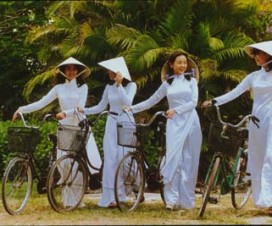
The beauty of women dressed in “Ao Dai”always leaves a deep impression on foreign visitors to Vietnam. Girl students dressed in white long robes take to streets on the way to schools or back home, or gracefully sail on their bikes along streets. Female secretaries in delicate pastels greet you at an office door and older ladies in deep shades of purple, green or blue cut a striking pose at a restaurant dinner. The “Ao Dai” appears to flatter every figure.

Early versions of the “Ao Dai”date back to 1744 when Lord Vu Vuong of the Nguyen Dynasty decreed both men and women should wear an ensemble of trousers and a gown that buttoned down the front. However, not until 1930 did “Ao Dai”appear partly similar to its look today. Now, Men wore it less, generally only on ceremonial occasions such as weddings or funerals. During the 1950s two tailors in Saigon started producing “Ao Dai”with raglan sleeves. This creates a diagonal seam running from the collar to the underarm and this style is still preferred today

“Ao Dai”is made individually to fit each customer’s shape to create the most graceful look. Its body-hugging top flows over wide trousers that brush the floor. The pants should reach the soles of the feet and flow along the floor. Splits in the gown extend well above waist height and make it comfortable and easy to move in.

Comfortability is always taken into account for fashions and beauty. Tailoring must ensure the wearer’s freedom of movements. Despite it is a long robe, “Ao Dai”must be cool to wear. Synthetic or silk fabrics are preferred as they do not crush and are quick drying, making the “Ao Dai”a practical uniform for daily wear.

The color is indicative of the wearer’s age and status. Young girls wear pure white, fully-lined outfits symbolizing their purity. Older but unmarried girls move into soft pastel shades. Only married women wear “Ao Dai”in strong, rich colors, usually over white or black pants. However, “Ao Dai”is rarely seen in places where manual work is practiced. The nineties saw a real resurgence of ao dai. It has become standard and common attire for girl students as well as female staff at offices and hotels. Traditionally, “Ao Dai”has become the most preferred dress on formal occasions.

Today, “Ao Dai”has been a bit modified. Its length is cut shorter usually just below the knee. Variations in the neck, between boat and mandarin style, are common. And even adventurous alterations such as a low scooped neckline, puffed sleeves or off the shoulder designs are appearing as ladies experiment with fashion. Color patterns are no longer rigidly controlled and accesses to new fabrics have generated some dazzling results. However, most visitors to Vietnam have highly appreciated local tailors’ skills when making ao dai. It is hard to think of a more elegant, demure and charming outfit, that suits Vietnamese women of different ages, than ao dai.

Ancestor worship – Vietnamese belief

Posted by vietnamtravelblog on October 10, 2008 under Vietnam Festivals | 10 Comments to Read

Source:  Vietnam Culture

Ancestor worship has been said that the Vietnamese believe in the dead, while the Occidentals believe only in death.

Ancestor worship was introduced into Vietnam by the Chinese during their long occupation of the country that began 200 years before the birth of Christ. Since then, it has been fully absorbed into the Vietnamese consciousness and, with Confucianism, underpins the country’s religion and social fabric. It somewhat represents for Vietnamese culture.

Ancestor worship is not only the adhesive that binds the Vietnamese together, but also one of the most difficult concepts for people from Anglo-Saxon or European origins to understand. It has been said that the Vietnamese believe in the dead, while the Occidentals believe only in death.

The basis of ancestor worship seems to stem from two principle ideas: (1) that “those who have gone before” have a continual and beneficent interest in the affairs of the living; and (2) more widespread, uneasiness, fear of the dead, with practices to placate them. The later ideas more often serve as a form of dispensing emotions than of worship.

How do Vietnamese people worship their ancestors?
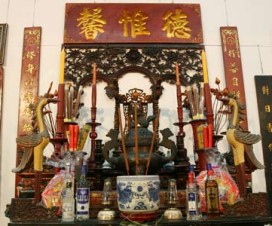
The practice of ancestor worship is relatively straightforward. Nearly every house, office, and business in Vietnam has a small altar which is used to commune with ancestors. Incense sticks are burned frequently. Offerings are made – fruit, sweets, and gifts. The latter items are paper replicas of dollar notes (‘ghost money’), motorbikes, cars, houses and so on. After worship, the paper gifts are burnt so that the spirits of the gifts can ascend to heaven for the ancestors to use.

In the past, the income from a plot of land was used to maintain the altar and arrange the rituals, but this tradition has now faded away. However, the custom that the eldest son will arrange the ceremonial and inherit the family house upon the death of his parents is still generally observed.

Another traditional element is the placing of wooden tablets on the altar for each of the ancestors over recent generations. This is less rigorously observed today, and tablets are often replaced by photographs. Some pagodas house commemorative tablets for ancestors on behalf of regular worshipers.

When do Vietnamese people worship their ancestors?
Worshiping takes place regularly on particular days, such as festivals, new and full moon days, the death day of the ancestor, and so on. On important occasions, such as moving house, starting a new business or the birth of a child, and whenever a member of the family needs guidance or a favour, the ancestors are consulted.

A proliferation of small fires of burning paper in the streets of towns and cities means that it is a festival or moon day. One paper fire is likely to be an event affecting a single family.

Why do Vietnamese people worship their ancestors?
For the Vietnamese, ancestor worship is not related to ghosts, spiritualism or even the supernatural in the Western sense. It is not even a ‘belief’ in the sense that it is open to question by the ‘believers’. The Vietnamese accept as a fact that their ancestors continue to live in another realm, and that it is the duty of the living to meet their needs. In return, the ancestors give advice and bring good fortune.

Devotees of Buddhism believe in previous existences, and seek to correct previous bad deeds to reach enlightenment. Ancestor worship is fundamentally different. For the Vietnamese, death, and the ritual and practice of ancestor worship, constitutes the transfer of power from the tangible life to the intangible. Existence is a continuum stretching through birth, a life spent in tangible form on Earth, followed by death and a spirit existence in another realm for a further two or three generations.

Who are the heroic ancestors
By virtue of their worthy deeds, heroic ancestors, such as Tran Hung Dao and the Trung sisters, continue to exist and be worshiped in temples for many generations beyond the two or three of ordinary folk. Their rectitude is a model to guide the behavior of the living.

What about ‘bad’ ancestors?
All ancestors are worthy of respect and reverence, regardless of their behavior as living beings. However, the misdeeds of a wicked family ancestor will be visited upon his or her children and grandchildren in the form of bad luck. This is a powerful influence upon the behavior of the living, influencing them to behave well and do good deeds in the present, thereby endowing their living and unborn children with good luck in the future.

How does ancestor worship affect daily life in Vietnam?
The effect of ancestor worship upon Vietnamese society is profound. There are three main concepts:
- regarding life as a small part of an infinitely greater whole embracing the entire race
- a belief that the past and present exist simultaneously
- a certitude that each individual’s behaviour in life has a direct impact upon the quality of the lives of his or her children and grandchildren
Taken together, these convictions extend the concept of the family far beyond the sense in which the term is used in the West. A Vietnamese person is never ‘alone’ – his or her ‘family’ is always present.

What is the future of ancestor worship in Vietnam?
Whether ancestor worship will continue to be strong as the influence of scientific rationalism and social change accelerates, is an open question. In the past, the majority of individual family members lived within close geographical proximity. The turmoil in the years before and after the defeat of the US forces led to an exodus of hundreds of thousands of Vietnamese people.

More recently, economic migration and travel to far countries to study or work have created a growing Diaspora. Only time will determine whether the strength of the beliefs that have sustained the Vietnamese family unit over many centuries and created a unique national community will withstand the pressures of globalisation and expanding modern technology.

My Quang (Quang soft noodle soup)

Posted by vietnamtravelblog on October 9, 2008 under Food and Drinks | Read the First Comment

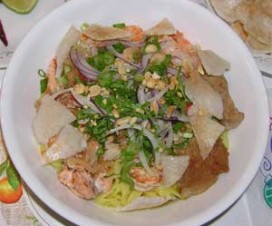
Similar to rice noodle (Pho) and chicken or pork soup (Hu tieu), My Quang is a variety of Pho (rice noodle soup), because the noodles are made from rice and soused with soup as serving. The soup sauce, which is added, comes from a mixture of flavor from beef or pork bone, shrimps, crabs, chicken and duck. The noodles are yellow, somewhat distinct from Pho. However, the main reason for having this color is to be in hannony with the colors of shrimps and crabs.

The best My Quang is made from rice in Phu Chiem, shrimp in Cho Dai and spicy vegetables in Tra Que. As a strict selection of substances to prepare, My Quang has been dominant in almost all of culinary markets in the Central provinces and expanded to Ho Chi Minh City with a high qualification of a Quang Ngai’s specialty

Source: Vietnamese Food

Exotic savanna in central Vietnam

Posted by vietnamtravelblog on October 8, 2008 under Vietnam Destinations | Be the First to Comment

A cascading stream amid the lush greenery of Nui Chua National Park in central Ninh Thuan Province.

Nui Chua National Park is home to a host of diverse fauna and flora species.

Located 30 kilometers from central Ninh Thuan Province’s main city of Phan Rang in Ninh Hai District, the 30,000-hectare site was made into a national park in 2003.

Entering the park, tourists will find green trees growing amid stones and sand in an intensely hot and dry climate.

A staff at the park said a German scientist who had traveled there with his team of researchers several years ago was shocked when he discovered it was almost as dry as an African Savanna.

On the mountains, the trees become greener and denser. Ancient apricot trees resembling bonsais bloom in a large area, with some flowers having as much as 13 petals, captivating visitors who come during springtime.

The park is also home to more than 1,000 flora species, around 300 species of vertebrates, several of which are listed in the world’s endangered list.

Over 100 kinds of forest orchids, most of which are rare and valuable, are sprinkled around Nui Chua’s grounds.

A range of mountains up to 1,000 meters above sea level creates a splendid backdrop for the park, overlooking one of the country’s most appealing and pristine bays, Vinh Hy Bay and Ninh Chu Beach.

The harsh climate of Nui Chua coexists with romantic lakes and effervescent waterfalls all year round.

Guests interested in visiting the only savanna in Vietnam can drive from Ninh Chu Beach in Khanh Hai Commune, Ninh Hai District along provincial highway No. 702 to Vinh Hy Bay, one of the amazing spots in the park.

Update from: http://www.thanhniennews.com/travel/?catid=7&newsid=42530