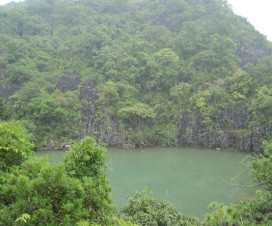
Better protection for Bái Tử Long National Park

Posted by admin on January 14, 2011 under Vietnam Beaches, Vietnam Destinations, Vietnam Travel Info, Vietnam attractions | Be the First to Comment

Better protection for Bái Tử Long National ParkQuang Ninh provincial People’s Committee has approved the project to protect and develop the value of Bai Tu Long National Park until 2015.

The project includes afforestation, forest caring, forest restoration, forest plantation farming and construction of forest protection stations, notice boards, a garden for rare plant migration training, etc.

It will be implemented within 4 years from 2011 on all of the islands in Bai Tu Long bay namely Ba Mùn, Trà Ngọ Lớn, Trà Ngọ Bé, Sậu Đông, Sậu Nam, Đông Ma, Hòn Chín, Lỗ Hố, Máng Hà Nam, Máng Hà Bắc, Di to, Chầy Chầy, Đá Ẩy, Soi Nhụ and more than 20 other small islands. The total investment capital is over VND 7 billion, coming from the state budget.

With the total area of 15,783 hectares, Bái Tử Long National Park supports about 2,000ha of lowland evergreen forest, most of which is on Ba Mùn Island. Plant species diversity is high in the forest in the national park, with no one family dominating. Common tree species include members of the Caesalpiniaceae, Theaceae, Dipterocarpaceae, Myrtaceae and Sapotaceae families.

The park is now home to 672 species of terrestrial plants and 178 aquatic floral species, of which 11 species have been listed in Việt Nam Red Book of endangered species.

It also boasts 37 species of animal, 96 species of bird, 15 species of amphibian, 22 species of reptiles, 119 species of fish; 132 species of invertebrate animal and 106 species of coral. One of the most endangered animals in the park is dugong, also known as a sea cow.

Apart from its biological diversity, the park boasts wonderful natural landscapes, intact beaches, archaeological sites of ancient Việt Nam and vestiges of the former busy trading port of Van Don.

Source: quangninh.gov

Bai Chay Bridge, one of Viet Nam’s 20 typical works after doimoi period

Posted by admin on under Vietnam Travel Info, Vietnam architecture | Be the First to Comment

Bãi Cháy Bridge, one of Việt Nam’s 20 typical works after doimoi periodBãi Cháy bridge was selected among 20 typical works after Doi Moi period, according to Vietnamese Architecture Association.

The list of 20 typical works after Doi Moi period was made by the Selection Committee which includes famous and experienced architecturers, artists, journalists, historians, etc.

The bridge started to be constructed on May 2003 by the Japan’s joint partners Shimizu-Sumitomo-Mitsui and the Transport Ministry’s Project Management Unit No 18 and was completed on December 2, 2006. The main bridge will be 903 meter long and 25.3 meter wide, with a clearance height of 50 meters, allowing 50,000-tonne vessels to pass through.

This is the type of cable-stayed bridge which has two outer span, reinforced concrete box beams prestressed with the width of the world record pace for this type of bridge.

The finance for the bridge worth VND 2.1 trillion (US$134 billion) primarily came from the Japanese official development assistance loans.

Spanning the Cửa Lục Straits in halong City and connecting Bãi Cháy with Hòn Gai, after opening to traffic, the bridge plays an important part in facilitating traffic on National Highway No 18, which links Hạ Long City and Hà Nội, and boosting the economy of not only Quảng Ninh but also the northern port city of Hải Phòng and Hà Nội.

Source: quangninh.gov

Collected by Vietnam hotel