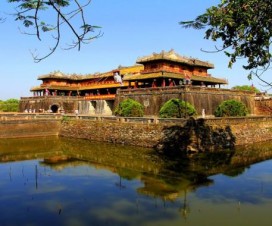
The majesty of Hue

Posted by admin on November 30, 2010 under Vietnam Destinations, Vietnam World heritages, Vietnam architecture, Vietnam attractions, Vietnam beauty | Be the First to Comment

Dai Noi, which is divided into the Hoang Thanh (Hue royal citadel) and Tu Cam Thanh (forbidden citadel), is the largest most-important heritage building in the ancient capital. It was started in 1804 and finished in 1833. There are 100 different constructions inside the palaces but most of them were destroyed by natural disasters and wars. UNESCO has contributed money to restore parts of the citadel.

Hue was the capital of Vietnam during the Nguyen dynasty (1802-1945). The city which is 1,066 kilometers north of HCMC has a distinctive geography, history, culture, architecture and culture. Nowadays, Hue attracts tourists to its temples and royal tombs that were acknowledged as World Heritage by the UNESCO in 1993.

The Saigon Times Daily’s photo-journalist Kinh Luan captures some of the romantic city’s history and natural beauty that Vibeke Jensen, head of the UNESCO office in Vietnam, was speaking about, when she said Hue was “One of the few places in the world that has both global-value tangible and intangible heritages.”

The 400 meter-long Trang Tien Bridge across Huong River was designed by architect Gustav Eiffel in 1897 and finished after two years. In the war time, the bridge was destroyed twice.

Built on the banks of Huong River in 1601, Thien Mu is the city’s most famous pagoda. Lord Nguyen Hoang Lord named it Thien Mu after a legend about a woman who fell from heaven to announce a time of prosperity.

Poetic Huong river and majestic Ngu Binh Mountain in the background are icons of hue. People say they are as solemn and as unobtrusive as Hue people.

Southern tourism triangle in the offing

Posted by admin on under Vietnam Beaches, Vietnam Destinations, Vietnam Travel Info | Be the First to Comment

VietNamNet Bridge – HCMC has reached agreement with two other provinces to develop what will become a southern tourism triangle through a variety of joint product development and marketing projects from now to 2012.

In the signing ceremony in the city’s coastal district of Can Gio late last week, the three parties – HCMC, Lam Dong and Binh Thuan – will initially link their key tourist destinations.

They will also organize conferences along the way to call for investors to diversify tourism products while issuing joint marketing brochures and implementing joint promotion programs.

They will jointly participate in tourism exhibitions at home and abroad, arrange local and foreign familiarization trips and connect their tourism and travel websites, among others, according to the pact between the three provincial tourism departments.

In addition to that, the tourism associations of the three localities clinched a similar cooperation deal to develop four tourism routes between HCMC, Dalat and Phan Thiet.

La Quoc Khanh, deputy director of the HCMC Department of Culture, Sports and Tourism, said cooperation between the three provinces had been in place since 2007 and had produced some good results.

“HCMC-based travel companies now contribute around 45% of total tourist arrivals in Lam Dong and have many tours linking sites of interest in HCMC, Lam Dong and Binh Thuan,” he said.

In terms of investment, he noted, HCMC companies are also at the top in the other two provinces.

But officials and travel firms at the signing ceremony conceded the three provinces had yet to make full use of marketing activities and promotional events in and outside the country.

The relationship between tourism firms in HCMC, Lam Dong, and Binh Thuan has remained loose and this might make it hard to translate the tourism triangle goal into reality.

“We’re aware of the limitations and will try to resolve them. The three tourism associations on Tuesday signed the cooperation deal that will help us strengthen the link between travel firms,” Le Thi Thanh Lien, deputy director of Binh Thuan Province’s Department of Culture, Sports and Tourism, said last Friday.

According to reports by the three tourism departments, Lam Dong has 242 tourism projects worth nearly VND47 trillion, with investors from HCMC accounting for 100 projects capitalized at VND29 trillion, and those from Binh Thuan having three projects valued at VND90 billion. Lam Dong is famous for its hilly resort town of Dalat.

Binh Thuan, which is known for the seaside resort town of Phan Thiet, has 253 tourism projects committed by investors in HCMC with total investment capital of VND37 trillion.

Source: SGT