Sapa’s beauty

Posted by mssarah55 on March 25, 2010 under Vietnam Destinations | 4 Comments to Read

Located in the northwestern region, the famous Sapa town in Lao Cai province is at the height of 1,600m above sea level. Its natural landscapes are captured by tourists.


A house on the road to Ho village covered by mist by Tran Viet Dung.

Terraced fields in Sapa by Tran Viet Dung.
A quiet mountainous road by Tran Viet Dung.
Chrysanthemums in Sapa town’s park by Tran Viet Dung.
The stone-made church in Sapa Town by Tran Viet Dung.
A H’mong woman and her son by Tran Viet Dung.
The path to Ham Rong Mountain by Tran Viet Dung.
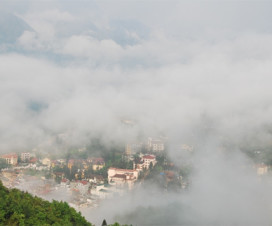
Sapa Town in fog by Tran Viet Dung.
Sapa’s peach blossoms by Hoang Dang Minh.
Specialties of H’mong people by Hoang Dang Minh.
H’mong children like watching TV by Ngoc Tinh.
The Sapa weather station by Pham Hoang Van.
On the peak of Ham Rong Mountain by Bui Thi Linh.
Sapa in fog by Bui Thi Linh.
The dawn on the peak of Fansipan Mountain by Ngoc Tinh.
Sapa – the town in clouds by Phan Vu.
Silver Waterfall by Bui Thi Linh.
Source VNE

The Sound of Đàn Bầu: Yesterday, Today and Beyond

Posted by mssarah55 on under Vietnam Culture, Vietnam Travel Info | Be the First to Comment

Believed to be as old as Vietnams’ early dynastic era, an extraordinary musical instrument exists through time holding with it centuries of beautiful music incorporated into lifelong histories of lives of the Vietnamese people. The Dan Bau is known to create soft, serene sounds, which, every melody produced by it embodies the beauty of the country and its people. One of the only two musical instruments thought to be of pure Vietnamese origin, the Dan Bau is the unequivocal presentation of the country’s unique culture.

Legends talk of a blind woman playing sweet music from the instrument as a means of living while her husband’s at war. That, they say, was the beginning of how the instrument was discovered and the unmistakable emotional appeal of its melody began to be appreciated. Though there’s not much to substantiate such story, one thing’s for sure, the sounds produced by the Dan Bau sends a powerful message of love, longing and beauty that never cease to evoke the hearts and souls of its listeners.

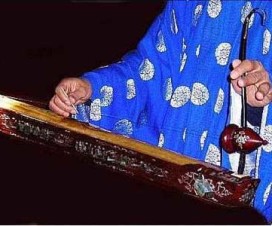
A single-stringed musical instrument, the Dan Bau is simple yet very unique. Đàn, meaning a stringed instrument, and bầu, which means gourd, the device is exactly what is says. In general, it consists of a few components which includes the soundboard serving as its resonator, the spout, gourd, string and a tuning peg. Though originally, the instrument is made of four parts: a bamboo tube, a wooden rod, a coconut shell half, and a silk string. The string runs across the bamboo and secured on one end to the rod, which is perpendicularly attached to the bamboo.

Present day Dan Baus are constructed using wooden soundboards in place of the bamboo. The traditional silk string have also been replaced with an iron string. The instrument’s spout, which is a flexible rod that varies the string’s tension, is made of buffalo horn that is square-framed at the root, while flat and gradually bent at the top. It plays an important role in producing sounds of different pitches beyond fundamental overtones of the instrument. The gourd used to cover the spout where the string is tied, acting as a resonator, still exists though it had been replaced by wood and serves nothing more than a decorative feature. Its tuning peg, which could be made of bamboo or wood, is located at the inside frame towards the bottom of the wooden soundboard. The iron string goes through a small hole at the end of the instrument’s surface towards the tuning peg. A pointed stick made of bamboo or rattan is commonly used as pluck for this instrument.

Most of Dan Baus today now have modern tuning machines to allow adjustments of the string’s base pitch. Usually tuned to the C note, it uses harmonies or overtones. It is played by plucking the strings while touching it lightly with the side of the hand at a point producing a harmony. Though it does not require for one to be highly skilled in order to play the Dan Bau, a great deal of precision is needed to allow rise and fall of pitch along with lengthening and shortening of the notes with the aid of the flexible rod that permits the shifting tension of the string, thus, trills could be played. The technique involves gently tapping the string with the tiny finger of the right hand while the other fingers pluck the string using a long plectrum. With the left hand, the note’s pitch could be lowered by pushing the flexible rod using the index finger, or pulling the rod away with the thumb if a higher pitch is desired.

Used to be played solo or along poetry recitals, the instrument had now taken part in large orchestra to accompany stage operas. Music incorporating Dan Bau with their songs have taken a huge turn beginning the 20th century where players infused electrical pickups and amplifiers with the instrument to make its sound more distinct and audible to larger audiences. Still, solo performances are greatly appreciate and musical pieces exclusively composed for Bau solo, such as Vu Khuc Tay Nguyen (Dance of the Central Highland) by Duc Nhuan, Dong kenh trong (The clear channel) by Hoang Dam and Vi Mien Nam (for the South) by Huy Thuc are widely applauded.

Likened to the monochords of other parts the world, along which are the Tuntina of India, Cung of East Africa, Duxiangin of China, none can compare to the serene, melodious and inspiring tunes that reaches out to the emotions to wherever the wind carries its sound. Every pluck of the Dan Bau’s string is a tale of love and history in itself touching every listener’s heart while stirring their souls. The melody produced by the instrument may be viewed differently by every person as he connects with his own feelings. No matter how re-lived over the periods, and how time changed its visage, Dan Bau is one instrument that translates a great part of Vietnam and a true expression of emotions that will forever transcend time.

Collected by Vietnam Visa

Ceramic Road along the Red River, Vietnam

Posted by mssarah55 on March 18, 2010 under Vietnam Culture, Vietnam Travel Info | 20 Comments to Read

The 2.018 meter-long project with total squares of 6.500m2 is an art construction playing a great meaning to welcome 1000th anniversary of Thang Long-Ha Noi and honor art heritages to patterns of history from the periods of Dong Son to dynasties of Ly, Tran, Le, Nguyen. The 2.018 meter-long project with total squares of 6.500m2 is an art construction playing a great meaning to welcome 1000th anniversary of Thang Long-Ha Noi and honor art heritages to patterns of history from the periods of Dong Son to dynasties of Ly, Tran, Le, Nguyen.
The road runs from Au Co Avenue through Nghi Tam, Yen Phu, Tran Nhat Duat, Tran Quang Khai and Tran Khanh Du roads. As planned, it comprises 21 sections of ceramic pictures with verities of interesting and colourful objects.
Taking part in this project, not only Vietnamese artists, Ceramic Road receives a very enthusiastic response of international artists. All with wishes to contribute a meaningful gift to bring beauty to the community as well to welcome 1000 year-old Hanoi Capital. Apart from the assistance of Michael Geertsen, a Denmark artist, and Dominique de Miscault from France, many other artists from many countries all over the world as UK, United State, Netherlands, Italia, Spain and Finland have registered to join. Ceramic Road is striving to set Guiness Record and become the longest Ceramic Picture in the world.

www.vietnam-visa.com

Cyclists enjoy tranquil rides

Posted by mssarah55 on under Vietnam Destinations, Vietnam Travel Info, Vietnam Travel Stories | Be the First to Comment

As eco-tourism gains popularity, more tourists are opting to take bike tours.

by Thanh Ha

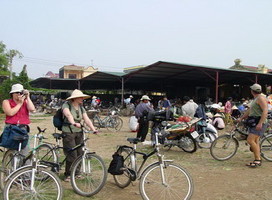
A cycling tour in the northern province of Ninh Binh was one of Rett Townsley’s favourite activities while travelling around Viet Nam.

“It was not my first bike tour but I have not ridden a road bike in several years. It was a good tour, even though it was very tiring. It definitely left me with a lot of good memories,” Townsley says.
Townsley is among a small group of tourists who travelled to Ninh Binh’s Hoa Lu District, the nation’s former citadel, which lures millions of local and foreign tourists every year.

A bus leaves Ha Noi early every morning for the two hour journey to the district. Townsley and his partners book rooms at the Xuan Hoa Hotel, which is said to provide the best travel services in the district, such as meals, rooms, bikes and tour guides.

The hotel provides an excellent jumping-off point for tourists to enjoy a visit to the ancient Hoa Lu citadel which was the country’s capital city for the Dinh dynasty (968-980) and the tien Le (Earlier-Le) dynasty (980-1009).

Maps to these destinations are free from the hotel. Townsley and his friends pay VND20,000 (US$1) for their bikes and share the $10 for a tour guide to show them around for a full day.

It takes Townsley and his friends nearly one hour to travel the 12km to the citadel, where they admire the temple of King Dinh Tien Hoang, who developed Hoa Lu as the capital and set up the first centralised feudal State in Viet Nam. They also enjoyed the temple to the first king of the tien Le dynasty, King Le Dai Hanh.

Their next destination is Tam Coc-Bich Dong, also known as Ha Long Bay on land. The area is home to an awesome stretch of giant limestone karsts jutting out of the rice paddies on the banks of a small river. Townsley and his friends leave the bikes aside for a short time to travel by boat through this secluded oasis away from the haze of the big city.

If they have planned for an extra day or two of holiday, the group can sail on to the Trang An Eco-Tourism complex, which is said to host a world of natural and cultural heritage.

With its striking limestone mountains, caves and clear streams, combined with the ruins of the former capital at Hoa Lu, the area annually attracts millions of tourists from across Viet Nam and around the world.

Back on land at Van Lam Wharf, an expanse of art work is waiting for the group. The area is a great place for tourists to explore Viet Nam’s needlework.

Thousands of embroidery and thread work products with many designs in different sizes are so beautiful that most people cannot deny at least one indulgence for themselves or as a gift for a loved one back home.

“I especially enjoyed the part of the ride that took us right up to the limestone mountains,” says Townsley, who also expresses his pleasure with the boat ride and the walk around the Trang An complex.

“However, the most interesting part of the tour is the bike ride itself. Our tour guide, Trung, leads us over the country lanes that link villages, rice fields and homes.

“It was one of the greatest experiences we had on this tour,” says Thanh Hoa, another member of the group.

“I’m a city girl so I have very little idea about rural life. I have been curious about the lives and activities of farmers, but now my mind has been opened quite a lot,” she says.

Despite his poor English, Trung guides people to the most beautiful and special places in the area where they can witness the beauty of the rural scenes or give a hand to local farmers with their work.

Open-minded

“Local people are open-minded. They are happy to let visitors help them cultivate rice seedlings, bail water to the fields or dig a fish breeding pond. You can even take a meal with a family or ask them to teach you how to embroider a simple product in Van Lam Village,” says Trung.

It seems as if the landscape has been untouched by time, and that’s exactly how locals want it to stay. “Although tourism has developed over the past few years, we still want to keep the original features of the region,” he says. As the only foreigner Townsley is the happiest person in the group – many people, including a lot of children, greeted him enthusiastically.

“I think the biggest advantage of the tour is just the fact that you can see so much more when you are on a bike than you would see from a tour bus. Also, bikes don’t cause pollution,” he says. He adds that he thinks the route is a little too long for most tourists. “I think 12km is okay but 20 is a little much.”

He suggests that better quality bikes would make the tour a better experience and that larger groups should come with a support vehicle. But he still intends to recommend the tour to his family and friends when they come to Viet Nam.

“My customers are really interested in this tour because it puts them closer to nature and to the culture, customs and habits of the local people, which are often very different from their own,” says Nguyen Viet Trinh.

“Most of our travellers are currently white-collar workers who don’t generally have time for biking. Bike tours give them chance to discover many new things and recover their health with exercise and fresh air,” Trinh says.

“However, we have only met 85-90 per cent of their demands because of a few customer service problems, including the quality of the bikes and tour guides,” he says. He adds that customer service improvements would increase the number of tourists to Viet Nam. — VNS

www.vietnam-visa.com

Bà Rịa – Vũng Tàu to host World Food Festival

Posted by mssarah55 on under Vietnam Travel Info | 4 Comments to Read

The southern coastal province of Bà Rịa-Vũng Tàu will host the World Food Festival 2010 from July 21-25.

A 3km-long party will be arranged along the beautiful beaches of Thùy Vân and Bãi Sau in Vũng Tàu City, representatives of the Organizing Board revealed at a press briefing held in Hà Nội on March 11.

The festival will also include markets on specialties and dishes from all 63 provinces and cities in Việt Nam and more than 80 nations in the world, they added.

With five main facets – gastronomy, culture, festivities, shopping and relaxing- the event is expected to provide visitors with opportunities to enjoy traditional dishes and beverages, explore different cultures, shop and take part in a colorful parade with thousands of other people from different countries as well as areas in Việt Nam.

During the festival, cooking demonstrations will be held on the beaches.

The Organizing Board hopes the festival will become an annual traditional event in Vũng Tàu Province and will be recognized as a Guinness world record in terms of the largest space for a gastronomy festival.

Source: VGP News

www.vietnam-visa.com

Nghệ An appeals for tourism investment

Posted by mssarah55 on under Vietnam Travel Info | Read the First Comment

VGP – Nghệ An, the largest province in the North Central part of Việt Nam, is calling on massive investment of around US $250 million in 22 projects on marine and eco-tourism from now to 2015.
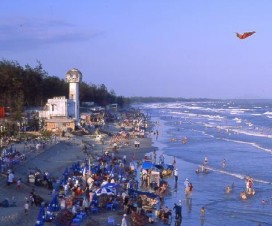
A beach in Nghệ An – Illustration photo

These projects include an eco-tourist area at Khe Kèm Waterfall (worth of US $63 million), a tourist area at Quyết Mountain-Bến Thủy (US $25 million), Sao Va Waterfall (US $10 million), and Nghi Thiết Beach (US $6 million).

To tap its tourist potentials, the local authorities of Nghệ An called upon investors to get involved in sea, convalescence and eco-tourism, sites in Quỳnh Lưu, Cửa Lò, Nghi Lộc, Con Cuông and Nam Đàn Districts.

These projects are expected to create new, attractive and typical tourist products for Nghệ An and the Central region of Việt Nam.

In addition, the locality also thirsts for more flows of investment building more commercial centers, sports services, entertainment parks, and so on.

The authorities of Nghệ An pledge to grant numerous incentives for investors in terms of investment promotion, site clearance, better infrastructure, and land lease./.

By Khanh Phuong – VGP News

www.vietnamhotels.net