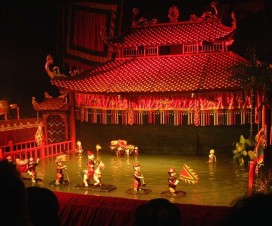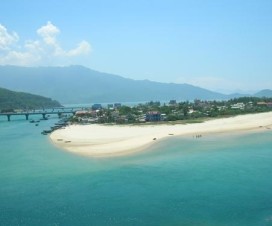
Doc let – Unspoiled beaches

Posted by admin on February 10, 2011 under Vietnam Beaches, Vietnam Destinations, Vietnam Travel Info, Vietnam attractions, Vietnam beauty | Be the First to Comment

Gone are the days when Nha Trang was a sleepy little beach town. In the last decade, this central coastal town has developed into an international tourist destination, complete with the hustle of trade and bustle of tourists.

But if you’re truly looking to get away from the resorts in  Nha Trang, head out 45 kilometres to the charming Doc Let Beach.

Doc Let, or Doc Lech, literally means “a hill one needs to crawl over.” Indeed, we had to crawl up the white sand dunes lining the beach before we could see the aquamarine waters.

Doc Let stretches over 10 kilometres and is largely undeveloped. On our drive up the coastal road, we found few hotels and restaurants.

Doc Let has the shallowest waters in all of Khanh Hoa Province. Along most of the beach, the sea is only half a meter deep even 100 meters from the beach. The crystal blue waters beckon even those who can’t swim, and time passes quickly as one luxuriates in the warm, tropical waters.

While most parts of Doc Let are free from tourist traps, a small stretch has been developed into the Doc Let Tourist Park. Fresh seafood stalls serve crabs, snails, clams, and squids under the shade of the casuarina trees dotting the beach.

HOW TO GET THERE
- Doc Let Beach is located in Ninh Hai Commune, Ninh Hoa District, Khanh Hoa Province.

- To get to the beach from Nha Trang, take National Highway 1A heading north. About a kilometre after passing Ninh Hoa Town, turn right onto a small road. Continue for another 14 kilometres to reach Doc Let.

Water spinach grows wild along the seashore at the Cat Trang (White Sand) Tourist Park, forming a green carpet adorned with violet flowers.

When the tide is low, crabs scuttle hurriedly across the beach, barely visible against the white sands. I tried hard to get close enough to get a picture, but the crabs are wary of humans, and disappear into their sandy homes in seconds.

If lazing around is not enough, get into some action with water sports. Boats and jet skis are available at the beach for VND150,000-250,000 (US$8-13) for 30 minutes.

For a breathtaking view of the waters, head for the skies. Parasailing costs VND450,000 for 15 minutes.

In the summer, Doc Let is surrounded by the Hon Khoi salt fields. Mountains of salt make for a unique landscape.

At a village near Hon Khoi Port, fishermen use round boats or coracles to go fishing every morning.

Doc Let Beach is near the famous Van Phong Bay, which is being developed as a tourist destination. There are a range of hotels and resorts near the bay as well as entertainment activities.

Source: Thanh Nien

The majesty of Hue

Posted by admin on November 30, 2010 under Vietnam Destinations, Vietnam World heritages, Vietnam architecture, Vietnam attractions, Vietnam beauty | Be the First to Comment

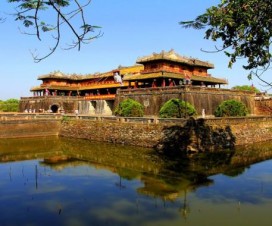
Dai Noi, which is divided into the Hoang Thanh (Hue royal citadel) and Tu Cam Thanh (forbidden citadel), is the largest most-important heritage building in the ancient capital. It was started in 1804 and finished in 1833. There are 100 different constructions inside the palaces but most of them were destroyed by natural disasters and wars. UNESCO has contributed money to restore parts of the citadel.

Hue was the capital of Vietnam during the Nguyen dynasty (1802-1945). The city which is 1,066 kilometers north of HCMC has a distinctive geography, history, culture, architecture and culture. Nowadays, Hue attracts tourists to its temples and royal tombs that were acknowledged as World Heritage by the UNESCO in 1993.

The Saigon Times Daily’s photo-journalist Kinh Luan captures some of the romantic city’s history and natural beauty that Vibeke Jensen, head of the UNESCO office in Vietnam, was speaking about, when she said Hue was “One of the few places in the world that has both global-value tangible and intangible heritages.”

The 400 meter-long Trang Tien Bridge across Huong River was designed by architect Gustav Eiffel in 1897 and finished after two years. In the war time, the bridge was destroyed twice.

Built on the banks of Huong River in 1601, Thien Mu is the city’s most famous pagoda. Lord Nguyen Hoang Lord named it Thien Mu after a legend about a woman who fell from heaven to announce a time of prosperity.

Poetic Huong river and majestic Ngu Binh Mountain in the background are icons of hue. People say they are as solemn and as unobtrusive as Hue people.

Journey Along the Road of Beauty and History
Posted by admin on October 28, 2010 under Vietnam Destinations, Vietnam beauty | Be the First to Comment

The many wonders and spectacular views cradled by Vietnam’s soil is no longer a secret to anyone. So as well as its rich culture and very interesting past. If there is one part in the country that holds the most of its beauty and history, the Hai Van Pass in National Highway 1A very much deserves the title.

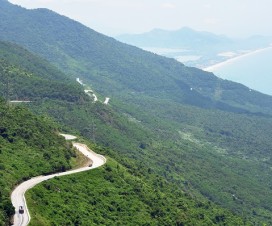
Located at the border of Thua Thien-Hue Province and Da Nang City, and known as part of the Truong Son Range, it is the highest pass in Vietnam at 500 meters above the sea level. The climb to this path is not just drenched with curves which give tourists a moment of excitement, amazement and a mix of fear and delight, but also unfolds the entire beauty form below which you could never set eyes on any other part of the country, perhaps in the world. In fact, the drive from Danang to Hue is believed to be the most scenic in all of Vietnam.

But Hai Van Pass is not just associated with beautiful landscapes. With it comes a long history, which now, is feared to be among the many historical places in Vietnam that is slowly fading behind as the country moves toward modernization. In 2005, the Hai Van Tunnel was built to give people a shorter journey from Da Nang to Hue. But why many would still choose to travel along the picturesque mountain road steep tells how the beauty of Hai Van Pass couldn’t be that easily ignored, worst, forgotten.

Hai Van means “Sea Clouds”, since the peak of the mountain where its many bending roads nestle almost touches the clouds. The history of Hai Van Pass goes all the way back to 1306 where it used to belong to the Champa Kingdom. King Che Man of Champa gave the Ulik area (the current provinces of Quang Tri and Thua Thien-Hue), including the pass, as a betrothal gift to Vietnam’s then king Tran Nhan Tong in exchange for the hand of the beautiful Princess Huyen Tran.

During the Nguyen Dynasty (1802-1945), the pass was an important military site and served as a protection for the Hue Royal Citadel. People then had to submit the necessary papers to be allowed through the guarded gate. Under the rule of the second emperor of Nguyen Dynasty King Minh Mang in 1826, French troops built a blockhouse, named Don Nhat, to protect the Hai Van Pass. This gate could not be seen as you journey on top of the pass, now taking the form of a brick gate covered with moss. It stands 10 meters high with walls as thick as five meters. It faces Thua Thien-Hue Province, and is inscribed with three words “Hai Van Gate” in Han script. On the other side, the gate is engraved with: “The most grandiose gateway in the world”, written in Han script. These words were said by King Le Thanh Ton (1442-1497) when he visited the site.

Anyone passing through Hai Van Pass could not ignore the many perilous obstacles and is the last spur of the Truong Son Range reaching to the sea. But the grandiose panorama that unfolds before them makes all the dangerous bends and curves so well worth the ride. Coming in close view with the historical sites along the pass will truly evoke old memories and feelings from the past. Hai Van Pass will satisfy anyone’s desire to conquer high peaks and be reminded of the glorious past of the beautiful Vietnam.

Vietnam’s traditional ao dai part of 1,000 Year celebrationvietn

Posted by vietnamtravelblog on September 28, 2010 under Vietnam Culture | Be the First to Comment

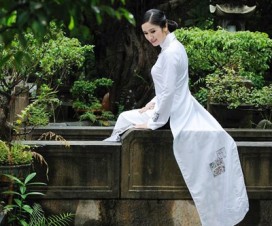
Some of Vietnam’s greatest beauties came together to pose in the traditional ao dai, a symbol of the nation.

Famous actress Thu Ha, Miss Ngo Phuong Lan (Miss Vietnam World 2007), Ngoc Oanh (Runner-up Miss Vietnam 2000) and former Model Hoang Xuan posed for the first time together wearing the ao dai.

The photo shoot was taken in anticipation of the Ao Dai Festival which will take place on October 1, 2010, the opening day of the upcoming events for the 1,000 Year Anniversary of Thang Long – Hanoi.

The ao dai is a Vietnamese national dress worn by women. In its current form, it is a tight-fitting silk tunic worn over pantaloons.

The Ao Dai Festival of the North, Central and South regions will be held at the well-known sight-seeing Thap But (pen tower) – Ngoc Son Temple, in Hanoi. The festival provides an outstanding art activity as part of the programme “The fanciful night by Hoan Kiem Lake”.

Based on an idea of bringing the finest of Vietnamese culture and tradition into the design, organisers designed and created 600 of the traditional dresses for the festival. The festival will include two main themes: One shows the city of Hanoi in the past and the other will show special features of the ao dai from Vietnam’s three regions. From these two themes, organisers have prepared several Ao dai collections such as “Recalling memories”, “Sacred dragon features”, “Hanoi’s streets” and “Sunny flowers”.

Vietnamese beauty stars Miss Ngo Phuong Lan, Ngoc Oanh, Tran Thi Quynh, Dang Thuy Trang and others will perform in the Ao Dai Festival.

The festival will last for 45 minutes with the performance of 100 models. The stage will have very unique design and decorations. Its catwalk will cover 350 metres and the stage will be decorated with flowered mats and conical hats. The show will also include performances on traditional activities of Hanoians in the past.

Below are some photos of the ao dai dresses which will be showcased on October 1, 2010:


Actress Thu Ha

Ngoc Oanh

Miss Ngo Phuong Lan

Former Model Hoang Xuan

Hoi An – An unforgettable experience

Posted by vietnamtravelblog on August 2, 2010 under Vietnam Beaches, Vietnam Destinations, Vietnam Overviews, Vietnam Travel Info, Vietnam Travel Tips | Be the First to Comment

Located 30 kilometres away from Da Nang City, the ancient and legendary Hoi An is one of Asia’s top destinations. Famous Thu Bon River, Cua Dai Beach, rice fields and old streets are adorned with souvenirs. The people are known to be friendly, honest and hospitable.

Hoi An vendors have earned a reputation for treating visitors well and not overcharging. The prices are very reasonable and the “foreigner tax” rarely, if ever, is applied. There are many small scale hotels for backpacking tourists ranging from USD10-12 per night.

Hoi An also offers unique culinary specialties such as Mi Quang, Cao Lau (two styles of vermicelli noodles native to Quang Nam Province), and Com ga (Chicken rice). Ba Buoi’s stall is very famous for Com ga and virtually anybody in Hoi An can show you the way to this stall.

Cua Dai Beach is just 4 or 5 kilometres away from Hoi An. It has many hotels and resorts with traditional style.
The Hoi An RiverSide and Hoi An River Beach are resorts looking over the beautiful Thu Bon River and all boast very beautiful views. Tourists can see farmers working in fields or storks searching for food, soaking in a peaceful countryside area.

In addition, tourists have another choice. They can stay in resorts looking towards the sea such as Palm Garden Beach Resort and Spa, Hoi An Beach Resort, Vitoria Hoi An Beach Resort and Spa or the Golden Sand Resort and Spa. They all have a modern design.

Cua Dai Beach is seemingly untouched. Its water is so clear that beach goers can see their feet. They can go to the beach all day and enjoy their dinner without having to leave.

Visitors can also see such sights as My Son Sanctuary, Cu Lao Cham Island in Quang Nam Province or Son Tra Peninsula, Ba Na cable car in Da Nang.

Below are some photos on Cua Dai Beach and hotels, resorts in Hoi An:

Like a beatiful painting

Like a beautiful painting

Cua Dai Beach has modern hotels and resorts but hold on to its traditional character

Coconut leave umbrellas at Cua Dai Beach

Sunset over Thu Bon River

Enjoy a cup of coffee on a boat, watching fields along its banks

A resort looking towards the sea

Resorts near the river keep their rustic nature

(Source: dtinews)

The sudden increase of Chinese tourist number to Vietnam
Posted by huongpr2389 on June 5, 2009 under Vietnam Travel Info | Read the First Comment

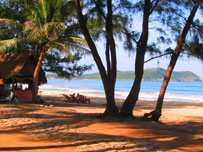
Since the beginning of this year, an estimated 30,000 Chinese tourists have visited Hanlong Bay, marking an increase of 25 percent against the same period last year.

Currently, around 400 to 500 Chinese tourists arrive in Vietnam via the Mong Cai Border Gate each day. During the recent Lunar New Year (Tet) Holiday 2009, nearly 1,000-1,500 Chinese tourists were visiting Vietnam every day.

Chinese tourists visiting Quang Ninh Province via other border gates have now reached an estimated 7,000 people. This comes as Chinese interest in traveling to Vietnam during Vietnam’s tradtional Tet Holiday increases.

Before, and after Tet, all hotels in Halong were filled to capacity. Large crowds of Chinese tourists stayed overnight in Halong, but they mainly slept in two to three-star hotels at costs of around RMB 8,00-1,000 per person.

In Lang Son Province, Chinese tourists also queued up to enter Vietnam. Deputy Head of the Huu Nghi Customs Deparment Nguyen Bao Ngoc said that the number of Chinese tourists entering to Vietnam during the Tet Holiday number several thousand. At the Tan Thanh Border Gate in Lang Son, many Chinese tourists said that they were coming to Vietnam to visit relatives and do businesses now that China had officially opened the border gate and relaxed restrictions.

In Lao Cai, statistics showed that nearly 10,000 Chinese tourists entered Vietnam via the Ha Khau Border Gate during the Tet Holiday until February 1st. This was the largest-ever number of Chinese tourists to pass through Lao Cai in only a few days, marking an increase of 30 percent against the same period last year.

Director of the Binh Minh International Travel Center Le Anh Dai said that because Chinese people were taking a longer vacation during the Lunar New Year, and had a custom to travel to the South in the Year of Buffalo, they chose Vietnam as an ideal destination. Moreover, a five package tour to Vietnam only costs around RMB 7,000 per person.

Sa Huynh, a pristine wonderland

Posted by huongpr2389 on May 18, 2009 under Vietnam Culture | 2 Comments to Read

Sa Huynh is an area dotted with quaint fishing villages and sandy beaches in the central region’s Quang Ngai Province.Located off National Highway 1A, along milestones 983-987 on the coast of Duc Pho District and parallel to the national railway line, Sa Huynh abounds with golden sand.

The color of the sand changes during the day from an earthy brown early in the morning, to a shimmering gold around noon, followed by a pale blue hue on moonlit nights.

Sa Huynh is rich in local seafood and there are several restaurants offering up fresh meals from the sea.

The area is also steeped in ancient culture dating back to 1,000 BC. The Sa Huynh people are thought to be predecessors of the Cham, the founders of the Champa Kingdom.

Along with the Dong Son Culture in the north and the Oc Eo Culture in the Mekong Delta, Sa Huynh is considered one of the most famous ancient Vietnamese cultures of the Iron Age era.

Along the beach, stretching around 6km, and near the Sa Huynh Tourist Resort is an abundance of scenic highlights.

Visitors can rent motorbikes and travel around Ma Vuong Mound to see historic archeological sites.

In the culture of the ancient Sa Huynh people, the dead were cremated and buried in jars. In the early 20th century, French archeologists excavated these ‘tomb jars’ and found many were also buried with stone adornments and tools.

At Sa Huynh Hotel, about one kilometer south of the Sa Huynh Railway Station, visitors can enjoy the view of the vast blue sea, rest in the shade of green casuarinas, feel the cool breeze on their skin, swim in the sea by a sloping beach, and enjoy food specialties such as boiled crabs with salt and chili, rice porridge with sea urchins, and sour soup with groupers.

When visiting Sa Huynh, be sure to purchase a few kilos of nep ngu (a type of glutinous rice once offered to kings) and fermented urchin paste, which is only available in the summer.

OocOmBok Festival

Posted by vietnamtravelblog on August 18, 2008 under Vietnam Culture, Vietnam Festivals | Read the First Comment

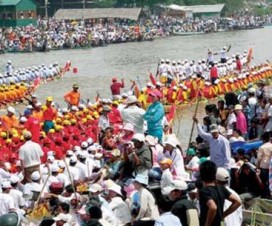
Ooc-Om-Bok Festival is a religious service that worships the moon deity of the Khmer minority group and prays for good luck, happiness, good weather and bumper crops. The festival is usually held when the dry season begins and rice are ripening on the fields.
The Moon-worshipping ceremony takes place on the evening of 14th of tenth lunar month before the moon goes to the top. The ceremony is held in the yards of the pagoda or of residents’ houses. People erect bamboo poles with a crossbar on which they decorate with flowers and leaves. Below is a table of offerings that include green rice flakes, potatoes, bananas, coconuts, grapefruits, oranges and cakes. People sit on the ground with crossed legs, clasping their hands before the altar and look up the Moon. An old master of ceremonies says his prayers, asks the moon deity to receive the offerings and bless people with the best.
After the ceremony, the elders ask the children of the house sit flatly on the ground with crossed legs before the altar. The elders then take a handful of green rice, feed each child and ask them what they wish while clapping their backs. If the children answer the question clearly and politely, all the best will come to them that year. After that, people enjoy the offerings together, and children play games or dance and sing in the moonlight. Anyone who visits the Khmer’s houses on this occasion will be tasted com dep (a kind of young sticky rice). At the pagodas of Khmer people, locals hold paper-lantern releasing into the sky and putting on the rivers. The custom of releasing flying lights and floating lights is believed to sweep away the darkness, impure and sadness from the village. Many traditional activities of the Khmer are organized on the evening of 14th.

Vietnamese Water Puppet (Mua Roi Nuoc)

Posted by vietnamtravelblog on August 17, 2008 under Vietnam Culture | Read the First Comment

If you are ever in Hanoi it will be regretful to miss the Water Puppet Theater – even if you think you are not a puppet kind of person. Water Puppets literally means “puppets that dance on the water”. This show is not just geared for kids, but meant to delight adults as well.

Water puppet

History:

Vietnamese Water Puppet originated from the Red River Delta of Vietnam in the tenth century. Some of the earliest troupes are in Nguyên Xá commune, Đông Hưng district, Thai Binh province. Water puppetry is deeply imbued with the cultural characteristics of the people of this area. This unique art first appeared around the 15th century, when post-harvest, artists who were also farmers would gather to perform and relax. The custom remains today in many localities in the Red River Delta such as Dao Thuc, Phu Da, Dong Ca, Nguyen Xa, Dong Ngu, Nhan Hoa and Nam Chan.

In ancient Vietnam, the rural Vietnamese believed that spirits controlled all aspects of their life, from the kitchen to the rice paddies. That is the reason why the farmers in this region devised a form of entertainment and worship to satisfy these spirits. Water puppetry is the lively creation of farmers who spent their days in flooded rice fields. At some point, they discovered that the water was an excellent medium for puppetry: it not only concealed the puppeteers’ rod and string mechanisms, but it also provided exciting effects like waves and splashes.

When water puppetry became more popular, villages competed against each other with their puppet shows. This led puppet societies to be secretive and exclusive, including an initiation ceremony that involved drinking rooster blood.

So far this art form has been unique to North Vietnam. Tourists can enjoy this kind of art all days in a week at Thang Long Puppet Theatre, which is the most well known one in Ha Noi.

Performance

For over a thousand years, performers in Vietnamese Water Puppet Theater’s feet have always suffered in cold and wet condition. Water puppetry is performed in a chest-deep pool of water, with the water’s surface as a stage. The puppeteers stand behind a screen and control the puppets using long bamboo rods and string mechanism hidden beneath the water surface.

The puppet is carved out of wood and often weighs up to 15 kg. A large rod supports the puppet under the water and is used by the puppeteers to control them. The appearance is of the puppets moving over the water. The puppets enter from either side of the stage, or emerge from the murky depths of the water. In the past when the rice fields were flooded the villagers would entertain each other using this puppet form.

A traditional Vietnamese orchestra provides background music accompaniment. Singers of Cheo (a form of opera) with origin in North Vietnam sing the songs which tell the story being acted out by the puppets. Performances of up to 18 short scenes are usually introduced by a pig-tailed bumpkin known as Teu, and accompanied by a small folk orchestra. The musicians and the puppets interact during performance; the musicians may yell a word of warning to a puppet in danger or a word of encouragement to a puppet in need.

Along with singing the atmosphere, while the decorations set the stage for each particula, traditional musical instruments like drums, wooden bells, cymbals, horns, two-string Chinese violins and flutes create r style of water puppetry. Researcher Nguyen Huy Hong believes that water puppetry combines sculpture, architecture, painting, music, stage and literature.

Content

The theme of the skits is rural and has a strong reference to Vietnamese folklore. It tells of day-to-day living in rural Vietnam and Vietnamese folk tales that are told older generation to younger generation. Of which stories of the harvest, of fishing and of festivals are highlighted.

The water also provides the best setting for the puppeteers’ theme: day-to-day village life. Water puppets bring wry humor to scenes of farming, fishing, festival events such as buffalo fights, and children’s games of marbles and coin-toss. Fishing turns into a game of wits between the fisherman and his prey, with the fisherman getting the short end (often capturing his surprised neighbor by mistake). Besides village life, scenes include legends and national history. Lion dogs romp like puppies while dragons exhale smoke and shoot sprays of water at the audience. Teu, a pig-tailed bumpkin, is the character who usually plays the role of introducing the performances. The introduction is always accompanied by a small folk orchestra. Spotlights and colorful flags adorn the stage and create a festive atmosphere.

Legends and national history are also told through short skits. Many of the skits, especially those involving the tales of day-to-day living, often have a humorous twist.

Water puppetry has always gone hand in hand with festivals. Each Lunar March 13, Bo Duong villagers hold village festival to commemorate their tutelary god. Aside from worship, the festival is also an opportunity for villagers to relax by watching water puppetry, taking in fireworks displays, flying kites and entering cock-fighting contests. The festival always attracts thousands of attendants. Village festivals are great wind down for farmers and artists alike.

By Le Trang from Vietnam-beauty.com