Travel Sapa Vietnam – A verdant rooftop

Posted by admin on December 11, 2010 under Vietnam Travel Info, Vietnam Travel Stories, Vietnam attractions | Be the First to Comment

My friend said that it would be a pity if you travelled to the northwest mountains of Vietnam without stopping off at Sin Ho market. I didn’t give his claim much credence at first, until I stepped foot into the market—known as Cho huyen Sin Ho, and open every Sunday.

Ethnic market in the North of Vietnam

Situated imposingly on the Sin Ho plateau of Lai Chau province, Sin Ho town is located on the highest peak, over 2,000 metres higher than sea level and surrounded by verdant mountain ranges and clouds.
Locals call it: The Roof of Lai Chau province. The small town is also well-known as the second Sapa of the northwest area. But the climate in Sin Ho is even more sour and scornful than that of Sapa. Suddenly, you can be standing in a sea of white clouds, then, just several minutes later, the rain will rumble down like a waterfall. But right after the last rain drop falls, the sun will rise brilliantly and a cool wind will blow over the small town.
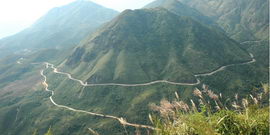
It takes me four hours to drive up the zigzagging road from Phong Tho town, at the junction between National Road No. 4D from Sapa and National Road No.12 towards Muong Lay town. The mountain road has been smoothly paved over, but it’s still a slow and winding drive. Consequently, I choose to spend a night at Sin Ho town and wait for the market until the next morning.

In the late afternoon, Sin Ho town looks small, deserted and gloomy, with unadorned and sparse wooden houses roofed with dark grey cement tiles and only a few shops and restaurants. It’s lucky that there are several modern guesthouses and mini hotels with reasonable prices. For only VND250, 000 per twin room, I check into the Thanh Binh guesthouse. It’s not an overstatement to say that at such a cost, this is the best hotel outside of Sapa in the northwestern area. It has spacious rooms, excellent facilities and a friendly personnel.

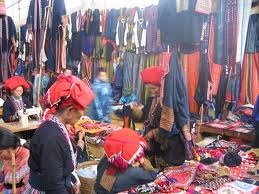
On Sunday morning, the sleepy town comes alive. From all paths up and down leading to the town centre, waves of tribes people walk or ride horses and motorbikes, all loaded with many kinds of farm products, toward the market. These tribes come from many unsociable villages up and down the mountains. They are Flower Hmong, Blue Hmong, Black Hmong, Lu, Black Dao and Red Dao, amongst others.

After a morning at the market, I take a trekking tour to Pha Xo Lin II village, just three kilometres from the town centre. The village is home to the Dao Khau tribe, also known as the Sewing Dao, or the Black Dao, who wear black trousers richly embroidered with signature flower, tree and star patterns seen on many Dao costumes. They also wear a front hanging black apron with a wide, plain blue band around its outside, together with a plain black turban.

The village is very gorgeous and poetic, with dark wooden houses roofed with black marble tiles and fenced in with marble hedges. This season, the peach and mango orchards are ripening in a riot of red and yellow. It’s mouthwatering to walk in the village, where you can take a seat under the fruit trees to delight in lovely lanterns swinging in the cool winds and their fresh and sweet tastes. Pha Xo Lin village is very well-known for its special golden red mangoes, with their sweet taste and jackfruit-like flavour.

Besides its tasty fruits, Pha Xo Lin village is a shopping paradise of brocades and embroidery products. It’s common to see Dao women sitting at their thresholds in their front yards or under the fruit trees sewing passionately. While you’re there, don’t miss out on buying some clothes, scarves or other decorous things from the tribes people. Their products are very refined and gorgeous, as befitting of their name—the Sewing Dao tribe.

Source: Timeout

Elegantly missing the point

Posted by admin on November 22, 2010 under Vietnam Travel Stories, Vietnam hotels | Read the First Comment

October’s events pushed Hanoi hotels to the forefront of Vietnam’s tourism industry and David Cornish tells you if one of them, the Elegance 5, made the cut.

Hotels, particularly of the boutique variety, have been blossoming around the city in recent years. While larger, international chains have a presence, Hanoi’s pride in this industry probably exists in the boutique market. As upper-end tourists begin traveling Southeast Asia more and more, they learn to expect quite a big bang for their buck.

One of the Hotels that has prospered recently, opening their sixth in the city, is the Hanoi Elegance Hotel group. In question for this review is their fifth location, aptly named Hanoi Elegance 5.

Admittedly, the hotel lives up to its name upon first impressions. Three friends, visiting from the U.S. were all pleasantly surprised at the quality upon check-in. The room actually looked identical to that advertised on the website, not always a given from previous experience in the city. The hotel had provided airport pick-up service putting my guests and myself at ease. The staff is remarkably friendly and really go out of their way for the customers. They take the time to learn each guests name and greet them using it whether coming or going. They even learned mine as I became a regular in the lobby while waiting to meet my visitors.

Does the elegance live up to its name?

The good:

First of all, the hotel is conveniently located and has some of the best customer service I’ve seen in Hanoi. Much more than I would expect, or at least that was my initial impression. The rooms are excellent, particularly the larger ones. They even provide a lap top for guests to use the internet free of charge. Cleanliness is astounding and fresh fruit is brought to the room daily. “I think they went completely out of their way for us,” shared one of my friends.

The staff taking the time to know each guest makes it feel cozy. They are very conversational and even sent people out on the streets to show my visitors where to go when they were looking for something. However, it can be a little overbearing at times. While walking, my three friends stumbled upon the Elegance 6, the newest of the Elegance hotels in Hanoi. They went inside to have a look, and the staff at this hotel knew all of their names as well. This seemed a bit strange and one friend asked, “What is this a spy movie? Did they hand out our pictures and info to all of their hotels around the city?”

Food at the hotel is fairly good. The breakfast (included with the room) is excellent. Not your standard “continental” breakfast but a real, hearty and filling breakfast with options of pho, eggs, cereals and more. The dinner food is a bit pricey and not authentic as far as their Vietnamese cuisine is concerned.

Perhaps one of the nicest features of the Elegance 5 is its rooftop bar. Situated on the 12th floor and overlooking Hoan Kiem Lake, the 360 degree views are amazing and by far the best I’ve seen in Hanoi. It is high enough to muffle the sounds and catch a refreshing breeze while relaxing for a drink. The drinks are, as expected, a bit more expensive than usual (3 dollars for Heineken, 5 dollars for whiskey, and a range for cocktails) but it is certainly worth it to soak in the views. They have a happy hour but it can be a bit confusing and it seems they forget to mention it to most who are on the rooftop when it’s happening. They are determined to bring all of the drinks at the same time so sometimes receiving your order can be a bit delayed. We waited more than 10 minutes for 3 beers once and we were the only customers in the bar.

The bad:

As my friends prepared to leave after spending ten days at the hotel, they checked out. They’d spent well over a thousand dollars on the room and their bill for food, drinks, etc. was about 1,000 dollars. Because of a late flight, they paid for the room an extra day so they could relax until they departed at 9pm, but the room was paid for until check out the next morning. They also chose to pay for the room the night they didn’t use it when I took them to Halong Bay so that they could store their things. Since the room had already been paid for, my friends kindly invited me to relax and enjoy the room for the night and explained to management that I’d be staying there. The staff kindly agreed and assured us that it was no problem. I said goodbye to my friends who had traveled very far to see me, they paid their bill, we gave each other hugs in the lobby and the time came for them to go, shuttle to the airport thanks to the hotel (and 15 dollars).

When I walked back into the hotel, the friendly greetings seemed nervous and quiet. I noticed, my bag, which had been put in the room, was now sitting by the front desk. I explained to the staff what they already knew, that I’d be staying.

“Excuse me sir. Yes. I need your understanding,” came a voice from behind the desk.

He explained that in fact, he had sold the room although my friends had just, minutes before, paid for it through the morning. Sure, I used to work in the hotel business, I know how it goes, plus, I live here and I’m not a tourist so I have a place to sleep. I explained to him that it was fine, he could just let me have the room some other night when they weren’t busy.

“I need your understanding,” was the only response. After explaining to the sales manager (the hotel manager unfortunately wasn’t there) that my friends had indeed paid for two nights in which they didn’t use the room and that they had just spent well over 2,000 dollars, that he can’t just expect me to understand. He kept quiet when my friends were checking out but knew he had indeed already sold the room. Again, “I need your understanding.”

The man began raising his voice as if I had done something wrong. This really bothered me after the amount of time and money that had just been spent but even worse, it made all the excellent customer service before it seem like it had been flushed down the toilet. After I told him to calm down and that it was his mistake, he offered me a free breakfast. I politely declined. It was the lack of foresight that baffled me. I wasn’t worried about the room, but surely, for a business eying longevity, you offer some form of compensation. Needless to say, if it weren’t for this totally irrational thinking, mismanagement and unprofessional handling of the situation, I’d probably suggest the hotel to others. However, they knew very well that I lived here, worked here, and in the long term, had they taken care of me, they would have had a plethora of potential guests staying at the hotel.

The conclusion:

I hate to let one bad situation ruin all the good, but in this business that’s the way it goes. To me, the service ended when the bill was paid. When I informed my friends, they were furious. They too, have nothing but good things to say about the quality but when they return, they won’t be staying there again.

The Elegance is a splendid hotel, but in the end, they elegantly missed the point.

Vietnam – Tell me what YOU want to know

Posted by admin on October 24, 2010 under Vietnam Travel Stories, Vietnam beauty, Vietnam tours | Be the First to Comment

When Monsieur and I travelled through Vietnam some time back, this fascinating country and its people had such a profound effect on me that I haven’t yet blogged about it. Every time I think of our journey, my mind fills with such a kaleidoscope of vistas and tastes and people and experiences that it overwhelms. But now, sixteen months later, I’m going to try to share our experiences.

To start with, here’s a synopsis of how we did it. We didn’t see everything that we wanted to see, because Vietnam is a big place with troublesome roads and slow trains and we only had two weeks within which to learn how to cross the roads and explore as much of the country as possible. The upshot of that is that there’s plenty to keep us busy when we go back one day. And we will go back one day. If I could wangle it, I’d go back right this minute.

GETTING THERE AND BACK:

Monsieur and I flew on Eva Air from London to Bangkok because direct flights from London to Vietnam are exorbitant and this way we’d both save money and see a little bit of Thailand. It’s significantly cheaper for UK residents to fly to Bangkok and then hop across to Vietnam on one of the region’s low cost airlines. In our case we flew Air Asia from Bangkok to Hanoi, and from Ho Chi Minh City back to Bangkok. Air Asia is cheap and efficient, but the baggage allowance is a meagre 15 kilos. Going out, this wasn’t a problem and my packed suitcase only weighed 10 kilos, which is somewhat of an achievement for this girl scout who likes to be prepared for all eventualities. Quite naturally, as we travelled about, Monsieur and I picked up more baggage weight in the form of clothes and gifts for family and friends, so that by the time we left Vietnam, our baggage excess was such that we had to pay a hefty $125 US dollars. The way we looked at it this was that once added to the cost of the flights themselves it just made the flights feel more regular in price as opposed to a real bargain. You have been warned.

Internally we flew Vietnam Airlines, which we found to be pretty good. We later found out that they have a terrible reputation but that wasn’t our experience at all. Had we had more time, we would have liked to try the train that travels up and down Vietnam, but unfortunately the journey times were too long to be practical for us.

So here’s what we got up to. It would be great if you pick out something that you’d like to hear about, leave it in the comments and I’ll write it up for you.

THE ITINERARY

Day 1 – Arrive in Bangkok. Stay at the Mandarin Oriental Hotel. Swim off the travel grime and enjoy lovely buffet at the hotel.

Day 2 – Breakfast by the river. Hire a driver to take us around Bangkok for 5 hours for the equivalent of a 15 minute cab ride in London. We manage to take in the Golden Buddha, the Grand Palace and a vibrant weekend market before returning to the hotel. Cocktails at the Sirocco Bar with fantastic views over Bangkok and dinner at the Blue Elephant.

Day 3 – Fly to Hanoi. Have fun with immigration officials and ATMs at Hanoi airport. Stay at the beautiful Sofitel Metropole Hotel. Learn to cross streets without being mown down by a tidal wave of mopeds. Walk to old town via Hoan Kiem Lake. Visit Ngoc Son temple. Circle the lake. Dinner at the Spices Garden restaurant at the hotel.

Day 4 – Take tour to Halong Bay. Long day. Epic ingests an entire dish of MSG. By herself. And suffers the consequences.

Day 5 – Walk around Hanoi. Visit Temple of Literature, Hanoi Hilton. Just about evaporate in the heat and humidity.

Day 6 – Fly to Danang. Pass China Beach on way to Hoi An. Stay at Ha An Hotel. Lunch at Banana Leaf. Do walking tour of Old Town – temples, Japanese Bridge, a ‘real’ Vietnamese home etc. Visit Yaly tailors. Dinner at Mango Rooms.

Day 7 – Fitting at Yaly then a lazy day at nearby Cua Dai Beach. Lunch at the beach. Dinner at Brothers Café.

Day 8 – Fly to Nha Trang. Stay at Six Senses resort. Laze around at the beach and in the pool. Dinner and DVDs in our room. We need to slow down for a couple of days, and so we do just that.

Day 9 – All meals taken at the hotel. The much-needed chilling-out period after so much travelling helps a lot so we spend another day at the beach.

Day 10 – Travel by road to Dalat. Looks close on map. Takes hours each way. Visit our driver’s family shrine, rest stop in village, see Dalat train station, Prenn Falls. See coffee/ tapioca/sugar cane plantations. Afternoon at Dalat Palace Golf Club. Interesting drive back to Nha Trang with our fascinating driver. Much of our conversation is taken up by what Vietnamese eat, which is just about everything.

Day 11 – Another day chilling out. Vietnamese coffee rocks. We watch Vietnamese musicians at dinner. We also have a sunburn relief massage with fresh aloe vera. I’d never had a massage before. What total decadence!

Day 12 – Fly to Ho Chi Minh City. Stay at Majestic Hotel on Dong Khoi. It rains buckets. Visit the post office, haggle with street vendors, give thanks for safe travels at Notre Dame Cathedral. Walk to Reunification Palace. Dinner at M Bar with great views over river. That river is a floating highway, even at night.

Day 13 – take tour out of HCMC. Visit Cu Chi Tunnels and My Tho on the Mekong Delta. Boat ride to Ben Tre for lunch. Coconut candy factory, snakes and longboats. Cao Dai Temple. Lacquerware factory visit. Dinner with Adam from Vietnam Travel Notes – we go to Ben Thanh Market together. REALLY good night!

Day 14 – last day in Vietnam. Shopping in town. Lunch at Lemongrass. Dong Khoi. Back to the airport. Long delay because of riots in Bangkok. Stay at The Peninsula Hotel.

Day 15 – Fly home with a head full of wonderful, colourful memories of Vietnam.

+16 months – Epic finally gets around to blogging about it.

(Source: epicurienne.wordpress.com)

Saigon and on and on

Posted by vietnamtravelblog on August 19, 2010 under Vietnam Destinations, Vietnam Travel Stories | 3 Comments to Read

After 6 months back in the UK, it was time to return to Saigon. It was quite a short time away really, but there are a few subtle differences since I was last here. I was walking from Ben Thanh Market to Sullivans Irish Bar, a route I had taken many times in the past. About halfway there I passed a rather large department store that I did not recognise. Confused, I started to think I had taken the wrong route. There was Parksons and Saigon Tourist as expected, but opposite an entire multi storey building I was sure had not been there before. It was as if the store had sprung up seemingly overnight. I carried on along the road and arrived at my destination. A few days later I was walking from Sullivans to Diamond Plaza. I got to the ‘new building’ and noticed Notre Dame Cathedral in the distance so decided to take this short cut. As I continued along the road I started to recognise other landmarks and it slowly dawned on me that the road I was taking, the road that I thought was a different route was in fact the same route I had always taken. I realised that the building that had appeared had previously been hidden behind advertising boards. Six months is a short time to be away, but for Saigon it might as well have been a lifetime.

Although I have written about some of my time in Saigon in earlier blogs, I thought it was time to talk a little more about this energetic city. Although I travel around as much of Asia and specifically Vietnam as I can, Saigon is my base; spending most of my time working there. To the newcomer it can be overwhelming, but once you get used to the eccentricities you soon settle in. The traffic is just to be expected, the scams can be avoided. What you have to remember is, people are doing what they have to in order to survive. It is still only a small percentage of the population that have good jobs, and despite being a communist government in name there are few state jobs and so it is left to the people to do what they can. Be it selling food, polishing shoes, repairing bikes on a street corner or unfortunately selling themselves there is a genuine feeling of ‘whatever it takes’.

Even if they have a low end job, it does not necessarily mean they are safe. With few government sanctions or health and safety standards, many people are performing dangerous jobs with equipment that is not suitable for the task. Again, this is just what they have to do to get by.

Saigon is still one of my favourite cities in Vietnam. It is the commercial heart of the nation and it is the ‘big city’ that draws the youth that Hanoi fails to be. Although much of the city is new, having been hit hard during the war, there is still a lot to see and do. So, rather than concentrate on the generalities of the City or the various highs and lows that have been documented elsewhere, I will talk about some of my favourite sights. It is the energy of the city that should inspire a visit, just walking around the city is an amazing experience. Once you have arrived and settled in though there is a lot to see and do.

Most city tours will include Notre Dame Cathedral, Reunification Palace and Ben Thanh Market; these are probably the three main attractions and if you only have a day in Saigon these are the must see places.

Notre Dame Cathedral sits in the centre of the Government sector. Nearby there are foreign consulates and Vietnamese government buildings. The cathedral itself is inspired by French architecture and is used for Catholic services for both foreign a local worshippers. Across the road from the Cathedral is the Central Post Office. Again this building is of French design. The highlight is very much on the inside with the high ceiling and traditional wooden booths.

Reunification Palace is not far from Notre Dame Cathedral. This strikingly modern (well 1970’s modern) building has gone under several names and duties over the years depending on what is happening in the country at that time. Most recently it was the home of the Southern Vietnamese government and it was here on 30th April 1975 that the South surrendered to the North as a tank came crashing through the main gate. The building now serves as a time capsule to that era and is an important place to visit on Reunification Day. Tours are held through the building and the war bunkers beneath it. It is an interesting walk through the past.

Ben Thanh Market is one of the most famous landmarks in Saigon. Crammed full of stalls you can by almost anything within these walls. It can be a daunting experience walking through though as you a pushed and pulled, being offered anything from knock off clothes to traditional Vietnamese items. Personally, I walked in one door and straight back out the other side without stopping.

There are several museums that I must also mention, and if you are staying for longer you should really check them out as well. All are easily walkable if you are staying in District 1 and all have very reasonable entry fees (15000VND is about the normal price for any museum in Vietnam; equivalent to about 50 pence).

The War Remnants Museum is a shocking reminder of the atrocities of war. The forecourt is filled with helicopters, aircraft and other battle hardware but as you get closer you realise this is not a traditional war museum, it is about the horror of war. A replica of a POW prison drives home the brutality, made even worse by the fact it was run by the US and the inhumanity was perpetrated by them. The main museum is mainly propaganda and photos from the war. I found it very hard to stomach, the only time I had felt this sickened was in Hiroshima.

The Museum of Ho Chi Minh City is housed in a neo-classical building. There are some examples of the successes of the Country, the space program for example, but mostly the museum is about the rise of Communism. As with all things in Vietnam, it is propaganda based and written by the Government. It is an interesting visit though.

The History Museum is at the entrance to the Zoo and is a journey from the Bronze age to modern day. The history of the Vietnamese civilisation is well presented, following the traditions, art and religions of the various ethnic groups that have combined over the centuries. There is also an opportunity to see a Water Puppet show, which is quite a fun introduction to this art.

And that pretty much covers that. There are plenty of things to do in Saigon, just give it a try and walk around.

http://www.travelblog.org

Enjoying Life on the Streets of Vietnam – Fresh Bia Hoi and Smoking with Locals

Posted by vietnamtravelblog on August 15, 2010 under Food and Drinks, Vietnam Travel Stories | 2 Comments to Read

Ah Bia Hoi. No trip to Northern Vietnam is complete without at least a couple glasses of the stuff. Forget Saigon, 333, or any of the other local beers. Look instead for a small, street-side shop selling locally brewed versions of this light drink.

Bia Hoi means simply “fresh beer”. It’s unpasteurized beer made daily in Hanoi. It’s incredibly light for a beer, usually clocking in somewhere around 3%… compared to a Trappist Belgian it’s downright wimpy…. but out in the humid, congested streets of Hanoi a 3% beer seems just right.

And it’s cheap. Man is it cheap. Locals drink the stuff at some crazy low rate… around 1,500 Dong or maybe as high as 2,000. I think we were gouged with a foreigner tax and forced to pay around 3,000 Dong a glass. That’s right… less than 0.20 cents USD!

On our last trip to Hanoi, we all headed over for some Bia Hoi after our filling local Vietnamese meal. Each of us had about 4 glasses of the stuff (7 of us drinking as one in the group was pregnant) and our resident eggs benedict expert from the brunch group, Joe, fell in love with the glasses (the Bia Hoi was served to us in these interesting bubble glasses)  bought a set of 8 glasses to take home…. I think all in all even with the purchased glasses we didn’t spend more than 8 USD.

We were at a local place for sure. The chairs and table were plastic and maybe 7 inches off the street. My chair nearly buckled as I sat down, obviously unaccustomed to such large passengers. Once seated near the locals though things slowed down. The busy streets seemed to make a bit more sense. Everyone was smiling at each other and moving at their own pace. The shop owners seemed happy we had chosen to join their little local watering hole and brought us snacks of boiled peanuts (nastier than they may sound). We politely choked them down and then immediately rinsed our mouth with another swig of Bia Hoi… maybe this was their cunning plan all along :)

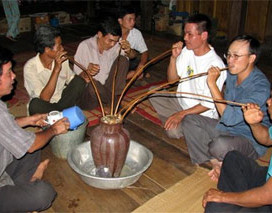
After my second or third Bia Hoi I noticed some locals smoking from a long wooden pipe. During our trip, I’d seen many Vietnamese workers tucked into alleyways and side streets smoking from something similar. I don’t know why I decided I had to try it, but I did… Before I knew what I was doing I was up, extra Bia Hoi in hand, and using my best charade skills to try and trade a Bia Hoi for a turn at the wooden pipe.

Turns out, Bia Hoi is a good currency for the street… that or the locals just wanted to see a foreigner cough his lungs up… which is exactly what happened. The trade was approved and I was loaded a fresh bowl of some reddish, earthy tobacco. It was definitely some form of tobacco, but had a unique flavor from anything I’ve smoked previously. The wooden pipe offers no filtration and serves basically as staging ground for a foot and a half column of smoke. My years of study in college hadn’t prepared me for this. Soon I was coughing my lungs up on the sidewalk like a home schooled freshman. Thankfully Lyan had borrowed my camera and documented the whole ordeal so I can relive it.

I sat with the guys for a bit, sharing Bia Hoi and the wooden pipe. The four Bia Hois and coughing fit had combined to give me a pleasantly light buzz. If only the Banh Mi place had been nearby it would have been perfection. That afternoon was one of the rare (these days when everything is so commercialized and packaged) travel experiences that somehow goes past tourist traps and guidebook recommendations and actually becomes a real moment of sharing culture and experience.

Normally we’d recommend a place and give you an address, but these places are all over Hanoi. Just ask your hotel or a local restaurant where the nearest Bia Hoi can be found. They’ll point you in a direction. Find a place, have a set and start drinking. Say yes to whatever else happens around you and see where things go :)

http://accidentalepicurean.com

Shopping in Hanoi – the Nha Tho Area in the Hoan Kiem Lake District

Posted by vietnamtravelblog on August 14, 2010 under Vietnam Travel Stories, Vietnam Travel Tips | Be the First to Comment

What to buy and where to buy it in Hanoi

I travel a lot and I am tempted by so many stunning Asian goods and textiles. When in a country which has a famous good, e.g. Sri Lanka’s Ceylon Tea, Chinese Silks, Thai teak, etc. it is a wonderful reminder of the trip to bring something home. However, having been in Asia for a while now I believe something must be very special in order to add kilos to my luggage and make it home into my personal collection. With that said I think there are some special shops and items in Hanoi worth checking out.

No doubt you will find the usual collection of Asian silks, fans, statues, fake designer goods, etc. I don’t need to tell you where to find these, vendors for these items are abundantly littered throughout Hanoi.

But what Hanoi uniquely offers, in my opinion, are some items that are hard to find elsewhere and still represent really good value. And a particularly good area to shop for all of these is the Nha Tho area or the Church area in the Hoan Kiem (Lake) District. Here are a few of our favorite things:

Lacquerware
This high gloss style of tableware is synonymous with Vietnam. It was introduced to the world in Paris in the 1930’s by a Vietnamese artist visiting an international trade fair. Since then, the world has fallen in love with the elegance and style of lacquerware. You can certainly find this in China and Thailand, but not with the same level of quality of variety. And personally, I think there is nothing more chic to serve champagne or tapas on that a glossy black and Chinese red lacquerware tray.

To be fair there are many stores for lacquerware in Hanoi. I tend to prefer the simple, traditional styles without a lot of flourish. No painted butterflies or infinity symbols for me….I prefer a wide of expanse of uninterrupted glossy color. And while there are several stores in the Hoan Kiem District, I like MARENA Hanoi, The Art of Lacquerware and Ceramic, located at 28 Nha Chung Street, +84 (0) 4 38285542 . The selection there is well edited and impressive.

Propaganda Posters
There are so many pieces of art, culture and communication left over from the war.  And unlike many other countries who might jettison these materials with a blind future focus, Vietnam has held onto and reproduced many of the stunning examples of art and culture from this period. One of my personal favourite genres is the genre of graphic propaganda posters. These posters were a form of graphic art used to educate and inspire citizen action to align with the political and cultural agenda of the time. They were effective “weapons” to raise morale, change behaviour and direct the efforts of the citizens during the war. Most of the themes during the war center around the people’s battle and production activities.

I have always loved rifling through the posters and reading the sometimes concrete and sometimes abstract slogans such as “Save the country – save the youth” or “Breed more pigs for a Vietnam with full stomachs.” Inspired by some of the more agricultural ones, we bought a series of food posters with a view to hang them in the kitchen – one about pigs, another about vegetable farming and another about coffee production. Again like with the lacquerware there are many stores in Hanoi, but we like The Hanoi Gallery, they have several locations, and we prefer the 17 Nha Chung location, +84 (0) 4 37711956

Cotton and Linen Hand-embroidery
Sure Vietnam is famous for its silks, but did you know they also have wonderful hand embroidered cotton and linen? Since the start of the 20th century, embroidery has been passed on from generation to generation. In Vietnam this exquisite art of supremely detailed hand embroidery is top quality and surprisingly affordable. From elaborately detailed and baroque designs to simple, modern tone-on-tone linens, you can find it all here. And this work is applied on all manner of linen items from lingerie travel bags to duvet covers to dining room place-mats and napkins to pillow cases to shirts.

One of my favorite stores for this is May at 7 Nha Tho Street, +84 (0)4 38289650. I love the assortment of items…all of the best quality…and all beautifully displayed. I struggled to choose between linen napkins and must have pored over the pile for 30 minutes – they were all so beautiful. I was tempted by the duvet covers but Paul thought it would be impractical with our naughty cat who might view it as a new and attractive item to scratch. But I did also walk away with lots of lovely shoe and lingerie bags for travel that I have been giving as (much adored) presents back in Singapore.

While certainly not a complete list, this should get you started on what is special to buy and where to buy it when in Hanoi. Be sure to finish off your day with a walk around Hoan Kiem Lake and drink a Bia Hoi and you have just had a lovely day in Hanoi.

by Joanna 

Wish you were here — Mũi Né sand dunes, Vietnam

Posted by vietnamtravelblog on under Vietnam Beaches, Vietnam Destinations, Vietnam Travel Stories, Vietnam attractions | Be the First to Comment

How you too can go slip-slidin’ away, down a sand dune in Vietnam

Mui Ne, Vietnam
An unlimited sand slide service is available for only VN$20,000-40,000 (roughly US$2-4).

The Mũi Né sand dunes are vast, located only 10-15 minutes from the Mũi Né coastline. Mũi Né is about 200 km from Ho Chi Minh City. It is located on the coast in South Central Vietnam. White sand stretches about 22 km from Phan Thiet (the largest and nearest town in Binh Thuan province) to the fishing village at Mũi Né’s furthest point.

These mountainous peaks of sand often host troupes of little Vietnamese children waiting in droves for tourists to come by. They offer a ’sand slide’ service for those who feel the need for some sandy speed. For a mere VN$20,000-40,000 (roughly US$2-4) they will assist you up the dunes, and will then give you with a plastic board to sit on to slide down again. You can climb and slide as many times as you like and they’ll even give you a helpful push should you need it.

But be warned: these children have a tendency to horde your attention. Once you get off your car or motorbike, they will come rushing at you in waves. So pick one and get slidin’!.

There are three ways to get to Mũi Né: either by renting a car, taking a train, or a bus. The trip can usually be condensed in a three to four-hour drive depending on whether you start traveling from HCMC, or elsewhere in Vietnam.

(Source: http://www.cnngo.com)

Long Weekend in Ho Chi Minh City – a Guide on Where to Eat, Shop, Sleep

Posted by vietnamtravelblog on August 5, 2010 under Food and Drinks, Vietnam Destinations, Vietnam Travel Stories, Vietnam Travel Tips | Be the First to Comment

img_7155Four days in Ho Chi Minh City were spectacular.

Living in Thailand, the thing that always amazes me is how different Vietnam is even though there are so many superficial similarities…Asian culture whose roots are Chinese, developing nation with a high poverty level, similar cultural customs, etc. But where Vietnam separates itself is with the people. This is a place where people have seen war, hunger and extreme communist regimes. This is a country where the work ethic approaches that of New York or Hong Kong and seems to be driven by a real feeling that they can advance and are not limited by their social status at birth. They are grateful for everything they have as they have worked hard to earn it. Ho Chi Minh city, formerly Saigon, is a prime example of this.

As the largest city in Vietnam it is the bustling commercial center for the country. And this is not lost on the Western world – many companies are moving their overseas manufacturing operations out of Thailand and China, not because the cost of operation is tremendously different, but because the commitment to quality and efficiency are vastly superior. Companies like North Face, Patagonia, some of Nike and running their global manufacturing facilities from HCMC.

And beyond the corporate world, there is a inspiring art scene with everything from serious painters to talented fashion designers. It really is unusual to see such original thought in SE Asia. This will sound jaded and no doubt will raise some eyebrows, but the region is not known for original thought….SE Asians are masters of copying and with clear instructions they are wonderful do-ers. But art and culture as we know it (original musicians, galleries with artists, fine arts museums, operas, symphonies) are simply absent in SE Asia. This is generally because of the government and resulting education systems which create followers rather than leaders. Original thought is squelched as that is the stuff of questioning minds and protests. But somehow, despite the current communist regime in Vietnam, there is a thriving art scene in HCMC. And while this certainly exists at a high brow level, it also exists on a more approachable scale – Vietnamese designers trained by french tailors during the colonial times turn out incredibly unique and inspired silk dresses in the most dazzling array of colors and patterns. This is just another example of how the Vietnamese persevere and create their own destinies.

Likely this is resulting from HCMC’s long history. It was actually part of Cambodia until it was annexed by the Vietnamese in the 17Th century. Colonized by the French in the 1800′s, the city became so Western and cosmopolitan that it was known as “Paris in the Orient.” Today, the city is still adorned with wide elegant boulevards , French colonial buildings and lovely little bistros and cafes making breads and pastries in the French tradition.

Au Parc was one such example. Easily the most delightful cafe I have had the pleasure of dining in, in all of SE Asia. A French cafe, it offers the standard fare (omelets, croque monsieur, pates, cheeses, cafe au lait) but also offers French North African fare (hummus, falafel, chicken tajine). What impressed us the most was the quality of the food – the freshest ingredients, prepared absolutely correctly. It was so good, we ate there twice! Sampling once from the French items and the second time from the North African menu. I will say that sometimes one stumbles upon gems in Asia – and typically these gems are qualified by the fact that they are “good” for Asia – meaning….well it is not NYC pizza, but not bad for Bangkok. Au Parc however, would have a welcome home in any major metropolitan city in Asia or the West. It was just that good.

So by day, aside from our visits to Au Parc, we explored the city on foot. It is actually quite small and completely manageable for a weekend trip. In one day we managed to see the Reunification Palace and the War Remnants Museum. Two must sees,for sure. But mainly we took in the city with long walks….popping in a lacquer-ware shop here, stopping for a Vietnamese coffee there. Funnily enough a large part of the one rainy afternoon was spent in Annam Gourmet Store. If you have lived or spent any time in Asia this place will blow your mind – the array of imported foods and wines is simply dazzling. Copolla Cabernet Sauvignon’s for $15, a wide selection of Belgian ales including Duvel and Chimay, organic flours and grains, imported cheeses and pates, imported chocolates and heavenly sweet treats. We emerged with a couple of bottles of Californian wine, organic buckwheat pancake mix and dried cranberries. Yum.

So back to Bangkok we go….with pancake mix, memories of a well spent weekend and a deeper appreciation for Vietnam.

by Joanna on March 17, 2009

http://accidentalepicurean.com

Getting lost in Hanoi's Old Quarter

Posted by vietnamtravelblog on August 3, 2010 under Vietnam Culture, Vietnam Overviews, Vietnam Travel Info, Vietnam Travel Stories, Vietnam Travel Tips | 8 Comments to Read

A CNNGo editor gets intentionally lost with his camera walking in the Old Quarter of Vietnam’s Hanoi.

Vietnam. Hanoi’s Old Quarter. Hectic, noisy, chaotic, adjective, adjective. Describing Hanoi’s oldest district is somewhat of a waste of breath. No need to ramble on about where exactly to go in the Old Quarter either, as the weaving and winding streets are best explored by aimless wandering. No destination. No pre-planned route. Just left, right, or straight ahead.

There is no road “less travelled” in this part of town. They’re all loaded with scooters, cars, bikes and people so the main bit of advice we’d give is to watch your step but be assertive when crossing the road. Don’t second guess your moves, look both ways, and enjoy the fact that yes, you are standing in the middle of the road with dozens of scooters whizzing by on both sides.

Hanoi is hot in the summer time. We’re talking 30 to 35 degrees Celsius at a very, very high humidity, so for a walking tour take lots of water and expect to sweat. The sweating is worth it, as the view of street life you get by covering the district on foot is fantastic. The neighborhood has over 1,000 years of history coursing through its meandering street veins, pumping with life representing both the past and present.

For those able to stand the heat, one full day exploring should do it. For those with less heat tolerance, taking two days at around four hours each day is recommended. Or simply visit during the cooler Fall or Spring months.

Electrical wires string along many streets in hap-hazard fashion. Much of the infrastructure looks like it is being held together by duct tape.

Old buildings line Hang Dao road, just north of Hoan Kiem Lake.

Rush hour in Hanoi’s Old Quarter is an experience. You must be on your toes at all times as the streets fill with scooters, bikes, cars, and people. The rules of the road are “pay attention and whoever flinches first loses the right of way.”

The sidewalks can be just as chaotic as the middle of the street. Locals stake out their spots with small plastic stools and the wares of whatever trade they’re plying. The ever-present scooters are parked at all angles. Small dogs skitter about. People bargain and negotiate for goods and food, and fans sprout from everywhere.


A family sits and chats in the hot Hanoi summer heat in front of their tombstone business.

The Hoan Kiem lake park is a green, shady spot locals like to use to escape Hanoi’s seemingly ever-present frenetic energy. The northern tip of the small lake borders the Old Quarter on Dinh Tien Hoang road.

One of the Old Quarter’s street markets.

A woman relaxes in the market. Expending as little energy as possible is a common strategy for fighting the heat.

Vendors in the market are mainly women.


A woman barbecues on the sidewalk in 32 degree Celsius heat. Hanoi has a rich street food culture, worthy of a book let alone another article.

Crabs and sea snails ready to be bought.

Locals eating a quick noodle meal.

Various animals roam freely in some parts of the Old Quarter. This scrawny little chicken looked too sad for even a bowl of soup.

An old stuffed deer sneering in a rictus death grimace from a shop window. A sight only seen by walking the streets for hours. Similar random sightings can be expected when least expected.

The Old Quarter has many streets dedicated to specific trades. This was the toy street. Others to be found included streets dedicated to shoes, clothing, tombstones, antiques, and scooter repairs.

These tourists opted for a more comfortable whirl around the Old Quarter. Though it is good to be wary as these rides are often overpriced.

(Source: Dtinews)

Cyclists enjoy tranquil rides

Posted by mssarah55 on March 18, 2010 under Vietnam Destinations, Vietnam Travel Info, Vietnam Travel Stories | Be the First to Comment

As eco-tourism gains popularity, more tourists are opting to take bike tours.

by Thanh Ha

A cycling tour in the northern province of Ninh Binh was one of Rett Townsley’s favourite activities while travelling around Viet Nam.

“It was not my first bike tour but I have not ridden a road bike in several years. It was a good tour, even though it was very tiring. It definitely left me with a lot of good memories,” Townsley says.
Townsley is among a small group of tourists who travelled to Ninh Binh’s Hoa Lu District, the nation’s former citadel, which lures millions of local and foreign tourists every year.

A bus leaves Ha Noi early every morning for the two hour journey to the district. Townsley and his partners book rooms at the Xuan Hoa Hotel, which is said to provide the best travel services in the district, such as meals, rooms, bikes and tour guides.

The hotel provides an excellent jumping-off point for tourists to enjoy a visit to the ancient Hoa Lu citadel which was the country’s capital city for the Dinh dynasty (968-980) and the tien Le (Earlier-Le) dynasty (980-1009).

Maps to these destinations are free from the hotel. Townsley and his friends pay VND20,000 (US$1) for their bikes and share the $10 for a tour guide to show them around for a full day.

It takes Townsley and his friends nearly one hour to travel the 12km to the citadel, where they admire the temple of King Dinh Tien Hoang, who developed Hoa Lu as the capital and set up the first centralised feudal State in Viet Nam. They also enjoyed the temple to the first king of the tien Le dynasty, King Le Dai Hanh.

Their next destination is Tam Coc-Bich Dong, also known as Ha Long Bay on land. The area is home to an awesome stretch of giant limestone karsts jutting out of the rice paddies on the banks of a small river. Townsley and his friends leave the bikes aside for a short time to travel by boat through this secluded oasis away from the haze of the big city.

If they have planned for an extra day or two of holiday, the group can sail on to the Trang An Eco-Tourism complex, which is said to host a world of natural and cultural heritage.

With its striking limestone mountains, caves and clear streams, combined with the ruins of the former capital at Hoa Lu, the area annually attracts millions of tourists from across Viet Nam and around the world.

Back on land at Van Lam Wharf, an expanse of art work is waiting for the group. The area is a great place for tourists to explore Viet Nam’s needlework.

Thousands of embroidery and thread work products with many designs in different sizes are so beautiful that most people cannot deny at least one indulgence for themselves or as a gift for a loved one back home.

“I especially enjoyed the part of the ride that took us right up to the limestone mountains,” says Townsley, who also expresses his pleasure with the boat ride and the walk around the Trang An complex.

“However, the most interesting part of the tour is the bike ride itself. Our tour guide, Trung, leads us over the country lanes that link villages, rice fields and homes.

“It was one of the greatest experiences we had on this tour,” says Thanh Hoa, another member of the group.

“I’m a city girl so I have very little idea about rural life. I have been curious about the lives and activities of farmers, but now my mind has been opened quite a lot,” she says.

Despite his poor English, Trung guides people to the most beautiful and special places in the area where they can witness the beauty of the rural scenes or give a hand to local farmers with their work.

Open-minded

“Local people are open-minded. They are happy to let visitors help them cultivate rice seedlings, bail water to the fields or dig a fish breeding pond. You can even take a meal with a family or ask them to teach you how to embroider a simple product in Van Lam Village,” says Trung.

It seems as if the landscape has been untouched by time, and that’s exactly how locals want it to stay. “Although tourism has developed over the past few years, we still want to keep the original features of the region,” he says. As the only foreigner Townsley is the happiest person in the group – many people, including a lot of children, greeted him enthusiastically.

“I think the biggest advantage of the tour is just the fact that you can see so much more when you are on a bike than you would see from a tour bus. Also, bikes don’t cause pollution,” he says. He adds that he thinks the route is a little too long for most tourists. “I think 12km is okay but 20 is a little much.”

He suggests that better quality bikes would make the tour a better experience and that larger groups should come with a support vehicle. But he still intends to recommend the tour to his family and friends when they come to Viet Nam.

“My customers are really interested in this tour because it puts them closer to nature and to the culture, customs and habits of the local people, which are often very different from their own,” says Nguyen Viet Trinh.

“Most of our travellers are currently white-collar workers who don’t generally have time for biking. Bike tours give them chance to discover many new things and recover their health with exercise and fresh air,” Trinh says.

“However, we have only met 85-90 per cent of their demands because of a few customer service problems, including the quality of the bikes and tour guides,” he says. He adds that customer service improvements would increase the number of tourists to Viet Nam. — VNS

www.vietnam-visa.com