Tet In HCM City And Beyond

Posted by admin on January 19, 2011 under Vietnam Festivals, Vietnam Travel Info, Vietnam tours | Be the First to Comment

Tet in HCM City for the New Year of the Cat is going to be bigger and better than ever with lots of entertainment venues and festivals to visit. Local tour companies are offering amazing Tet packages.

The HCM City People’s Committee has announced programs for Tet Festival 2011 in the city’s downtown area, including Nguyen Hue Flower Street 2011, Bánh tét (cylindrical glutinous rice cake) festival, fireworks, the lighting city, snapshots of New Year 2011 and doorshows.

HCM City

The annual seventh Nguyen Hue Flower Street 2011 is themed “New Heights” as HCM City sets its sights on a bigger and better city. Sections of the street will be decorated in different spring themes — Hn Vit (Vietnam’s Soul), Tt phng Nam (Southern Tet), Ni vòng tay ln (Get together), Vn lên tm cao mi (Reach New Heights), Xuân an vui (Happy and Peaceful Spring). Other attractions include a flower arrangement booth, a wishing pond to collect money for charity, coffee stalls, folk music and games.

Nguyen Hue Flower Street extending down Nguyen Hue Boulevard from the City Hall to the river opens from 7 p.m., Jan. 31 till 10 p.m., Feb. 6. It will be closed to traffic for the holiday week. In addition, from 6 p.m. to 11 p.m. on Feb. 6, the nearby Le Loi Street from Ben Thanh Market to the Municipal Theater will be for pedestrians only.
The Bánh tét Festival from Jan. 26 to 31 is being jointly organized by all the city’s 24 districts. Activities will include bánh tét cooking contests and a bánh tét Tet gift drive for poor families. Saigontourist Holding Company, in cooperation with the HCM City Department of Labor, War Invalids and Social Affairs, will give 10,000 bánh tét to disadvantaged children.

The fireworks displays on the Lunar New Year’s Eve (Feb. 2) will take place at seven places around the city while Le Loi, Dong Khoi and Le Duan streets and Chi Lang Park on Dong Khoi Street are decorated with hundreds of lights from Jan. 26 to Feb. 13.

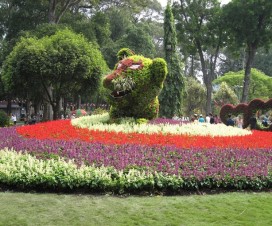
During the last days of the lunar year and the first days of the new lunar year, you can join the Spring Flower Festival at Tao Dan Park and Quoc Te Square, a.k.a. Tortoise Fountain, in the city’s District 1. This year the “Bird Competition” comes back after a long absence.

According to HCM City Greenery and Park Co., the event’s organizer, some highlights of the festival from Jan. 28 to Feb. 8 will be bonsai, flower and fish exhibits by locals and foreigners, an area for souvenirs, games and food at Tao Dan Park. The “Nha Rong – Ho Chi Minh Museum” miniature made from flowers and leaves by a Japanese artisan and orchids from the HCM City Orchid Club. Tortoise Fountain will be turned into a lotus pond with an exhibition titled “HCM City Socio-economic Achievement” and music performances.

Tours around Vietnam

Besides Tet programs in HCM City, tourists can enjoy Tet travel tour promotions around the country.
HCM City-based tour operator Vietravel is introducing the “Spring Travel 2011” program with over 100 tours and lucky prizes till Feb. 28. The spring heritage tour of the North will take you to Hanoi, Halong, Sapa, Trang An, etc. Witness the rich history of the central region by visiting Tet festivals along the Hoai River in Hoi An Town, Danang City, citadels in Hue City and Phong Nha Ke Bang caves in Quang Binh Province. Waterfalls and thousands of flowers are symbols of the Central Highlands while opera songs for Tet are specialties in the Mekong Delta.
Vietravel is holding a Tet lucky draw with prizes including diamond jewelry, vouchers and 20,000 gifts.

Another local travel giant Saigontourist Travel and Service Co. is offering 100 tour packages to enjoy the New Year of the Cat. There are nearly 20 island tours to Con Dao, Phu Quoc, Nha Trang, Phan Thiet and Danang. A world heritage trip in spring, the legendary Central Highlands and spring in villages in the Central Highlands. Saigontourist has also launched special tours for overseas Vietnamese returning for Tet.

Cholontourist Travel and Service Co. this year has tours to highlands and beaches, including adventure tours.

SGT

Traveling through cultural and historical museums in Hanoi
Posted by admin on January 13, 2011 under Vietnam Destinations, Vietnam Travel Info, Vietnam architecture, Vietnam tours | Be the First to Comment

Traveling through cultural and historical museums in HanoiOver 1,000 years of establishment and development, Hanoi has become the national cultural, economic and political center of Vietnam, where most Vietnamese dynasties have left their imprint as well as cultural and historical vestiges still remained at museums in Hanoi.

The system of museums in Hanoi are the richest collection of documents on lands and people of Vietnam in general, Hanoi in particular. They play an important role in preservation and promotion of the local cultural and historical values which serve study tours by school pupils, students or other visitors.

In the system of national museums of the country, Vietnam Museum of Ethnology is both a research centre and a public museum exhibiting the ethnic groups of Vietnam. The mission of the Museum is scientific research, collection, documentation, conservation, exhibition and preserving the cultural and historic patrimony of the nation’s different ethnic groups. The museum also serves to guide research, conservation, and technology that are specific to the work of an ethnographic museum.

Vietnam Fine Arts Museum is considered as one of the most crucial museums in maintaining and promoting the treasure of cultural, artistic heritages of Vietnamese ethnic communities. Visiting the Museum, viewer can understand the entire history of Vietnam fine arts through the collections, exhibits that are displayed here.

Located on the Tong Dan street, the museum of Vietnamese Revolution was established in August 1959 in a two-storey building. It was redesigned into 30 galleries and as of 2008 contains in excess of 40,000 historical exhibits.The visit to Museum would be a time to understand the changing times of the society that ranges from the Vietnamese streets to the seats of power. The objects on display offer insight into the culture of Vietnam.

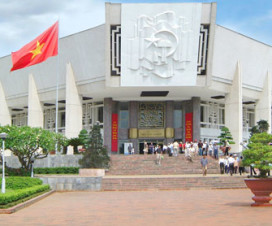
Ho Chi Minh Museum is located in the same compound with the Ho Chi Minh Mausoleum and the Presidential Palace. It was established during 1985 – 1990. It has a collection of 3000 paintings and 700 artifacts. The five-storey building of the museum is divided into thematic units. Next to the museum is Ho Chi Minh mausoleum surrounded by well-kept gardens and guarded by soldiers. The embalmed body of the Vietnamese leader is preserved in a glass sarcophagus.

Recently, the museum of Hanoi was built to celebrate the Thang Long-Hanoi 1,000 year anniversary event. This is a modern architectural structure with the total area 53,000m2 on Pham Hung street. Exhibits will be drawn from a collection of some 17,000 documents and artifacts relating to the history of the ancient capital.

In the process of globalization, museum is considered not only the “linking bridge” of the past, present and future, but also cultural communities. Naturally, the values of culture and history are highlighted the key elements of tourist products to attract visitors.

Museum has enough potentials and advantages of a tourist attraction where can satisfy the cultural and spiritual demands of visitors.

However, to combine tourism and museums, diversifying and improving the quality of tourist products are one of the most important solutions to museum tourism. These include the quantity and quality of the original objects, forms (colour, sound, light… ) on display and tourist services (souvenir shops, restaurants…).

In addition, the content and methods of interpretation significantly contribute to “display language” – the voice of original objects which helps tourists to acquire knowledge about culture and history through objects on display.

Furthermore, the tourist products in museums should avoid the duplication of content and forms on display to fully exploit potentials of museum tourism.

Source: TITC

Collected by Vietnam hotel

Start of year augurs well for tourist trade
Posted by admin on under Vietnam Overviews, Vietnam Travel Info, Vietnam tours | Read the First Comment

The number of International tourists to Vietnam in the first week of this year was up 10 – 20 per cent on the same period last year, according to initial estimates.

Doan Thi Thanh Tra, Saigon-tourist’s marketing manager, said the company welcomed more than 1,500 international tourists during the first week of 2011, the Vietnam Investment Review reports.

Last year, Saigontourist served 320,000 international tourists and gained a turnover of VND1.23 trillion (US$61.5 million), a growth of 18 per cent and 20 per cent, respectively.

On New Year’s Day, the company received dozens of tour groups.

“This was a great start to the year, having many tourists come via air or boat. We expect more for the entire year,” Tra said.

The company is expected to grow by 15-20 per cent this year.

The number of international tourists to Vietnam via another large tour operator, Fiditour, also increased by 15-20 per cent during the first week.

Nguyen Thi Thuyet Mai, Fiditour’s director of Foreign Affairs and Media, said the company would grow by 20-25 per cent this year.

The company expects to serve 15,000 international and domestic tourists during the coming Lunar New Year holiday, up 30 per cent year-on-year.

Nguyen Minh Man, PR manager of Vietravel, said the company welcomed 50 international tourists on New Year’s Day.

The company has targeted 30 per cent growth in the number of tourists this year compared to 2010, Man said.

Vietravel led the tourism sector in turnover last year with VND1.45 trillion ($72.5 million), and expects to earn VND1.8 trillion this year. Tourism activities in other localities have also been flourishing.

For instance, in the first two days of the year, Halong City received 10,000 tourists from vessels, while central Khanh Hoa Province and the historic Hoi an in central Vietnam welcomed 2,000 international tourists.

According to travel companies, regular promotions and advertisements on Vietnam tourism have been the driving force behind the surge in the number of tourists.

The opening of new of international routes, including HCM City-Istanbul on Turkish Airlines on December 30 last year, Taipei-Danang City on Taiwan’s Transasia Airlines in mid-December, and HCM City-Beijing on Vietnam Airlines in mid-December, has also spurred tourist interest. Vietnam Airlines has seven direct flights to China, and it intends to increase the HCM City-Beijing route from three to four flights per week beginning in April.

Beginning November 9, Vietnam Airlines in cooperation with Vietnamtourist (Vitours) in central Danang City launched charter flights for a three-month period from Hong Kong to Danang on Wednesday and Saturday.

The airline began two charter flights per week from Seoul to Danang on January 9.

It expects to open a direct flight from Hanoi and HCM City to London this year.

Tran Chi Cuong, head of the Tourism Division under the Danang Culture, Sports and Tourism Department, said the city would open international flights including Danang-Japan and Danang-Con Minh (China) to attract more international tourists.

Da Nang received 42,000 international tourists by air last year, up 250 per cent year-on-year.

At least 90 per cent of international tourists come to Vietnam by air, said Doan Thi Thanh Tra.

The additional flights this year will increase the number of international tourists to the country, he added.

Source: VNS

Sailing in Vietnam – Where is the wind?
Posted by admin on December 31, 2010 under Vietnam Travel Info, Vietnam tours | Be the First to Comment

By Michael Smith in Mui Ne

A customer sails an RS Feva in front of the Manta Sail Training Center in Mui Ne – Photo: Michael Smith

A kilometer offshore… The fishing port to my left, the flat blue horizon on my right with a couple of fishing boats working their nets within waving distance… I’m heading just to the right of the point at Mui Ne. The sail pulled on tight as the boat beats upwind. My sailing coach and one of his staff are couple of hundred meters ahead in separate dinghies. The Lasers they are sailing are much faster than my RS Feva and they have a lot more experience than me. It’s my first time out in a boat on my own. It’s magic.

I can hear the boat hum when I find the wind and it tilts and picks up speed. I keep my gaze on a fixed point ahead and steer for it. If I take my eyes off it for more than a few seconds I will lose my bearings – the boat will go everywhere – and I could end up in the drink again. A quick look up at the sail, then back at the water churning around the rudder, it’s time for my next tack. I push the tiller slowly across the boat and duck under the sail.

A minute later my boat’s on the edge of the fishing fleet. A brown-faced local sailor in his hammock after lunch opens one eye to watch me go slowly past his anchored wooden boat. I can see my coach, Nick, and his off-sider, Tung, pulling up on a beach just short of the point. Getting there against this wind will be a nice challenge to apply my new knowledge.

Sailing has been a dream for years. So when I found out about Manta Sail Training Center in Mui Ne, I went for it. Living the dream – isn’t that what life’s about.

On my first day, one of the coaches, Nick Newman, sat me down in the club house for a bit of theory with a diagram about beating, running, reaching and some safety stuff. Then showed me how to rig up a boat with one sail and we hit the water. No longer a spectator in the sport, I was straight-away learning hands-on how to set the sail with the mainsheet.

After half an hour of studying the wind and sailing together, he takes his hands completely off the controls when he hands me the tiller and moves to the front of the boat. All of a sudden I have both the sail and the tiller in my hands and we capsize for the first time with about five dunkings to go. I don’t seem to have enough hands. The strong wind lost me, I don’t know where it is coming from, so Nick resumes his place in the stern.

About five more sessions over the next few days with the two Vietnamese assistant coaches and I am ready to go solo. The feelings range from exhilaration when the wind is strong; to a gentle ease and oneness when the boat is steady.

The sailing center only opened in November. A British sailing instructor, Julia Shaw, opened it and equipped it with about 20 boats including RS Fevas and Teras, Laser Radials and Standards, 420s, Flying Fish and Bics. There has been a steady trickle of customers since the boats became available.

One customer, Phil Clandillon, who’d been sailing small dinghies since he was a kid, said he’d searched online in London for sailing in Vietnam before he came, but couldn’t find anything.

“When I found this place it was perfect. Good sheltered conditions, nice new boats, warm water. Couldn’t be better for learning,” said Clandillon who was using an RS Feva to teach his girlfriend, Dulcie, to sail.

The introductory price is US$30 an hour for a boat or US$50 an hour for a boat and coach.

Local tour guides provide an insight into the real Sa Pa
Posted by admin on December 28, 2010 under Vietnam Travel Info, Vietnam tours | Be the First to Comment

VietNamNet Bridge – It’s a strange land that leaves me with different feelings whenever I come to rediscover it.

Steps to heaven: The familiar terraced fields in Sa Pa attract many domestic and foreign visitors. (Photos: VNS)

SaPa is an incredibly picturesque town in the Hoang Lien Son Mountain Range near the Chinese border in northwestern Viet Nam, 350km from Ha Noi.

It can be explored almost year-round from March to early December. Vietnamese most like to visit during June and July to escape the summer heat in other parts of the country. Sa Pa is 1,500m above sea level so the weather is quite mild, and cold at night.

The best time to go to Sa Pa is on a weekday, as weekenders tend to flock here. However, the famed “love market” only takes place on Saturday nights, so visitors often extend their tour to Saturday to experience it.

Tourists can see many hill tribe people, their villages and rice terraces. The ethnic minority groups generally retain their lifestyles and traditional costumes.

The area’s high mountains, deep ravines and lush vegetation rise to the peak of Mt Fansipan – the highest point in Indochina. The combination of fresh mountain air, relaxed ambience, sweeping panoramas and fascinating hill tribes make Sa Pa a must-see destination.

A trek took us deep into a hill tribe region where tourists are still something of a novelty. Staying in village homes allowed us to experience firsthand a lifestyle that has been little touched by the modern world and a curiosity from our hosts just as great as our own. The trekking is fairly strenuous at times but the spectacular scenery and sense of adventure make it worth the effort.

Gracious guides: Many local women work as souvenir sellers and tour guides to lead tourists to discover their hometown’s lifestyle and hidden charm.

I can’t explain why all of the local tour guides are women. All are under 30 and haven’t yet married. Thao Thi Ru, a Dao ethnic woman, has guided tourists since she was 12, after starting her career as a souvenir vendor. Sometimes, to get tourists buy her hand-made souvenirs, she has offered herself as a guide for free. Gradually, she has learned English from them, learned to cook dishes to their tastes, and acquired the experience to become a professional tour guide.

“Being local, we have an advantage over tour companies,” Ru said. “Foreign tourists prefer us to guide them because we know the ways and easily lead them to villages and local houses. They love to understand the local customs as told by locals like us.”

Under Ru’s direction, we visit Ta Van, Ta Phin and Ban Ho communes and get a greater understanding of the Mong and Dao people’s stone-carving, weaving, jewelry-making, metalwork and embroidery crafts.

Ta Phin Cave, at the far end of Ta Phin village, is an attractive destination which tourists often bypass without a local guide’s suggestion.

The cave requires a guide with a flashlight, and the guide will shine the torch on a variety of stalactites.

Some of the locals invite visitors to go to their homes to show how they live and what they have, and tell them about their families. On following them to their houses, tourists find out how simply they live. The tour guides suggest you to buy the merchandise you like from them as repayment for what they have shown for you.

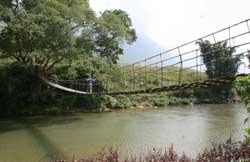
Bridging the divide: A foreign tourist tries to cross the May (Rattan or Cloud) Bridge in Sa Pa, a destination for adventurous tourists.

Local tour guides also lead the trips to the forests and mountains because they know thoroughly the terrain.

Before starting a tour, the guides remind tourists to bring food, shoes, sleeping bags and other necessities, said Giang Thi Co, a Mong woman.

“I have learned from the elders folk medicines to treat stomach aches, muscle pains and snake bite,” Co said. “Once, a Western woman couldn’t walk anymore because her legs were sore, so I picked some leaves to apply to her swollen calves. She felt better and said ‘good, good!’ to me.”

City lovers may find Sa Pa is not the place for them as its rich ethnic lifestyle is far removed from modern life. If you expect to go shopping in malls, Sa Pa has nothing to offer. The only way to go shopping is to go to the local market where you can find unique handicrafts, jewelry and fabrics with colourful embroidery. While tourists don’t know how to bargain or choose the best items, the local guides are ready to help.

Sa Pa is famous for its “love market” where local young people go to show off and find partners. It is held every Saturday night and provides a unique and unforgettable experience.

The love market is a tradition in the culture of the Mong, Tay and Dao. All the people around Sa Pa live in isolated villages and can only get together once a week during the Sunday morning market. The night before, young men and women from all around come to the love market to meet and express their emotions through playing the khen (pan pipe) and singing according to traditional customs of their people.

The experience of Sa Pa trip is not something that everyone can buy, but adventurous people and those who seek to know the hidden charm of Vietnamese hill tribes living in their old traditional mountain villages cannot miss this place.

VietNamNet/Viet Nam News

Ho Chi Minh City needs more rooms for MICE by 2015
Posted by admin on December 27, 2010 under Vietnam Travel Info, Vietnam hotels, Vietnam tours | Be the First to Comment

HCMC, the country’s biggest tourism centre, will need to build around 6,000 three- to five-star hotel rooms by 2015 to meet the rising demand of MICE guests, according to a report.

The city received 2.6 million foreign visitors last year and the figure was earlier forecast to rise to over 2.8 million this year but the actual number might be around 3.1 million.

Given that growth rate, the Hotel Division of the HCMC Department of Culture, Sports and Tourism has forecast growth of international arrivals in 2009-2015 would be 15% per year to reach over 3.9 million visitors by 2015. Around 988,000 of the visitors will come for business purposes.

The hotel division said at a meeting early this week, “The three- to five-star hotel rooms make up around 24% of the total rooms, so they are not enough to serve to big MICE (Meetings, Incentives, Conventions and Exhibitions) groups.”

The city now has 785 hotels with over 24,000 guest rooms, including 68 three- to five-star hotels with nearly 9,300 rooms.

HCMC, according to the division, has around 200 meeting rooms measuring a total of 28,000 square meters. Almost all of the rooms are at the standard hotels, and the rest at convention centres such as White Palace, and Saigon Exhibition And Convention Center.

As for the hotels, the Windsor saigon has the biggest number of meeting rooms, at 22 with a total area of 2,700 square meters, and its grand ballroom can seat 1,200 people.

The Sheraton Saigon Hotel and Towers has 13 meeting rooms covering a combined 1,500 square meters. The seating capacity of its grand ballroom is nearly 1,100 people.

MICE organisers often choose four- to five-star hotels for international conferences but the meeting rooms that meet requirements for such conferences are insufficient to meet the demand.

Rents for the meeting rooms at the five-star hotels vary depending on locations. The 1,000-seat-plus ballroom at the five-star hotels in the downtown area costs US$13,500 per day but the rent is a mere US$3,600 for five-star hotels far from the city centre.

For the same downtown location, the rents may also be different. A five-star hotel may charge a 700-seat meeting room at US$3,000 while another five-star hotel may demand US$6,800 for a 500-seat meeting room.

Source: SaigonTimes Online

New tourist boats for Phong Nha Ke Bang

Posted by admin on December 21, 2010 under Vietnam Travel Info, Vietnam attractions, Vietnam tours | Be the First to Comment

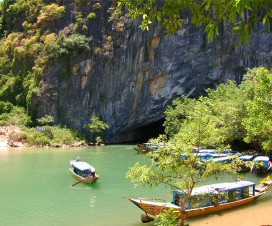
The Phong Nha Ke Bang National Park in the central province of Quang Binh has put into operation two new kinds of boats to provide tourist ser­vices for tourists.

The new boats, part of a project to develop tourism in the sub-Delta River region, will help protect the environment and provide safety for tourists on a tourism route on the Son River.

According to Mr. Le The Luc, the project’s Director, the new boats will help local people develop and protect heritages well.

In the near future, more new boats will be provided to local people to re­place old boats, which were not suitable for carrying tourists.

A Fanciful Ba Na in fog

Posted by admin on December 17, 2010 under Vietnam Destinations, Vietnam attractions, Vietnam beauty, Vietnam tours | Be the First to Comment

Ba Na Da nang city– Chua Mount Tourist Area has been covered by fog, making its natural scene as an aquarelle picture carrying a fanciful mystified beauty.

Ba Na is located in Hoa Vang District, 40km from the centre of Danang City. Nowadays, a modern system of cable cars (instead of climbing by land as previous time) helps the visitors get a bird’s-eye view, very miraculous and attractive while enjoying a feeling of flying in the blue sky amidst the clouds and wind. The 5,042 meter (16,545 ft) cable car ride will take approximately 15 minutes, reaching a vertical rise of 1291.81 meters (4,239 ft) above sea level.

The dynamic investor, the Ba Na Cable Car service joint stock company has spent VND300 billion ($17.2 million, £11.64 million) in the cable car system which is able to transport 1,500 passengers an hour.

Going with the Cable which gains two new Guinness World Records (one for the longest non-stop cable car and one for the highest non-stop cable car); coming to Ba Na – Nui Mount Tourist Area to see the magnic natural scence covered four-ways by cloud.

On 25 March 2009, a Guinness World Record representative will be in Ba Na Hills, in Da Nang City, Vietnam, to present an official certificate to the Ba Na Cable Car Service Joint Stock Company for the great achievement of two new Guinness World Records, one for the longest non-stop cable car and one for the highest non-stop cable car.

Ba Na cable car

Ba Na Cable Car gains two Guiness World Records

Ba Na’s charming landscape viewing from cable Car

Feral nature

The cable car is more higher more fuzzy fog

Loc Uyen Garden

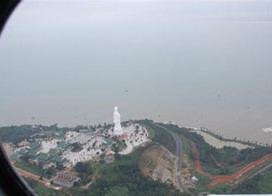
The huge Budhist with 26 metres in height at Ba Na hill

The bridge on Ba Na hill engulfed in fog

Suspension bridge with 1000 meters in height

Travel Vietnam with Backpackers

Posted by admin on December 15, 2010 under Vietnam Travel Info, Vietnam tours | Read the First Comment

The backpacker grapevine, online and word of mouth, lands Vietnam travelers in areas where Westerners congregate such as Ho Chi Minh City (HCM City’s) Pham Ngu Lao area in District 1. One Westerner I spoke to there said he had heard about it by posting a query on the lonelyplanet.com website about where to find the backpacker social life when he traveled to HCM City.

Humble beginnings

In the few years since those first cheap hotels opened, hundreds more guesthouses and cheap hotels  in ho chi minh have started thriving businesses in the few blocks that the area occupies. Many of the properties that do not have rooms for rent operate as restaurants, bars, Vietnam tour operators or shops selling souvenirs, cheap clothing and knock-off CDs – basically anything a backpacker might buy. “Open tour” buses, which allow travelers to hop on and off buses several times with a single ticket, start from here and arrive there, heading for all the country’s top destinations – Nha Trang, Hoian, Hue or Hanoi. Normally these deposit passengers at a commission-paying guesthouse, and budget travelers could face a battle to head elsewhere.

However, the area’s success has caused property prices to rocket, and many guesthouses are now giving themselves a facelift, re-branding themselves as boutique hotels and charging US$50-70 a night, much higher than three to five years ago. But, in general, for the moment at least, there is enough curiosity about Saigon’s backpacker ghetto that it draws curious Vietnamese and Westerners to hang out in its quirky bars and cafes.
Just like the HCM City’s backpacker area, Ta Hien Street in downtown Hanoi is a popular destination of foreign tourists to trade travel stories and drink some of the world’s cheapest beer. On the website of The Lonely Planet, Ta Hien is dubbed as “The first street that backpackers visit when they arrive in Hanoi and the last place they see before they leave.”

The 200-meter-long strip of broken pavement and sullen houses in the heart of the old quarter plays home to hundreds of travel agencies, budget hotels, cheap eats, hawkers and any business that is likely to ply a few dollars from the price-conscientious backpacker.

But the real meet and greet spot of the city is draught beer corner, an intersection that serves up cool pints of odd tasting beer for as little as VND3,000 (16 U.S. cents) a glass. At the intersection of Ta Hien and Luong Ngoc Quyen streets, the four draught beer shops are teaming with groups of backpackers who have settled into Hanoian street life. But when sunset falls, the “international crossroad” starts to come alive. It all starts at about 8 p.m. and goes until midnight. People gather, drink beer, chat and sing.

Backpackerville expands

Besides Saigon and Hanoi, other cities across Vietnam that are making tourism a specialty are watching backpacker areas that spawned a few years ago grow and develop organically.

It is said that visitors cannot claim to have been to Can Tho City in the Mekong Delta region if they have never been to the city’s Ninh Kieu Pier.

The capital of the Mekong Delta and a few hours by bus from Saigon, Can Tho attracts backpackers who want to discover the mystique of the Mekong. Ninh Kieu Pier cannot compare with the backpacker area in HCM City for the dynamism and variety of tourist services. However, its natural scenery far outshines that of city’s area. One of the interesting things is that the pier for the boats is in the middle of the park. The boats take passengers across the river. They also take visitors to orchards on islands a few kilometers from the city, to the tourist attraction of Huong Phu Sa on another island, or to the floating markets of Cai Rang and Phong Dien.

At one end of the park, Can Tho Market bears the signs of increased tourism. The 200-year-old market has been restored to keep the original character. The central part of the market has become a large area where souvenirs are sold. When night falls, the restaurants here are full of foreign visitors. Especially, from 8 p.m. to 10 p.m., the floating restaurant keeps moving slowly along the Can Tho River, so tourists on the restaurant can enjoy looking at the scenery of the mighty river in the dark.

Traveling toward to the central region, when staying in the central coastal city of Nha Trang, budget travelers would do well to visit the “headquarters” of foreigners on Biet Thu Street. With many shops owned by foreigners, visitors there may feel as if they are walking down a street in a modern European city. While the rest of the city sleeps, the party rages all night in the haven. Most of the mini-hotels, shops, restaurants and bars are crowded with large numbers of visitors from Europe, America and other places.

Over the length of its 500 meters, there are over 20 restaurants and bars serving food from Germany, Italy, France, Japan, Korea and others. Shoppers will find a treasure trove of souvenir shops selling locally produced goods and there are plenty of travel agents offering tours and travel services.

Meanwhile, the whole ancient town of Hoi An in Quang Nam Province that is some 500km north of Nha Trang City is seen as the area for backpackers as it is so small that tourists just need to walk about two hours to discover it. The sightseeing places gather in some central streets, especially on Tran Phu Street. Tourists can see many houses built based on Chinese architecture. The night in Hoian is very beautiful, especially the riverside road, where many restaurants have romantic decorations. On the 14th day of the lunar month, people will switch the electricity off and hang decorative multi-colored lanterns.

Traveling some 150km toward the north to visit Hue City, the former capital of Vietnam and now a tourism destination, backpackers can go to the area including Nguyen Tri Phuong and Le Loi streets to feel the social backpacker atmosphere. From the “backpacker/budget traveler” alley with a few hotels and cafes whose prices are listed for foreigners, tourists can easily go to the river, Imperial Palace and Dong Ba Market. Scooters-for-hire are available.

In general, the backpacker areas have greatly contributed to Vietnam travel industry and helped popularize the country’s beauty to the world. Thus, it is necessary for tourism authorities to improve the good things of the areas and set some standards so the backpackers will pass on their recommendation to the next wave of travelers.

(Source: Vietnamtravel.dztime)

Vietnam travel set to hit five million

Posted by admin on under Vietnam Travel Info, Vietnam tours | Be the First to Comment

Vietnam travel is set to welcome a record 5 million international tourists this year after the arrival of 428,300 visitors last month.

General Statistics Office figures put total arrivals to November at 4.6 million, 36.5% higher than for the same 11 months last year. The monthly average was 420,000 visitors, the highest in the last 20 years. The previous record, 4.236 million visitors, was set in 2008.

Tourism industry revenue is expected to total US$4.6 billion against 3.8 million visitors and $3.05 billion last year.

Milestone
The new figures were a milestone in the development of Vietnam travel industry and proved that travellers still thought the country was safe, friendly and attractive, said Director General of Vietnam National Administration of Tourism (VNAT) Nguyen Van Tuan.

The Director General attributed them to Vietnam travel potential and the global economic recovery.

Systematic promotion campaigns as well as major national and international events had been especially important, he said.

Visitors from mainland China, Japan, Malaysia and Thailand, where the currencies were stronger than the dong, preferred Vietnam for its cheaper prices. They could buy more with their money in Vietnam than in other countries.

Director of Travel Department under VNAT Vu The Binh said the record 5 million international visitors for the year was the result of a successful process and the industry would continue to promote the country’s image and tourist products.

For example, the administration had piloted a trans-national caravan tour within Vietnam, Lao, Thailand and Cambodia as “Four countries – One Destination” earlier this month.

It would launch promotions in the major markets of Taiwan, Malaysia and Singapore later this month.

But the industry lacks trained staff, infrastructure, competitiveness and tourism products, says the VNAT.

“The key objective is to find and develop highly typical tourist products including shopping and adventure tours as well as resorts. These are the ways to attract more foreigners who will return” said Binh.

Manager of Maketing Department of Saigontourist Travel Service Company Doan Thi Thanh Tra said it was important that each tourist enterprise seeks and offers suitable and typical services for its clients. They also need to better train their staff and improve service quality.

Vietnam’s travel season usually goes from September to February, so the industry could be expected to bloom in the last month of the year, she said.

(Source: VNS)