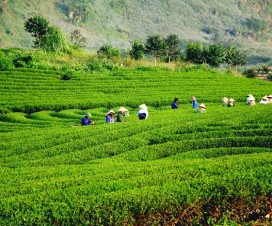
Pure nature in Moc Chau Plateau

Posted by admin on July 30, 2011 under Vietnam Destinations, Vietnam beauty | Be the First to Comment

Despite it is in summer or winter, and the days are foggy or full of sunshine, Moc Chau Plateau is always attractive with its dreamlike beauty.

Tea hill with fresh green in Mock Chua Plateau

Located in Son La province, at a distance of 200 kilometers from Hanoi, Moc Chau Plateau is 1,050 metres above the sea level, with an area of about 80 kilometres in length and 25 kilometres in width.

Moc Chau Plateau is famous for a large herd of milk cows, immense tea hills, big gardens of plum and apricot – tree, and large pastures of about 1,600 hectares.

The milk cow in Moc Chau is the black and white cow race of Holland. From this large herd of cows, Moc Chau has developed the experience tourism so that tourists can feed the cows and do the milking themselves.

This kind of tourism also offers tourists to enjoy the fresh pure cow’s milk and have camping over night right in the pasture.

It would be totally relaxing and comfortable to walk on the hill slope of green and soft grass and enjoy the fresh cool air around. Scattered everywhere are the white flowers and in the distance are the green hills hiding in the shadow of the clouds. All those things just make the landscape here so dreamlike.

Tourists can also prepare meat or buy some from the small restaurants in town to have a roasting meal at night just like nomadic people.

Climate is a special tourism resource of Moc Chau Plateau. Usually, the medium temperature is just 200C, with cool summer and dry winter. The autumn and spring in Mo Chau is the season of tea and pine tree. That is the time when the whole plateau will be covered with a beautiful and fresh green color.

One more outstanding point of this place is the Dai Yem Fall. From Pa Hang border gate in Long Sap commune, Moc Chau town, go along the main road about 4 kilometers, there is a junction of two streams, where the fall starts.

Going through the forest, down to a short and sloping section, tourists would see the two streams pour water down from the height of about 100 meters.

Dai Yem Fall stays below the road surface. The lake under the fall is always clean and clear all year round. The scene around is very natural and wild, which makes its beauty so impressive.

A trip to Moc Chau Plateau will promisingly refresh travelers with joyful and peaceful feelings.

(Source: SGGP)

Discovering Saigon from 180m observatory
Posted by admin on July 26, 2011 under Vietnam Destinations, Vietnam attractions | Be the First to Comment

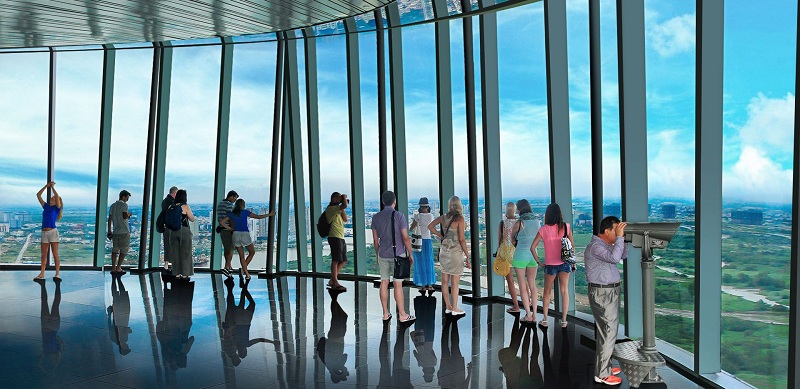
Many visitors and local residents in HCM City are very eager to visit the Saigon Skydeck observatory on the 49th floor of the Bitexco Financial Tower to see the city from above.

The 178m observatory opens from 9.30am to 9.30 pm everyday. It has become a destination for many visitors who want to discover HCM City by binoculars.

Mrs. Lucy, 65, from New Zealand, said: “I’ve been here twice and I’m impressed by Ho Chi Minh City panorama from the top. I will return to this observatory with my friends.”

Mr. Phil, 40, a British visitor who comes to the observatory with his girlfriend, said: “Though the observatory does not have entertainment services, it is interesting to see the whole HCM City at the height of nearly 180 meters. I like the lotus-shaped design of this building.”

However, most of Vietnamese visitors said that the observatory ticket prices are too high.

The ticket for adult is priced VND200,000 ($9), VND130,000 for children from 4 to 12 and the elderly of over 65 years old. It is free for kids of less than 3. Group visitors will enjoy softer prices.

Saigon Skydeck is equipped with six long-range binoculars, enabling visitors to see details in Saigon’s streets very clearly.

The observatory also has six screens on the glass wall, which display information about the city’s landscapes or relics.

Saigon Skydeck is the first 180m observatory in Vietnam. It is located in HCM City’s tallest building, the Bitexco Financial Tower.

(Source: VNE)

Discovering ‘coffin museum’

Posted by admin on under Vietnam Destinations, Vietnam Travel Stories, Vietnam attractions | Be the First to Comment

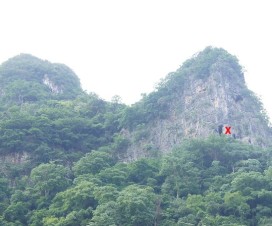
Po Cung Grotto on Pha Hang Mountain in Thanh Hoa Province is the largest grotto cemetery in Vietnam.

The grotto is 10m high, divided into three parts with two doors of 5m high. It is the cemetery for 74 ancient coffins made of tree-trunks. Most of them are quite intact.

Anthropologists explained that instead of burying dead people, some ethnic groups put dead people in caves. In Vietnam, this practice was popular during the Dong Son era.

Archaeologists discovered coffins dating back to the first century in Thailand caves and coffins from the 5th century BCE to the early 20th century in China’s caves. Coffins in the form of dug-out canoes in Po Cung grotto are the first of their kind to be discovered in Vietnam. These coffins are made of tree-trunks and they are placed on wooden brackets.

The biggest coffins are 2.8m long, 0.48m wide and the smallest are 1.4m long and 0.28m wide. Many coffins don’t have bones inside.

Scientists observed that this grotto may be a cemetery of several big families and they still want to know how they brought the coffins into the grotto, which is located high on the mountain.

After Po Cung grotto was discovered several years ago in Quan Hoa district, officials have combined with the Institute for Archaeology to research the grotto. The provincial government aims to turn it into a tourist site.

Discovering Vietnam’s Po Cung Cave:

On the way to Po Cung cave.

The red cross sign is the cave

Archaeologists left signs on the road.

The cave door.

Broken coffins.

(Source: Vietnamnet)

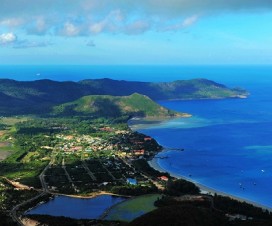
The quieter side of leafy Con Dao

Posted by admin on July 22, 2011 under Vietnam Destinations, Vietnam beauty | Be the First to Comment

Con Dao island

Tropical almond trees stand firm on a seaside road in Con Dao

Quiet yellow-sand beaches and historical sites may lure visitors to Con Dao but it’s the old tropical trees that protect them from the scorching sunshine in the archipelago off the southern province of Ba Ria-Vung Tau.

There are a number of cay bang trees which are over 100 years old and hang over Ton Duc Thang and other roads in Con Dao to provide respite from the heat for tourists, who ride past on their motorbikes or stroll around.

Strong winds and sunshine may be not be your idea of a nice break but these noticeable characteristics have turned out to contribute to shaping the trees into distinctive bonsais. The trees are spread out over two lanes of the seaside roads and they shield pedestrians taking a leisurely stroll on the pavement between the tree lines and mossy yellow walls of the old prisons,

Con Dao island, Vung Tau, Vietnam

A beautiful view of an old tree and the sea from Con Son

from the sun.

From tourists resorts, beyond the lines of tropical trees in the esplanade, you can witness the calm of the sea, with fishing boats bobbing on the water and the distant mountains.

At a little coffee shop called Con Son, you can sip a cup of coffee and rest after a long trek at the seaside or in the forests.

Vung Tau, Vietnam

A giant banyan tree’s roots cover the wall of a historical site in Con Dao - Photos: Mong Binh

Breaths of wind blow in from the ocean sending red leaves of the tropical trees down onto your table as drops of coffee are slowly seeping through the filter, and whet traveler’s appetite for more adventure in the quiet town of Con Dao.

Inside and outside this small town there are other types of ancient trees including the banyan whose roots cover the ruins of historical sites. Underneath these roots contain untold stories about the bravery of revolutionary fighters who shed blood for the independence of Vietnam.

(Source: SGTO)

A pagoda on top of Ba Na Mountain

Posted by admin on July 21, 2011 under Vietnam Culture, Vietnam Travel Stories | Be the First to Comment

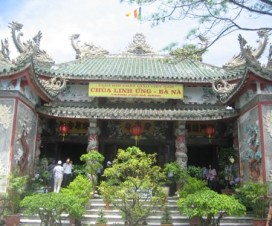
A tour of the top of Ba Na Mountain in the central coast city of Da Nang Vietnam is never complete without a walk around the Linh Ung-Ba Na Pagoda.

This is one of the three Linh Ung pagodas in Danang with the other two being Linh Ung-Bai But on Son Tra Peninsula and Linh Ung-Non Nuoc on Marble Mountains.

Linh Ung-Ba Na is the highest pagoda among the three as it is located at around 1,500 meters above sea level.

The pagoda is part of the Ba Na Hills ecological resort complex on top of Ba Na Mountain. It is a real challenge to walk up a very steep road to the pagoda from the Gare De Bay transit terminal where visitors take a cable car ride to the top of the mountain after going halfway to the peak. Don’t worry about that as vans are available for those who are not ready for a workout.

The pagoda is an excellent place where visitors can take a good look at the French-style mansion of the Gare De Bay terminal nestled in the jungle and looking just like a European castle as described in a fairy tale. Standing there, visitors can also have a bird’s-eye view of the jungle and the city below.

What’s more striking about the pagoda is the 27-meter-high white Sakyamuni Buddha Statue with the octagonal base having a story about the eight stages of the Buddha’s life.

Just around 40km west of downtown Danang, the Ba Na Mountain and especially the Linh Ung-Ba Na Pagoda should be given a try when you are in Danang.

Ba Na Mountain - Danang Vietnam

The main hall of the Linh Ung-Ba Na Pagoda

Danang City - Vietnam

A view of the outside of the pagoda

Da Nang, Vietnam

A sign on a cliff tells people that they ought to remember tree planters when they eat fruits

Ba Na Mountain - Danang, Vietnam

A rockery inside an artificial lake around which there are benches for visitors to take a rest after a short walk down from the pagoda’s main hall - Photos: Anh Khoi

Da Nang, Vietnam

The 27-meter-high Sakyamuni Buddha Statue

Da nang city, vietnam

Visitors pay homage to the Buddha inside the main hall

(Source: SGTO)

Hanoi’s iconic bridge could become art museum
Posted by admin on July 20, 2011 under Vietnam Travel Info | Be the First to Comment

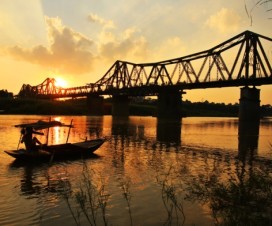
The Vietnam Urban Planning Association has proposed conversion of the century-old Long Bien Bridge in Hanoi into a contemporary art museum.

Long Bien Bridge

If the proposal is accepted, the bridge would no longer be used for rail traffic, and a new bridge would be built to replace it.

Long Bien would be raised by around 3 m to provide more clearance for vessels passing on the Red River below and cannons would be installed on its spans to celebrate the country’s martial history.

Speaking at a seminar on restoration of the bridge held in the capital last Friday, Nguyen Nga, a former town planner in the French capital Paris, said: “A wide-open space would be created to exhibit ancient steam locomotives and carriages that would be turned into cafes and restaurants. The bridge’s spans would be covered with glass.”

The rail tracks would provide space for cultural activities while streets on both sides of the bridge would become four-kilometre-long, green walking streets.

A highlight would be the conversion of the river’s alluvial soil floodplain area into a park featuring natural and artificial botanical gardens and resorts.

A contemporary art museum in the shape of a lotus, voted as Vietnam’s national flower, would be built on an area of 2.5 hectares on the right bank.

The work was expected to be finished by 2020 at a cost of VND4.68 trillion (USD227 million).

“The project aims to improve the habitat of local residents and increase green space in the capital,” she added.

The 2.5-km cantilever bridge was built in 1903 by French architects Daydé & Pillé when it was one of the longest in Asia.

(Source: Tuoitre)

A stunning bird’s-eye view of Nha Trang
Posted by admin on under Vietnam Beaches, Vietnam Destinations, Vietnam beauty | Be the First to Comment

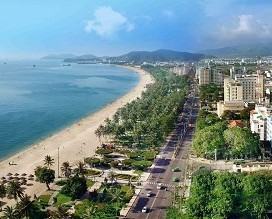
When the sun is about to cast its last beams over ranges of mountains and hills surrounding Nha Trang Bay and the central coastal city, the Altitude Bar has soft music mixed with the sound of gentle waves slapping against the ocean shore beneath.

Nha Trang, Vietnam

Nha Trang Bay at sunset taken from the Altitude Bar

Then as the afternoon breezes from the world-recognized bay come in, they awaken and breathe new life into the Altitude on the five-star Sheraton Nha Trang’s 28th floor.

Considered the highest bar in Nha Trang, it offers an incomparable spot for visitors to have a bird’s-eye view of Nha Trang bay and the city.

The Altitude is open to both hotel guests and visitors from 4 p.m. to 10 p.m. daily, but the hotel’s director of food and beverage Michiel de Kleer says the best time to visit the bar is from around 5 p.m. to 5:30 p.m. when the sun is going down behind the mountain ranges and hills in the west, leaving a lot of beautiful colors in the sky as dusk settles.

As darkness comes, we see the city at night. From the Altitude, guests can spot the Ponagar tower, the giant statue of Buddha and other city attractions lit up in all their glory.

The neon lights along the seaside street of Tran Phu point hungry travelers towards the restaurants that serve a wide selection of seafood and specialties of the city and the central region as a whole.

The moon appears in the clear, summer night, radiating its light all over Nha Trang Bay, which has been called one of the most beautiful bays in the world.

Nha Trang beach, Vietnam

The sunshine of Nha Trang Bay viewed from the Altitude - Photos: Mong Binh

Under the moonlight, tourists and locals swim in the calm sea of summer, stroll hand in hand or chat in groups along the arch-shaped beach with some sitting down on the white sand to take it all in.

And you can see it all from the Altitude Bar. Guests can order a cocktail, mocktail, fruit juice, wine, champagne, beer, coffee and other drinks as they look onto the bay. Or they can sit indoors and immerse themselves in the music and enjoy their beverages. For more information and reservations, call (058) 388 0000.

(Source: SGTO)

Gleaming and beautiful sight of Perfume River in Hue City
Posted by admin on July 19, 2011 under Vietnam Destinations, Vietnam attractions, Vietnam beauty | Be the First to Comment

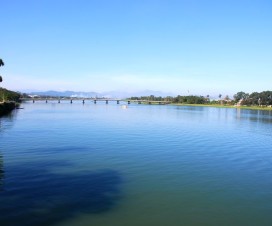
For a long time, Hue has been famous for many beautiful and ancient landscapes, and one of them is the Perfume River.

Perfume River

Perfume River flows mildly like a silk range and leads to Vy Da garden, Thien Mu pagoda, Bach Yen River and Huyen Khong pier one after another. All of these four destinations are magnificent, peaceful and ancient.

Along with those beautiful and romantic scenes, Hue is also famous for many pleasure activities, which are very interesting such as “Releasing boat”, “Playing with the moon”, “Hue singing”, “Sleeping on boat ”and“ Playing with verse All these activities are associated with Perfume River and only have in Hue city.

“Sleeping on the boat” is just a name, since nobody come to the boats for sleeping but only for enjoying the cool wind, watching the moon and the sky and listening to the beautiful songs.

“Playing with verse” is a literary gamble, which enquires players to be very intelligent as well as to have good plans and strategies. The interesting point of the game is that players cannot only make use of all knowledge about literature that they have but also learn many new things from others.

Hue singing is originated from the combination of traditional music and royal music. This elegant and attractive kind of music is really worth listening. Tourists would have a chance to sit on the imperial boats that kings and lords used to be seated in the old time.

In the hold of the boat, there is an imposing orchestra includes nearly all kinds of Vietnamese traditional musical instruments.

The bandsmen as well as the singers are still very young, and they all wear “áo dài”, the Vietnamese traditional clothes. On the prow of the boats, there is a wide and airy space for enjoying the moonlight and the fresh air.

When the night falls down, Perfume River becomes more fantastic. The lamplight spreads on the river just like silver. The winds blow softly and the boat floats slowly. Everything makes travelers feel so peaceful.

In the distance across the river, Thien Mu pagoda appears vaporously, Phuoc Duyen tower looks like being laminated with the moonlight. The scene is so charming and romantic.

Having a night on Perfume River, listening to Hue singing and enjoying the fresh cool air along with the beautiful scenes around, tourists would discover some feelings that could only be found in Huế.

(Source: SGGP)

Lotus blossoms flourish in a small mountain town of Vietnam

Posted by admin on July 18, 2011 under Vietnam beauty | Be the First to Comment

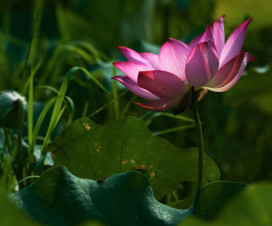
Pho Rang, in the northern mountainous province of Lao Cai, has become adorned by a great deal of summer lotuses.

The flowers create a rainbow of colours, and also attract tourists to the ares.

Residents in Bao Yen Township’s Pho Rang have grown lotus for years. Fresh lotus seed cups are often sold in Bao Yen’s market.

(Source: dtinews)

San Diu paintings revive spiritual history

Posted by admin on July 17, 2011 under Vietnam Culture | Be the First to Comment

San Diu ethnic paintings, meant for worship and found in the mountainous northern province of Tuyen Quang, owe much of their survival to local collectors.

Holy relics: Two San Diu paintings, made for worshipping, are preserved in the northern province of Tuyen Quang.

According to researcher Phan Ngoc Khue, these type of paintings appeared a very long time ago.

“Paintings have always played an important role in the spiritual life of the San Diu people, revealing specific elements of both their culture and lifestyle,” he said.

Traditionally, San Diu paintings were applied on cardboard using only natural colours.

As part of San Diu customs, sorcerers often display different forms of art including Buddha statues, bronze dragons and paintings made to worship, symbolising various spiritual images.

Locals believe that these type of paintings help them see God or Buddha during worship ceremonies.

Tran Van Thang, a Son Duong District resident, said that the paintings reflected people’s conceptions regarding past and present life.

Despite their popularity, only a few old paintings are kept locally.

Collector Bang Xuan Luc, who lives in Son Duong District’s Thien Ke Commune, said: “I’m so lucky to have some of the oldest paintings around, left to me by my parents upon their death. I still use the paintings during ritual ceremonies throughout the year.”

Pham Duc Si, from the Ha Noi Fine Arts College, presides over a 500-painting collection, 200 pieces of which come from the San Diu ethnic group.

“I bought these paintings by chance while travelling through former Ha Tay Province (now Ha Noi) a few years ago. Because of their exquisite colour I started studying their origins with much interest,” Si said.

In order to avoid deterioration, many painters have resorted to working on cement bags and often even on silk using various chemicals.

The provincial Department of Culture, Sports and Tourism is busy drawing up plans for the preservation of traditional paintings.

“We plan to collect traditional artwork and information from among ethnic people, which will take a lot of time and money,” Au Thi Mai, a department official, said.

“Despite the challenges, we will aim to do our best in preserving traditional Vietnamese artwork from around the country,” she added.

(Source: VNS)