Enjoying clouds on the Roof of Indochina

Posted by admin on May 28, 2011 under Vietnam Destinations, Vietnam beauty | Read the First Comment

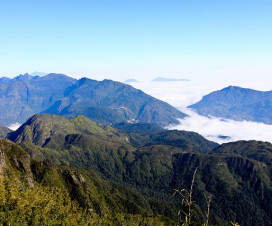
Fansipan is the highest mountain in Vietnam and Indochina, at 3,143 meters. It is located in Lao Cai province in northwest Vietnam, 9km southwest of Sa Pa Township in the Hoang Lien Son Mountain Range.

Fansipan is dubbed “the Roof of Indochina”. It is also one of the very few ecotourist spots of Vietnam, with about 2,024 floral varieties and 327 faunal species.

The topography of Fansipan is varied. Muong Hoa Valley, at the lowest altitude (950 to 1 000m), is created by a narrow strip of land at the base on the east side of the mountain. It can be climbed in a steep and fairly strenuous hike.

“Hunting clouds” on the Roof of Indochina has been always an interesting tour for adventurers. The feeling of bobbing on clouds to see the grandiose landscape of the nature is worthy for their efforts to conquer this 3,143m peak.

How to get there?

The most popular means of transport chosen to save your time and money is train. From Hanoi, you can get the train at Tran Quy Cap railway station to Lao Cai, then get a bus to Sapa and start your adventure.

You should book train tickets 1-2 weeks before the trip, especially if your trip is scheduled at the weekend. The ticket price may be different if you book it directly at the railway station or through travel agents. You should also book the return ticket early at your hotel or travel agents in Sapa or Lao Cai.

To adventure the Fansipan, you need the license granted by the Hoang Lien Son National Par to get into the park. You can take the license in the morning, when you start to visit Fansipan.

There are many ways to the peak of Fansipan. There are four major roads. The first way is from Cat Cat to Sin Chai. This is the most difficult road in Lao Cai to conquer Fansipan. Those with good physical strength and want a long trip often choose this road to adventure the Roof of Indochina.

The second way is from Cat Cat to Tram Ton. This road is good to see Fansipan clearly. However, it is quite long.

The third way is from Sapa to Tram Ton: This is the shortest and most simple road for everyone. You can hire a car of a travel agent to go from Sapa to Tram Ton. You should book the return.

From Tram Ton, you will get into the jungle at around 10 am. You will pass many streams and stop at Bai Soi for lunch at around 12.30-1 pm. From Bai Soi, the road will be more sloping. After two hours of walking from Bai Soi, you will reach a camp at the height of 2,200m and you will rest there.

The next day you will continue the trip to the camp at the height of 2,900m and then to the peak. This is a long and sloping road so you should walk slowly to maintain their breath. You can have lunch on the peak and return to the camp at the 2,900 or 2,200m for a night rest and return the next morning.

The route to Fansipan doesn’t require so-good physical strength but endurance. You should practice exercises on a daily basis at least one week before the tour.

Pictures of Fansipan:

The road to Fansipan

Wild flowers on the Fansipan

Thuy Thom (photo: quycoctu.multiply.com, phuot.com)

Collected by http://Vietnamhotels.net

Nha Trang all set for sea extravaganza
Posted by admin on May 18, 2011 under Vietnam Destinations, Vietnam Festivals, Vietnam Travel Info | Read the First Comment

The fifth biennial Nha Trang Sea Festival, themed Nha Trang – Coastal Destination this year, will be held next month.

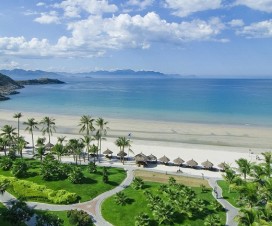
Life’s a beach: Nha Trang Beach in the coastal province of Khanh Hoa will host some 60 cultural, arts and tourism events next month during the fifth biennial Nha Trang Sea Festival. (Photo: VNS)

It will feature some 60 cultural, arts, sporting and tourism events, Khanh Hoa Province People’s Committee deputy chairman and head of the organising board, Le Xuan Than told the media in HCM City on Monday.

“The festival aims to attract domestic and foreign tourists to the province and the country,” Than said.

Thai Nguyen Province will also participate into this event this year, he said.

From June 2 to 10 there will be a fishing and sea tours at night, an S1 water-motorbike performance, a sepak takraw competition on the beach, and a Nha Trang sea bath day.

There will be environmental protection activities, including a city-wide rubbish clean-up on the International Environment Day (June 5), and a conference on marine preservation.

Exhibitions will be held to showcase Cham culture, Lu Cam porcelain, calligraphy, photographs of the city, and high-quality Vietnamese goods, as will a festival of folk cuisine and the region’s special dishes, a music concert and comedy shows.

The organisers will highlight the region’s speciality – swallow’s nest – with conferences on the industry’s history and traditional culture, developing swallow communities and the uses of swallow’s nests, and two swallow’s nest festivals in the city and on Hon Noi Island.

A charity show, Dance on the Beach, will be held on June 10.

The main festival will open with a fireworks display. The opening day will feature a volleyball competition, a film week, a street photo exhibition on the Beauty of Aloe Wood Region, another on the Truong Sa (Spratly) Archipelago, a Champa pottery and brocade display, a cooking contest, a food court, and a street-arts show.

The highlights of the festival will be parades of bicycles, pedicabs, Vespa scooters and vintage motorbikes, an exhibition of sand art, human chess, a Fish Worshipping ceremony, stunt kite flying, dancing by the best couples from the Khanh Hoa Gymnasium, poetry recitation, and music shows themed the sea and islands.

Morbihan Province of France will participate in the festival, bringing its own musicians and photography enthusiasts.

Vietravel’s diving centre, Vinadive, will organise underwater weddings for 10 couples on June 15 at Hon Mun Sea Reserve Area.

Of the cost of organising the festival, 80 per cent has been contributed by organisations and businesses in Khanh Hoa and elsewhere.

Source: VietNamNet/Viet Nam News

Mangrove palm forest draws tourists in Hoi an
Posted by admin on May 16, 2011 under Vietnam Destinations, Vietnam Travel Info, Vietnam tours | Be the First to Comment

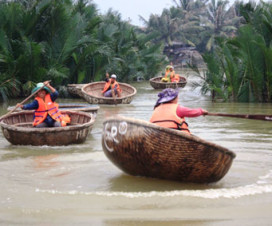
About three kilometers from the ancient town of Hoi An, the Dua nuoc (mangrove palm) forest in Cam Thanh Commune in the central province of Quang Nam has become a much sort after tourist destination.

The forest rests at the convergence of Thu Bon and Truong Giang rivers before they flow into the East Sea. The Hoi An mangrove palm forest plays an important role by forming a natural filtration system before the river currents merge into the sea.

The year-round green forest grows along the river and canal banks. On islets and areas around the forest, there is a particular ecosystem, which is home to many species of fishes and shrimps.

Local residents are well aware of the value of the mangrove palm forests to the environment and for tourism and are cooperating with organizations and tourist companies to exploit the tourist potential, annually broadening and preserving the forest area.

Visitors to the forest can take a leisurely bicycle ride through the forest. Crossing the various paths there, visitors will see local farmers picking mangrove palm leaves, which they use as roofing material and for handicraft items.

Boats are always available to carry visitors along the canals to pick mangrove palm nuts and enjoy a cool coconut drink.

For those who want to relax in a fresh atmosphere, they can bring fishing rods, choose a suitable place and enjoy the sunset as it lazes over the Thu Bon River. People prefer wide-open spaces, they can row a boat out to the river or cast a net with the help of local anglers.

Source: Thanh Nien

Anantara resorts makes its foray into Vietnamese market

Posted by admin on May 13, 2011 under Vietnam Travel Info, Vietnam hotels | Be the First to Comment

Anantara has announced that it will be opening its first property in Vietnam in July this year.

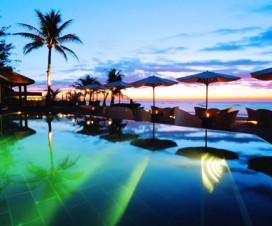
The Anantara Mui Ne Resort and Spa will be located next to the town of Phan Thiet in Binh Thuan Province, along a shoreline spot on a former coconut plantation.

Following a traditional Vietnamese architectural design, the resort offers 89 rooms, suites and pool villas, as well as a variety of banqueting, event and meeting facilities, including five conference rooms for up to 250 participants.

Other facilities at the resort include an open-air seafood restaurant on the beach and the signature Anantara Spa.

Collected by Vietnam hotels

Many activities for sea festival in Nha Trang 2011
Posted by admin on May 10, 2011 under Uncategorized, Vietnam Festivals, Vietnam Travel Info | Be the First to Comment

Khanh Hoa Province authorities have approved a program for the Sea Festival scheduled for June 11 to 15 in the tourism city of Nha Trang, including cultural activities, art performances, sports, and tourism promotion.

On June 2, or a fortnight before the official festival, several activities will be held to welcome the main event, including a fishing tour at night, a sea tour at night, a martial art performance on the seaside, an art picture market, and calligraphy exhibition. There will also be a display of Champa culture, a photo exhibition, a fair for high-quality Vietnamese goods, and music concert and comedy shows.

The main festival will feature a film week, Lu Cam porcelain exhibition, Champa pottery and brocade display, a street photo exhibition, fireworks displays, water-motorbike performance, a food court and a fashion show among others. According to the organizer, the topic on Truong Sa Archipelago will be highlighted during the festival.

France will participate in the festival with music performances, photography talks, and French language discussions.

On this occasion, the diving center Vinadive under Vietravel Nha Trang branch will organize underwater weddings for ten couples on June 15 at Nha Trang Beach to promote sea tourism in Nha Trang to domestic and foreign tourists.

See best hotels in nha trang at the website http://Vietnamhotels.net/.

(Source: SGT)

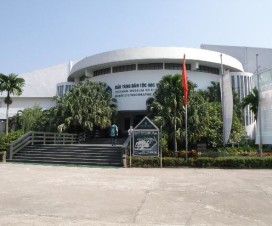
The museum for everyone

Posted by admin on May 9, 2011 under Vietnam Travel Tips, Vietnam attractions | Be the First to Comment


A life-sized replica of a Jarai burial ground in the outdoor viewing area at the Vietnam Museum of Ethnology in Hanoi.

Many foreigners make the mistake of thinking about Vietnam as a homogenous nation, comprised of a single race of people.

In fact, it is home to a variegated tapestry of cultures—54 ethnic minorities live within its borders.

These tribal communities are scattered throughout the country and some are isolated by rugged terrain.

Those looking to get a rudimentary grasp on these various cultures should head to the Museum of Ethnology on Nguyen Van Huyen Street in Hanoi.

On May 18, in celebration of International Museum Day, the institution will give away gifts to the first 100 visitors. Special tours have been organized on the day as well as a series of reports on the institution’s cultural preservation efforts

A foreign favorite

Director Vo Quang Trong said the museum sees about half a million visitors, every year. Lately, he said, it’s getting a bit crowded.

More than thirty foreigners have posted comments on www.travel.yahoo.com and www.tripadvisor.com calling the museum an excellent first stop in Vietnam.

“The museum really gives you great insight into [Vietnam’s] 54 ethnic groups […] and a sense of the country you’re in,” wrote Nadja Ring and Kevin Madigan on the yahoo website.

French President Jaques Chirac inaugurated the building during his visit in 1997.

Since then, the museum has continued to showcase exhibits created by local and foreign photographers and ethnologists.

The façade was designed by the Tay architect Ha Duc Linh and modeled after an ancient Dong Son Drum. The interior was designed by the French architect Véronique Dollfus.

Fourteen years later, the museum serves as a center for the exhibition, preservation and research of these groups’ cultural legacies in Vietnam.

Today the museum’s collection includes 30,000 artifacts, 2,190 slides, 42,000 photographs, 237 audiotapes, 373 videotapes and 25 audio and video CDs.

The exhibits also include interactive video displays that chronicle the process of making non la (palm-leaf conical hats), the funeral rights of the Muong people and a Bahnar buffalo-slaughtering ceremony.

The director said that 30,000 artifacts collected in Vietnam and abroad are not divided equally among the ethnics due to difficulties in studying and collecting subjects especially in underdeveloped and shrinking ethnic groups.

Green museum

A sizeable portion of the Vietnam Museum of Ethnology is situated in a well-manicured outdoor space.

During regular visiting hours, ethnic artisans hold craft demonstrations as well as traditional food preparations.

Children have the chance to watch water puppet shows, enjoy to he (edible toy figurines), and participate in traditional games.

The museum’s “living” displays are probably the largest of their kind and cover an area of roughly 3.3 hectares.

Most of these exhibits are located in the meticulously-landscaped garden. So far, these exhibits are divided into ten plots, some of which house up to seven life-sized traditional structures.

Trong laments that only ten ethnic groups are represented in this outdoor space.

Last year, the 830-hectare Vietnam Ethnic Culture and Tourism Village opened 37 kilometers west of Hanoi. Trong claims that the village does not adequately represent any ethnic groups since the organizers invited some private companies to built tourist attractions – mostly out of concrete.

Trong said his museum invited members of each ethnic community to build traditional structures for visitors to see and enter. These builders periodically return to maintain the structures.

The model structures include a Dao home, a Tay stilt home and a long stilt-home (45m) associated with the matriarchal Ede.

The latest additions to the display garden include traditional Ha Nhi homes of the Bahnar and Cham people.

The structures are presented alongside information about the tools and techniques used as well as information about the builders themselves.

“Few museums have such an outstanding green space,” said Doan Thanh, a Vietnamese-German painter, who held an exhibition at the museum in 2008. “As a result, it provides an ideal place to study Vietnam’s various cultures as well as providing a space for picnicking, taking wedding photos, and allowing children to play.”

Some of the capital’s urban residents consider it a place to go back in time.

Nguyen Dang Tuan Minh often heads to the museum on his bicycle. Once there, he enjoys the cool breezes and open space.

“Whenever I think of my late grandmother and my hometown in the province, I spend time in the museum garden and visit the model northern home,” said Minh. “It brings back memories of my childhood.”

Address: Nguyen Van Huyen Street, Cau Giay District, Hanoi (about 8km from downtown)

Open from 8:30 a.m. – 5:30 p.m. Tuesday through Sunday. Tours take at least three hours.

Ticket: VND25,000 (US$1.25)

Reported by Minh Ngoc – Priscilla Aquilla – Thanh nien news

Sapa – Top ten places to walk by Lonely Planet
Posted by admin on May 6, 2011 under Vietnam Destinations, Vietnam Travel Info, Vietnam attractions, Vietnam beauty | Be the First to Comment

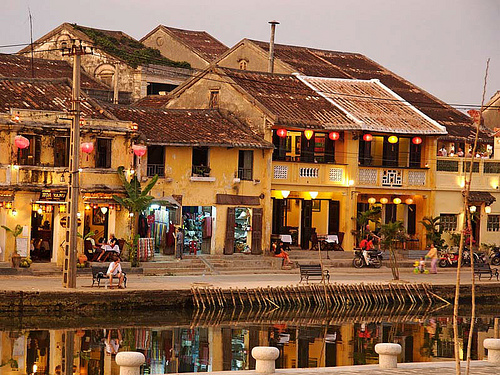
Sapa Town in the northern mountainous province of Lao Cai has been voted one of the world’s top ten spots for walking by popular travel guide Lonely Planet.

The other greatest places for walkers are the Grand Canyon in the US, Aoraki/Mount Cook Village in New Zealand, Lake District in England, Torres del Paine in Chile, Lauterbrunnen in Switzerland, Brecon Beacons in Wales, Kakadu National Park in Australia, Taman Negara in Malaysia, and Dartmoor in England.

According to Lonely Planet, walking can be the best way to experience a place.

“Heaven on earth”

For Vietnamese, Sapa is also a top holiday destination.

1.600m higher than the sea level, Sapa has a mild temperature of 15 to 18 Celsius degree.

Though this town welcomes visitors all year around, it is generally agreed to be most beautiful in April and May.

Before the summer, the weather may be a bit cold and foggy, and after the summer, the rain season sets in.

In April and May, Sapa is blooming with green pastures and flowers, many of which can’t be found anywhere else in the country, and few visitors fail to marvel at the beauty of the cloudy valleys here every summer morning.

Sapa is also home to many breathtaking spots such as Ham Rong Mountain, Silver Waterfall, Rattan Bridge, Bamboo Forest and Ta Phin Cave.

And this is here that adventurers can climb to Vietnam’s rooftop on Fansipan Mountain at 3.143m above the sea level.

See the best hotel in sapa at the website http://Vietnamhotels.net/.

Hotel developers ask for investment incentives
Posted by admin on May 5, 2011 under Vietnam Travel Info, Vietnam hotels | Be the First to Comment

The Vietnam National Administration of Tourism (VNAT) is going to lodge a proposal to the government, asking for investment incentives for the enterprises that develop hotels and tourism accommodations.


Do Thi Hong Xoan, Chair of the Hotel Association, thinks that the current tax policy applied on tourism accommodations is unreasonable.

“A resort area covers 20 hectares, but the investor only uses 35-40 percent of the total area for the construction works. However, in this case, the investor has to pay the same high tax rate for the whole area of 20 hectares, which I believe an unreasonable taxation,” Xoan said.

She went on to say that only devoted people dare to make investment in hotels at this moment, because it is very difficult to borrow capital, while the bank loan interest rates are sky high and hotel room occupancy ratio is low.

Also according to Xoan, a lot of hotels and resorts have been build in recent years, but Vietnam still lacks high quality accommodations for tourists. Therefore, it is still necessary to encourage the investment in hotel development, especially high grade hotels, in order to well prepare to serve tourists when the number of travelers to Vietnam increases sharply.

Meanwhile, investors are now facing big difficulties due to the high land tax and high electricity and water prices.

Hotel and resort developers have voiced the same complaints that the corporate income tax and the peak hour electricity pricing mechanism applied to tourism accommodations are overly high.

Vu The Binh, Chair of the Travel Association, said that travel firms have complained about the land tax over the last many years, but there has been no change in the tax policy so far.

According to Phung Quang Thang, a senior executive of Hanoitourist, in the tourism sector, there are two business fields that need big investments, but it will take investors a long time to take back investment capital: hotel development and means of transport development. “The State should offer investment incentives to help develop the two business fields,” he said.

In fact, the investment incentives offered to tourism accommodation developers have been stipulated in the Tourism Law already. The law says that the State offers preferences in land allocation, finance and credit to institutions and individuals who make investments to develop material facilities for tourism, especially in remote areas. The law also stipulates that Vietnam allows importing of modern specialized equipment to be used at high grade tourism establishments.

However, according to Le Mai Khanh, Deputy Director of Hotel Department under VNAT, to date, only the tax incentives applied to the import of equipment for the first time have been clarified.

When asked why VNAT still has not promulgated legal documents clarifying the investment incentives stipulated in the tourism law, Vu The Binh, who was the Director of the Travel Department under VNAT, said it always takes a long time to compile and issue legal documents. Therefore, in many cases, legal documents do not have the topicality right after they come out.

VNAT’s leaders said they have proposed to put the amendment of the Tourism Law into the upcoming National Assembly’s session’s agenda. While waiting for the law amendment, in order to help ease the problems on enterprises, VNAT will ask the government to apply some preferences in tax, land allocation, electricity and water prices.

Meanwhile, the representative from the Ministry of Planning and Investment, said that the proposals for investment incentives need to come in line with the tourism law, the tourism development program up through 2020, which has been submitted for the government’s approval.

Regarding the proposal to reconsider the tax rate imposed on the resort land area where there is no construction work, he said, that clients who want to stay in the resorts, have to pay money for the whole campus, environment and the whole area, not only for the rooms. Therefore, it would be unreasonable to impose tax on the land area with construction works only.

Source: DTCK

Thua Thien Hue to host national tourism year 2012

Posted by admin on under Vietnam Travel Info | Be the First to Comment

The national tourism year 2012 themed “Hue-Ancient capital city-New experiences” will be held in central Thua Thien Hue province.


The event is expected to promote Vietnam ’s tourism products and cultural heritages, attract more foreign tourists and boost domestic tourism.

Hue Festival – a quintessential biennial event of Vietnamese cultural heritages – will be the major cultural draw card.

Lying on the north-south railway and main road connected to Laos and northeastern Thailand and with the Phu Bai international airport and the Chan May seaport, Thua Thien-Hue province will be a stopover for central and nationwide tourists.

In particular, Hue city – the local tourism centre – was the capital city of the Nguyen feudal dynasty and is the sole place in the country preserving the royal court music “nha nhac” recognised by UNESCO as masterpieces of oral and intangible heritage of humanity.

Thua Thien-Hue is also well known for its cuisine, craft products and folk festivals, including the Cau Ngu festival, the boat race on the Huong (Perfume) river and Hue Festival.

The system of tombs and pagodas together with beautiful beaches like Lang Co beach, Thuan An and Canh Duong and the Tam Giang-Cau Hai lagoon will be especially attractive destinations for tourists.

The National Tourism Year 2011 themed “ Exotic Beaches and Islands ” took place in central coastal Phu Yen province on April 1.

Source: VNA