Posted by admin on February 28, 2011 under Vietnam Destinations, Vietnam Travel Info |
The People’s Committee of northern Quang Ninh Province is considering tightening regulations for boats staying overnight in Ha Long Bay, with vessels not meeting standards banned from operating, said deputy chairman of the committee Dang Huy Hau.
The regulations will clearly define the number of lifejackets on board, minimum motor power, and captain’s qualifications.
Hau said that local authorities had inspected 135 of the 151 tourism ships staying overnight on the bay. All of the inspected ships had the correct permits for over-night stays and most of them met safety regulations.
However, some of fire fighting equipment and pumps on some boats did not meet the necessary capacity. Some boat cabins were in poor condition and lacked lifejackets, he said.
The remaining 16 ships will be checked in the next ing days.
“Local authorities will establish a specialised team to regularly supervise all vessels spending nights on the bay,” said Hau.
Tourists, especially foreigners, will receive safety information.
The committee will also redefine safe anchorages.
“We will limit the number of vessels spending nights on the bay to about 50 a night,” said Hau.
Reducing the density of ships will make inspections easier, and help keep maintain a safe distance between ships, he said.
Hau added that after the fatal sinking that left 12 tourists dead on February 17, the number of tourists visiting Ha Long Bay had remained unchanged, and many tourists, including foreigners, were still happy to stay overnight.
At present about 400 ships operate on the bay and about 150 ships anchor overnight with more than 1,200 tourists, according to initial statistics provided by the committee.
International tourists return to Ha Long Bay
The number of tourists visiting Ha Long is getting back to normal after a slight decrease, Ha Long Bay’s Management Board has announced.
On Thursday, the Italian Costa Classica cruise ship brought around 2,150 Chinese tourists and sailors to the bay.
The tourists will take a 6-day tour around Vietnam after a 5-day tour around the bay, according to Saigontourist, the company authorized to receive the cruise.
The Portugal Princess Daphne with 500 Australian tourists will also arrive on March 2.
Last week, a tour boat sank, killing 12 people. All tour boats with night-stay services have been checked and put back to operation.
Source: VNS/Tuoitre
Posted by admin on under Vietnam Travel Stories, Vietnam beauty |
After travelling from Hue to Hanoi we caught the overnight Green Train to Lao Cai in the mountains on the Chinese border. The train left Hanoi at 9.00 pm and we had a four berth compartment to ourselves. However, luxury was in short supply with shared loos and one washbasin for the carriage and it was a very rickety ride, making sleeping difficult. We arrived at Lao Cai at 5.30 am the following morning and were met by a guide who took us for a very early breakfast at a nearby restaurant. After breakfast we went to the bridge where one can cross over to China. The bridge is open from 7.00am to 7.00pm each day and we watched a steady stream of Vietnamese making their way over the bridge where apparently they purchase cheap Chinese goods which they then bring back to sell in Vietnam.
On the way to Sapa we stopped at a mountain town known as Bac Ha where, every Sunday, there is a large market to which all the surrounding villagers come to exchange goods and purchase their necessities. It could have been a rural scene in 18th century England, with almost everything for sale including cattle, pigs, hens, dogs, vegetables, ironwork and clothing, just to name a few. Of course, the piles of sugar beet and bamboo and the water buffalo that were being sold weren’t very Anglo Saxon.
Our hotel in Sapa had spectacular views of the town and the surrounding mountains, but very intermittently as most of the time it was surrounded by swirling mist. We experienced a drop in temperature and had to dig deep into our suitcases to find our warm clothes that we hadn’t worn since we left Totnes. We were thankful for the 3-bar electric fire in our bedroom and made sure that we reserved a table in the restaurant for dinner each night by the big log fire.
On our first full day John went off with Cuong, our guide, for a five hour hike in the mountains. The views through the mist showed terraces of paddy fields clinging to the slopes and there was water everywhere which made for a very muddy walk at times. It was almost like an oriental version of Wales! The packed lunch was eaten at the home of a Vietcong war veteran in one of the mountain villages.
Throughout the market at Bac Ha there are local women wearing a colourful traditional dress
built of wood with a corrugated iron roof, was very dark. It consisted of two rooms downstairs and two up which housed him, his family of eight and his scooter. On the walls were his certificates of commendation which he proudly showed off. Opposite his house was the village school which unfortunately was bereft of pupils as the locals feel it is more productive for their children to try and get money from the tourists than receive an education. Tourism is not necessarily helping these village people.
Lynne declined the opportunity of hiking and took the soft and restful option of a day at the hotel spa and pool to recover from the train ride!
On our second full day in Sapa the guide took us off for a drive to visit a couple of mountain villages. The houses are very basic being constructed of timber with corrugated iron or asbestos roofs and with very little home comforts inside. The homes also act as stores for the crops they have grown and houses their domestic animals such as hens together with their motorbikes. The floor is bare earth but clean and they have a very old TV in the middle of the house connected to a dish.
Just outside of Sapa the landscape is dominated by the watery terraces where shortly the annual rice crop is to be planted. What must they think when they see the conditions we live in on their televisions? No wonder so many of the local people devote their life to trying to extract money from the tourists. However the scenery surrounding the villages is a definite bonus and must provide some form of spiritual compensation.
At the end of the second full day it was back to Lao Cai to catch the 8.00 pm train back to Hanoi and arriving at 4.30 the following morning. Hanoi is the last lap of our journey.
by John from Totnes, The delights of Bangkok, Cambodia and Vietnam travelblog.org
Posted by admin on February 26, 2011 under Vietnam Travel Info, Vietnam hotels |
Coastal Vietnam resorts invite holiday-makers to ‘Golf the Beach’
Two of Vietnam’s premier courses have joined forces in a bid to lure more golfers to one of the country’s most activity-rich tourist areas.
Ocean Dunes Golf Club in Phan Thiet and Sea Links Golf & Country Club in nearby Mui Ne have formed Golf the Beach: Vietnam’s Must-Play Getaway, to better showcase the virtues of this sandy strip along the country’s southeastern coast. The partnership’s web hub, www.golfthebeachvn.com, goes live on Feb. 22.
“It’s about strength in numbers, and that’s why Golf the Beach is a very exciting development indeed,” said Stephen Banks, general manager at Sea Links. “We’ve got two excellent championship courses here, with several more in the planning and construction stages, but this is the first time the Mui Ne/Phan Thiet area has been promoted as a golfing destination.
“We think it has major potential. We’re so close to Ho Chi Minh City, but a day or two has never done this region justice. Golf the Beach merely states the obvious: Golfers can come and play two of the best courses in Vietnam, each within 15 minutes of the other. At night, in between rounds, they can avail themselves of everything else the region has to offer.”
These non-golfing attractions are legion, which is why the Mui Ne/Phan Thiet strip has developed in recent years into a prime draw for both foreign and Vietnamese tourists. Sandy beaches, reliable sun, cooling breezes, and plentiful restaurants, accommodations and nightlife make Mui Ne in particular the country’s top beach destination.
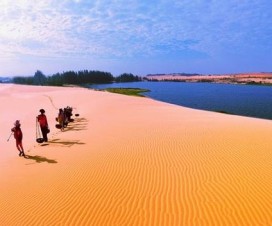
To the north lie the famed Red Sands of Mui Ne while, to the south, stretch kilometers of open, quiet roads perfect for extended moped excursions to undeveloped beaches of one’s own choosing. At the same time, dependable wind and warm water have turned Mui Ne/Phan Thiet into one of the most popular spots for windsurfing and kite surfing in all of Southeast Asia.
“Or maybe you’d rather take the cable car up Ta Cu and lay down beside the largest recumbent Buddha in Southeast Asia,” said Glenn Cassells, director of golf at Ocean Dunes GC. “There’s a very relaxed feel about this part of Vietnam, both on and off the golf course. But it’s a beach destination at heart, and the vibe reflects that. It’s clean, sunny, slow and casual – especially when you’re coming from a place like Ho Chi Minh City, or any big city. It’s a place to truly get away.”
Golf has long been a stitch in this fabric. The Nick Faldo-designed course at Ocean Dunes has been a linchpin of the Vietnamese golf scene since opening in 1996. Indeed, it was the first modern resort course built in this country, the first to open outside the urban hubs of HCMC and Hanoi.
Sea Links, an attractive and formidable test created by acclaimed course architecture firm Golfplan, joined it in 2008, the product of a golf course development boom that still holds sway up and down the country.
The two courses offer golfers wildly contrasting yet equally compelling experiences.
Ocean Dunes is laid out at sea level – directly beside the East Sea – and combines elements of firm-and-fast links play, Florida resort golf, and colorful pine barrens. There are several standout holes that weave their way through the track’s dunescape, coniferous forest and chain of lakes. However, the uphill 9th – a par-3 played through a funnel of casuarinas pines to a raised green at seaside – is regularly voted among the best short holes in the world.
Sea Links, meanwhile, is more expansive and its dramatic location – amidst the dunes high above Mui Ne – offers spectacular long views of the East Sea. The undulating course is challenging; many experts rate it the toughest in the country. It measures 7,617 yards from the back tees, and holes such as the 4th – a treacherous long par-4 – and the signature dogleg 7th are as testing as they are visually pleasing.
“The two courses complement each other by being so very different,” confirmed Banks. “One is a flat course, one is hilly. One is more of a traditional design and one is thoroughly modern. Both are great courses, however, and they are never anything less than exhilarating. Golfers who come to this area for a golf week will almost definitely play both tracks more than once. That’s both our calling card and our mission.”
“We’ve got everything in place,” Cassells added. “As well as having two championship courses, this area has its own micro-climate so conditions are way better than the rest of Vietnam for much of the year. Cool breezes and sunshine – that’s every golfer’s dream.”
For further information about mui ne resort, please visit the website http://vietnamhotels.net/
Source: travelweekly.asia
Posted by admin on under Vietnam Beaches, Vietnam Destinations, Vietnam Travel Info, Vietnam Travel Tips, Vietnam attractions, Vietnam beauty |
Lay down beside the Buddha
On top of Ta Cu — a mountainous plateau accessed by an Austrian cablecar system 1.6 miles long, and 505 meters high — resides the region’s renowned recumbent Buddha. Some 49m long and 10m high, this reclining Buddha is reputed to be the largest in SE Asia. An additional climb through woods droning with cicadas leads you to the fissured and graffiti-splattered Buddha, a cement statue whose serenity and gravitas still manages to shine through, even with forest growth encroaching from all quarters.
Ride the Wind
Who says Charlie don’t surf. Okay, the breaks in Phan Thiet might not satisfy Lieutenant Colonel Bill Kilgore, Robert Duvall’s surf-obsessed character in Apocalypse Now. But this perch on the South China Sea is supremely windy, which has proved the draw for in-the-know adventure sport mavens who make regular pilgrimages here for killer wind- and kite-surfing. Pascal Lefebvre, owner of Jibe’s Beach Club — one of a dozen establishments which can make this experience happen for you — says that Phan Thiet’s popularity is due to the quality of its wind, usually between 20-25 knots during the season, and sometimes as high as 40. “It’s nearly guaranteed every day of the season,” he said. “Great wind and warm water.”
Hit the Road
Unlike traffic-choked Saigon, this part of Binh Thuan Province is a motorbiker’s dream. While most moped-enabled tourists are drawn north of Phan Thiet (to the famed Red Sands of Mui Ne), the coastal road leading south is, if anything, even more alluring. Great swathes of empty sand back onto quaint Vietnamese fishing villages untouched by the hand of development. Rent a motorbike from a local for a few hours (about $5) and head south to Ke Ga Lighthouse. Once past the small downtown of Phan Thiet, you’ll feel as though you’ve got the road all to yourself — and the road is never more than 50 yards from the ocean. Note the secluded resorts along that stretch that seem like ghost towns but are actually great places to stop and have a drink with a view.
Eat & Drink
Quan Bo Ke — Situated at the north end of the Mui Ne strip this al-fresco joint offers some of the cheapest and best seafood in town. Lobsters go down well with the Russian tourists who flock here, but a better bet are the generous platters of grilled scallops with spring onions and peanuts – a steal at around VND90, 000 or $5 a pop.
Joe’s The Art Cafe — Strangely bohemian for a 24-hour bar in an Asian seaside resort, Joe’s offers an imaginative menu, a decent wine list and nightly live music. Perfect for a sandwich or snack after a night out. It also shows movies, sports comfy couches, and stays open till the wee hours of morning.
Cay Bang — Get into some seafood here at the south end of Mui Ne’s strip. Right on the water, it’s popular among locals and tourists alike and offers the rare (and raw) experience of picking your own fish. Upon arrival, you are escorted into a room/garage full of dozens of tanks, swimming with squid, rockfish, grouper, etc) You can tell them to fry it, steam it, grill it, whatever.
Shree Ganesh — Run by the same crew responsible for Saigon’s popular Ganesh restaurant, this particular spice emporium offers a flawless selection of north and south Indian dishes.
Three more fine venues on the strip in Mui Ne: Sankara Beach Bar & Restaurant, The Indian Restaurant, and Mia. For drinks in a more upscale setting, hard to beat The Sailing Club.
Visit Van Thuy Tu Temple
Two hundred years ago, Van Thuy Tu had three separate repositories of whale skeletons. Today, the Temple site is famous mainly as home to Ong Nam Hai, a 100-foot whale skeleton moved inside, in tact, in 1893. The actually found it washed ashore in 1890, and buried the whale in a spot close to the ocean. After three years, the body eroded, they dug up the skeleton and built a temple for it. They still keep more than 100 skeletons here, as with tradition, still burying the whale where they found them or in a sandy cemetery beside the temple — thus offering respectful offerings to the spirits who look after fishermen and bring the bountiful catch. The plants in the cemetery are grown in pots, so the root systems don’t bind up the soil, making exhumation more difficult.
Behold, Bamboo Basket Boats
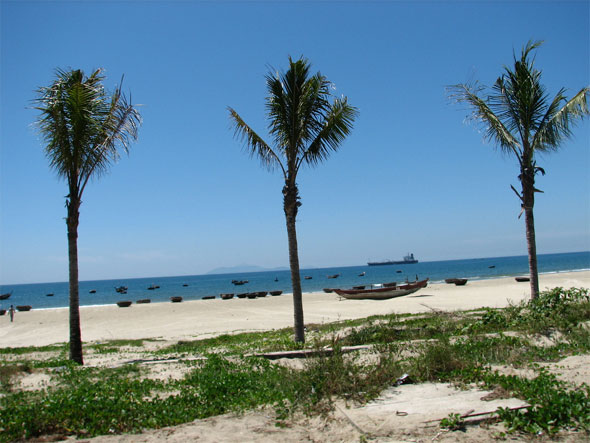
At night, gazing out onto the East Sea, lines of illuminated squid boats bob gently on the horizon. During the day, the bamboo basket coracle is the more familiar sight — here and all along the south central coast of Vietnam. It takes about a week to weave the strands of a basket boat and seal the bamboo lattice with a pitch derived from the dau trai tree. The boats sell for about 400,000 dong, or $27 each. Fishermen frequently make boats in the grounds of the Van Thuy Tu Temple, and surrounding streets, but they are ubiquitous all along the beaches of Binh Thuan Province. Fishermen propel these boats by churning a single oar, like a milkmaid at butter.
Check out the Cham Towers
The Cham people are thought to have arrived on these shores from the island of Borneo and, at its 9th century peak, the Cham culture controlled coastal lands from Hue in central Vietnam all the way south to the Mekong Delta. The Cham Kingdom fell before the encroaching Vietnamese in the 16th century, but some 100,000 ethnic Chams still reside in Vietnam, and they are particularly prominent in Phan Thiet/Mui Ne. A grouping of impressive Poshanu Cham towers can be found just off the road from Phan Thiet north to Mui Ne. The government repaired and restored these architecturally significant temples from 1990 to 2000. Just beyond the ruins — in a coupling of empires both long gone — are the ruins of a French playboy’s seaside bungalow.
Book resort in mui ne now to get good prices at http://Vietnamhotels.net/
Posted by admin on February 25, 2011 under Vietnam Travel Stories |
So by the time we left Hoa’s Place we had quite a crew happening, there was Cia from Melbourne, Dan, Sally and Steve from London and in Hoi An we picked up a Mexican his name Efrain. This was to be our gang for the next few days.
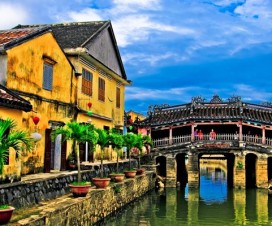
Hoi an like Halong Bay and My Son is also a UNESCO World Heritage Site, it is an old port town but nowadays is famous for its 100’s of tailors and cobblers. We got Jono a 3 piece suit made and me a dress, unfortunately we forgot to take a pic of his suit before we shipped it off (Trace it should be showing up in about 3 weeks) , he reckons its the comfiest suit ever and I must admit he does look dashing in it!
Even more exciting for me is we got shoes custom made, we got 2 pairs each for $85 , so now we are strolling the streets in pumps that have our names embroided on them, it had to be done!
So far Hoi An has been our favorite place and we have also had our best food here. Because Efrain had been in Hoi An for 3 weeks he knew where to go for cheap beer, and I’m talking 15 cents for a glass and for good food, to Ms Nam’s. We cruised across the river to Ms Nams on our first evening after a few beverages and had an AMAZING meal, so we jacked us up a cooking class there the next day.
The cooking class was a lot of fun, we learnt how to make spring rolls, banh xeo this pancake thing that you wrap in rice paper (so so good) and white rose which is a dumpling type thing that is unique to Hoi An. Jono was made the scribe by the group as he wasn’t super interested in the cooking so we could take the recipe’s and make them at home.
The next day Jono, Cia and I decided to hire bicycles and ride to the beach. Of course we got lost and went on a minor detour but this is always the fun part. Eventually we made it to the beach where we stopped for a beverage before starting the trip back into town.
That night we were all booked onto the sleeper bus to out next destination Nha Trang………
by JayZee, Mekong Meanders and Beyond, travelblog.org
Collected by vietnam hotel
Posted by admin on under Vietnam Travel Info |
| Think investing in Vietnam is all about Hanoi and Ho Chi Minh City? Think again. |
|
|
| Danang, Vietnam’s fourth most populous city, has been booming over recent years, thanks to its great geography, nestled between jungle-covered mountains and miles of sandy beaches.
While the beautiful setting has spurred tourism – resorts, villas and golf courses proliferate on the beachfront road south of the city – a growing number of factories have been established here to take advantage of Danang’s location in the centre of Vietnam. (danang hotels)
Danang’s success is also down to the single-minded leadership of Nguyen Ba Thanh, the head of the local government, says Peter Ryder, chief executive of Indochina Capital, an investment firm that has pioneered a number of high-profile developments in the city. He says that Danang is regularly voted the best place to do business in Vietnam. It has the best infrastructure by far of any major urban area and the growth in per capita income has been ahead of other places in Vietnam. Nguyen Ba Thanh is the nearest Vietnam has to a Lee Kuan Yew.
Like Hanoi, the capital, and Ho Chi Minh City, the main business centre, Danang’s economy has been growing way above the national trend rate of around 7% over the last decade. From 2006-2010, the city’s economy grew at around 11% per annum and it is targeting 13.5%-14.5% growth over the next five years.
In contrast to the chaotic, traffic-clogged streets of Hanoi and Ho Chi Minh City, travelling around Danang, a city of 900,000 people, is a breeze, with wide boulevards, ring roads and bridges in all the right places.
The decent infrastructure, combined with the stunning setting, is helping to attract a growing number of tourists and developers.
A golf course designed by Colin Montgomerie, and backed by Indochina Capital, sits next to another course designed by Greg Norman, and backed by VinaCapital, a rival investment group. (Nick Faldo is getting in on the act 20 miles north, in a village called Lang Co).
Small apartments in luxury beachfront developments are being sold for around $100,000 for a 50-year lease, while high specification villas are being picked up at over $1m, according to people working in the local property market.
The vast majority of the buyers are the first generation of Vietnamese “second-homers”, mostly from Hanoi (where they like to pay in cash) and Ho Chi Minh City (where they prefer credit).
But the rapid pace of construction has inevitably stoked fears about overdevelopment. A number of large projects have been halted ostensibly for lack of financing – although local cynics say that some speculators only want to give the impression of construction in order to get hold of the land before flipping it for a quick profit.
Ryder says: ” We’re definitely concerned about over-building on the beachfront. What we’ve done has been unique enough so it will still wind up doing well. But we don’t have any plans to do any new projects.”
Another developer argues that demand from cash-rich, wealthy Vietnamese who want a combined holiday home and investment will continue to support further development in Danang.
With the currency continuing to depreciate against the dollar, inflation accelerating and the stock market in the doldrums, many well-off Vietnamese still feel that property is their best bet.
Source: blogs.ft.com
|
Posted by admin on February 24, 2011 under Vietnam Destinations, Vietnam Travel Info, Vietnam attractions |
By Susan Griffith | The Independent |
According to the young Red Dao woman with the incisor decoratively encased in gold, her village of Ta Phin had not seen the sky, let alone the sun, for six long weeks. The winter had been so cold and hard, she explained as we slopped along the muddy track (she in her plastic sandals, me in my hiking boots), that many villagers, including her own family, had lost at least one of their precious water buffalo, animals that cost upwards of eight million dong (£250) to replace.
This level of hardship rather eclipsed our own. Yet there was no denying that our little group was feeling downcast by the lack of visibility in this remote region fabled for its glorious landscapes. Someone had even dared to breathe the word “depressing” as we peered into the monochrome murk. The hotel lobby was heated only by a mean little corner fireplace that had been reluctantly stoked with kindling by the hotel manager in his shiny, too-tight suit.
The only reliable source of heat was bed, where the electric blankets were switched on around the clock; but you don’t journey to a hidden corner of Asia to go to bed.
We had just arrived off the overnight train from Hanoi at the railhead town of Lào Cai. From here the only way is up: we had travelled for an hour by switchback road through the pre-dawn blackness to the hill resort of Sapa in northern Vietnam. China’s Yunnan province was only 36km away. This region was unknown to Europeans little more than a century ago when French missionaries arrived to convert the local hill tribes (I speculated whether they had won them over with gifts of blankets). After moving the capital of Indochina to Hanoi at the start of the 20th century, the French colonial masters seized upon Sapa as a place to escape the heat of the lowland summer – an amusing irony in our case. Opened to tourism again in 1993, Sapa has become a honeypot, attracting tens of thousands of visitors, including many urban Vietnamese in the rainy summer months.
We thought with longing of the brochure photographs of verdant valleys, rice terraces reaching to impossible heights, and bucolic villages with a scattering of wooden and bamboo houses. We knew that a couple of kilometres away Mount Fansipan rose to a height of 3,143m, the highest peak in Indochina. But we might as well have been searching for Cleopatra’s Needle in the haystack of a pea-soup fog in Victorian London. I couldn’t help but be reminded of the hordes of Japanese tourists I had once seen staring forlornly at an opaque mass of cloud where New Zealand’s Mount Cook should have been. While travellers to the tropics are familiar with the concept of “wet” and “dry” seasons, Sapa seemed to have come up with a variant: the foggy season. Holiday weather is always a lottery, but I wondered if the decision by Travel Indochina to launch a tour to this new destination in winter might have been a gamble too far.
Oh well, there was always Sapa’s other attraction, its diverse population of minority peoples. Of the various groups, the principal ones are the H’mong and the Dao (pronounced Dzao) who settled in these hills after fleeing persecution in southern China, mainly in the 18th and 19th centuries. Nowadays village women, tiny of stature, flood into Sapa to sell their handicrafts. The traditional tribal costumes and customs flourish still, and the people’s cheerfully coloured clothing and headgear brightened the gloom.
The Black H’mong wear deep indigo tunics with embroidered sleeves and back aprons, dark velvet puttees and pillbox turbans, multi-hooped silver earrings and huge bamboo baskets strapped to their backs. Apart from their lapels embroidered with geometric patterns, the distinguishing characteristic of the Red Dao costume is the astonishing headdress. On top of partially shaved heads, they wear a length of scarlet material wrapped and folded to create a bulging cushion-like turban from which red tassels, tiny bells and silver coins dangle down their backs. Before you get as far as Sapa market, where textiles are displayed on circular cloths rescued from defunct umbrellas in a charmless concrete room, village traders will surround you on the street to display their wares.
Against the odds, the fog and our spirits lifted the next day. As if on cue for the first day of the lunar new year, early morning sunshine flooded the deep balcony of the hotel, illuminating the jagged line of hills all around and revealing the town’s attractive ochre-coloured turreted villas with balconies and shuttered windows. Within minutes, the mist had rolled in again, but now it was easy to persuade ourselves of the possibility that rambles between villages scheduled over the next few days would reveal further wonders.
The scenery around Sapa is magnificent, but it was the human drama that proved most gripping. A boy no older than 10 nonchalantly whittled a stick as he rode bareback on a water buffalo plunging knee-deep across the fallow rice paddies on his way home. A man brandishing a curved-bladed knife bounded up the terraces behind his house in search of something meatier than a cabbage. Children played a version of hopscotch that involved the near-impossible feat of picking up a pebble with their bare toes while hopping on one foot. In the background, a sow failed to discipline her litter of squealing squabbling piglets while white ducks did pirouettes on the village pond.
The beating of a drum presaged the most remarkable spectacle of all. We were invited into a sizeable one-room house to observe from behind an open partition a religious ceremony akin to a Mummers’ Play. A young man sat on a bench and started to shake violently, then cavort wildly round the dirt floor. When the gyrating dance subsided, three youths moved jointly up and back holding up bamboo sticks painted red for good luck. Like a child at a pretend tea party, the holy man who was directing proceedings mimed the pouring of tea into a row of tiny tea cups and then burned lucky (phoney) money.
The young men turned their attention to the altar next to which painted tableaux and calligraphy panels had been hung. They hopped forward and backwards on one foot, shouting a word that sounded like “hop”, which probably meant something along the lines of “May our ancestors’ spirits keep our buffaloes warm this year”. They scattered corn on the floor before showering each other with edible confetti. All that was missing was an accompanying ethnographer to interpret what we had witnessed, though it seemed reasonable to assume that prosperity and plenty were being invoked for the year ahead.
If prosperity does increase in those villages, it will be due to the tireless efforts of the village women. The male population is largely invisible, especially at festival time when many over-indulge in rice wine. The men in evidence were swanning around on their motor scooters. All the tribal girls learn to sew as children and become expert needleworkers. Gaggles of them can be seen in doorways bent over their handiwork or stitching as they walk, mostly objects to sell to tourists – although, as in 18th-century England, they create their finest pieces for their weddings. If it is true that the best seamstresses are able to make the best marriages, then some of these young women must be betrothed to princes.
These enterprising women have no access to shops or fixed outlets. So they have adopted a peripatetic sales technique that many tourists find exasperating but is undeniably successful. Large groups besiege hikers setting off on footpaths to one of the six or so minority communes accessible from Sapa on half-day or full-day trips. The village women quickly identify the most likely victim and attach themselves accordingly as “friends” and informal guides.
Running the gauntlet is unavoidable, even for those with “Miser” emblazoned on their foreheads. I put my cards on the table from the outset of the first trek, telling my entourage of Red Dao women that I have been to many countries but have at home no souvenirs; I would not be buying. Undeterred and with quiet dignity, “my” group of about four women accompanied me for the entire half-day’s amble, answering questions when their English permitted and smiling for the camera. They called our attention to points of interest such as the now-disused rattan bridges straight out of an Indiana Jones film. Some performed feats such as fashioning a sculpture of a horse out of a single strand of grass. When asked about their music, one sang a haunting lament for those “with no mummy, no daddy”.
At the end of a trek, it is impossible not to feel some obligation to these eager, smiling people when they produce their embroidered pencil cases, purses and shoulder bags, silver earrings and bracelets. The quality is as variable as the price. Some is just imported Chinese tat. The dye which they make themselves from the nondescript-looking indigo plant grown locally comes off straight away (though can be fixed later by washing in cold salt water). It might go against the grain to encourage this commercialisation of contact with local people. Yet all I can say is that the day I resisted their blandishments, I felt more of a heel than when I handed over a few hundred thousand dong (a trifling amount).
Revived by the watery sunshine and the glow of having made a small financial contribution to an impoverished community, we were eager to travel 18km deeper into Lào Cai province to stay at Topas Ecolodge, run by an expatriate Dane. The conical thatched roofs atop an isolated cone-shaped hill are reminiscent of the distinctive Nó* lá (bamboo hat) worn by Vietnamese paddy farmers. All the clean Scandinavian design inside and efficient heating of the individual lodges proved a welcome haven. The lodge’s trekking sheet did not make clear that the short “Buffalo Track” was a route suitable for buffaloes, not humans. Droppings marked the deeply rutted quagmire like so many cairns.
But the panoramic views justified the effort. Stepped terraces reached dizzying heights and created patterns as beautiful and natural as sand ripples under shallow water. These astonishing constructions result from generations of wet rice farmers working from the top down, in case a terrace collapses and obliterates the one below. In winter the puddled mud on these tiny man-made platforms glints in the light. In summer, the emerald greens and golds of the ripening rice must transform these valleys into a place reminiscent of Tolkien’s Shire on a Brobdingnagian scale.
Street life in Hanoi had prepared us well for experiencing Vietnam in a way appropriate for a country where gambling is an entrenched part of the culture. Huddles of young boys on Hanoi’s back streets bet eyebrow-raising sums of money on impromptu games of chance. In the evenings, old men can be glimpsed through half-open doors intent on their hands of cards, and it is certain they are playing for more than the delicious roasted peanuts used in their cuisine.
Even the most cautious visitor to north Vietnam, city and country, will be forced to play a game of hazard. Stepping off the kerb to cross a road for the first time feels like spinning a revolver cylinder and giving yourself a one-in-six chance of survival. The technique is to wait for a bit of a lull and then step slowly and steadily across the road, establishing eye contact with all oncoming scooter drivers who will lean one way or the other to avoid you. Easy for people with strong nerves, impossible for Westerners who cleave to the supremacy of lollipop ladies.
Clambering into our comfortable bunks on the train at the beginning of the trip, we knew that we were dicing with disappointment. But as we left this mountain fastness behind, the peak of Fansipan finally revealed itself above its girdle of clouds, making us feel especially vindicated in our gamble to visit Sapa in the fog season.
Collected by vietnam hotel
Posted by admin on under Vietnam Destinations, Vietnam Travel Info |
Da Bia international mountain climbing competition is scheduled to be held at Da Bia Mountain in Dong Hoa District, in the central province of Phu Yen on March 27.
This announcement was made by the provincial Department of Culture, Sport and Tourism. The mountain climbing tournament attracts local teams from 13 cities and provinces nationwide and international teams from Laos, Cambodia, Thailand and Myanmar.
The competition has two categories, a 5km race for professional athletes and a 2km race for amateur climbers.
The event is part of the 2011 National Tourism Year in Phu Yen and other south-central coastal provinces.
Source: SGGP
Posted by admin on February 23, 2011 under Vietnam Travel Info |
Tourists to Hoi an City yesterday received the first of more than 40,000 maps from Hoi An tourism, which have been published for tourists free of charge.
This project is jointly organised by Quang Nam Province’s Tourism Association, the Representative Office of UNESCO in Hanoi and Robin Tauch & Partner Foundation.
Under this project, maps will be delivered at ticket booths and hotels across the City. With such a map, tourists will find it easy to reach some 52 tourist spots in the centre of the old quarters of Hoi An. Moreover, they will be directed to craft villages in the outskirts of Hoi An city, such as Kim Bong Wood, Cam Kim Mat and Tra Que Vegetables villages.
The way to My Son Sanctuary and Cham Islands Biosphere Reserve Site of the world is also clearly illustrated in the map.
Ms. Margaret Costelloe, a UK tourist, said she has visited Hoi An nine times and each time she found new feelings while visiting the old quarters of Hoi An.
The map was an interesting thing that she had received in Hoi An, this time, and according to her, tourist sites were positioned in detail in the map. Besides, ways to trade villages were very useful for many travelers who would like to explore those places on their own.
This map-delivery-project, as Ms. Le Thi Xuyen, the deputy head of Quang Nam Province’s Tourism Association, aimed to promote tourism in the central province of Quang Nam.
For further information about travel in Hoi an, hoi an hotel, please follow this link http://Vietnamhotels.net/.
Source: Dantri
Posted by admin on under Vietnam Travel Info |
By Le Vi in Vung Tau
 |
| Vung Tau Beach seen from the light house |
I went to Vung Tau last week to unwind. The popular weekend getaway may not be famous like Nha Trang or Mui Ne with their stunning beaches, islands, islets and sand dunes. But Vung Tau has its own charms and is an amazing escape at weekends for Saigonese who haven’t got the time to go farther.
It took me about three hours on motorbike. When I arrived the red sun was setting so I rode straight to the ocean and sat there until the aches and stresses of my long journey melted away.
 |
| Pilgrims climb the steps to the Jesus statue in Vung Tau City – Photos: Le Vi |
I took a hotel room by the sea, then went down to the beach where couples were walking hand in hand. Some stalls were selling delicious fresh seafood. The wind blew in my face, a sea breeze for a city soul. The lights of boats in the distance were like stars on the water making the scene romantic and mysterious.
In the sand I saw words written, ‘I love you,’ ‘I miss you’ together with their names in hearts. I felt life was so beautiful and happiness was simple.
Early the next day, I woke up to go to the lighthouse to enjoy the dawn and admire the sun rising over the ocean. The view included Lon and Nho mountains and a bird’s eye look at the town.
Some local women were on their way to the market and some men were swimming while most tourists still slept. The day began in that way, simple and carefree.
After taking breakfast, I went to the Jesus monument where many Catholic pilgrims go everyday to pray.
As the sun warmed, I went back to the beach to swim. It was busy and disappointing as none of the girls were wearing bikinis, preferring instead to swim in their shorts and T shirts. Some of them wore long-sleeves and masks to protect them from the sun.
A lot of people sat at tables under umbrellas enjoying the seafood that the vendors cooked for them.
After a while I got tired of playing with the waves as the water is not very clean. So I said goodbye to Vung Tau feeling revitalized enough to return to the congestion of HCMC.
(Source: Saigon times)