Posted by admin on January 30, 2011 under Vietnam Travel Info |
Welcomes approximately 300,000 French visitors every year. French visitors often choose cultural and historical tours or eco tours. Most French visitors are interested in discovering the remnants of French culture in Vietnam history.
Visiting the Mekong Delta Region by boat tours, most French visitors often go to Can Tho and visit the Binh Thuy Old House which is a beautiful example of French architecture. Built in 1807, the Binh Thuy Old House is well-known. It has been chosen as a studio for many famous Vietnamese films and was the location for ‘The Lover’- the book and film written by French writer Marguerite Duras. French stage director JJ Annaud, stayed in this house for a week to film “the Lover”. Francis and Natalie, two French visitors said that they have known the house through The Lover and they decided to go to Vietnam to see this house.
Besides traveling, many French people have stayed and developed a career in Vietnam. Benoit Perdu who worked as a director for many French companies in Vietnam has been attracted by the Mekong Delta Region. He decided to establish a tourist company in Can Tho. His luxury boat Bassac has served visitors during tours through the Mekong River. He and his Vietnamese wife have run a Vietnamese restaurant in Can Tho for several years.
Da Lat, the city of thousand flowers and many French buildings is popular among many French visitors. In the 19th century, Doctor Yersin discovered the Langbian Highlands in 1893 and proposed the construction of Da Lat City. It was well designed in 1923 with the first plans drawn up by French architect and city planner Ernest Hebrard (who became more famous for designing much of Hanoi’s most striking colonial period buildings). Jaquelin- a French visitor talked in an enthusiastically said he visited Dalat every time he visited Vietnam. He wants to find a suitable job in Dat Lat so that he would be able to stay in Vietnam for long time. Many French tourists want to visit the K’long Ethnic Village to listen to a folk tale of K’Ho minority about a cockerel with nine spurs. The tale said that there was a couple in love. According to K’Ho ethnic custom, the groom’s family exacted the marriage gifts including 5 buffalos, 20 dresses and 5 cockerel. However this time, the groom’s family demanded a nine spur cockerel. As the girl climbed over mountains and crossed deep rivers to find the marriage gifts, she got lost in the forest and she didn’t return home. Since then, villagers built a bamboo giant nine spur cockerel to commemorate the poor girl. Nowadays, the statue of the cockerel which weighs a gigantic eight tonnes stands in front of K’Long Village and has become the village symbol.
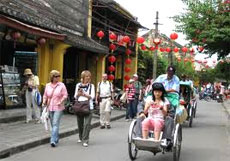
In the Northern and Central regions, French tourists like visiting Hanoi, Sapa and Hoi an because they want to learn Vietnam culture features and French marks in these sites through the adopted culture and historical architecture.
France is among key markets of Vietnam’s tourism sector. More than 300,000 tourists visit Vietnam and the figure increases from five to six percent every year. Direct flights between Vietnam and France via the Charles De Gaulle International Airport (France) have helped visitors to travel easily. Moreover, the Vietnam tourism sector has strengthened its promotional activities in France. For example, the Ministry of Culture, Sport and Tourism is opening a tourism promotion center in France. During the last few years, Vietnam Airlines has coordinated with the Ministry of Culture, Sport and Tourism and the Vietnamese Embassy in France to hold a Vietnam Tourism Festival in France which has helped travel agents and companies share information, business opportunities and polish Vietnam’s image internationally. These activities have been promoted via popular websites such as Le Monde, Courrier International, Voyage and Telerama.
Source: VEN
Posted by admin on January 29, 2011 under Vietnam Festivals, Vietnam Travel Info |
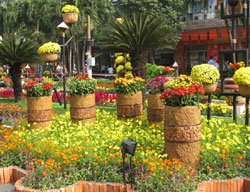
To meet people’s entertainment needs during the Lunar New Year (Tet), Ho Chi Minh City (HCMC) government and related departments are preparing a range of cultural activities to welcome the Year of the Cat.
This year, under leadership of the Ho Chi Minh City People’s Committee, the Saigontourist Travel Services Company in conjunction with local departments will organize a range of programs in the city center including the Nguyen Hue Flower Street, the “Tet” (cylindrical glutinous rice) Cake Festival, Shining City, Lunar New Year’s Eve Fireworks, Street Decoration and Door Shows with the themes of Vietnamese soul, Tet in the south and safe and happy spring to serve tourists from 7pm on January 31 until 10pm on February 6. The highlight of the festival this year will be the Nguyen Hue Flower Street. Following the theme of “the Spring Dawn” of 2010, this year’s theme will be “New Heights”. Nguyen Hue Flower Street will reflect enormous efforts of Ho Chi Minh City to achieve higher economic, social and political results.
As part of the activities welcoming in the Year of the Cat, the Ho Chi Minh City Department of Information and Communications will, in conjunction with the Ho Chi Minh City Association of Journalists launch the Spring Newspaper Festival of 2011 on January 20-21, 2011 at the Ho Chi Minh City Youth Palace of Culture. This is an annual Ho Chi Minh City Spring event. Nguyen Anh Tuan, the deputy director of the Department of Information and Communications, said that the Spring Newspaper Festival would feature 45 pavilions which showcase all types of the press. It is estimated that the festival will feature about 200 centrally-governed newspapers, local newspapers and newspapers from surrounding provinces. Many of the newspapers will release special New Year editions, which will be given to students, soldiers and workers in industrial zones. In addition, a meeting among famous journalists, students, workers and soldiers will be held. People who attend the festival will receive free health advice and there will be competitions for the most well-designed booth and publication front cover.
A book street festival will also be organised. Nguyen Hoang Ha, a representative from the Department of Information and Communications, said that the book street festival would feature the Fahasa Book Distribution Company, Thanh Nghia Book Distribution Company and Ho Chi Minh City Library, with the intention of promoting an increased appreciation for literature, especially among the young. Many other activities such as the publishing of e-books, books for the blind and meetings with famous poets and writers will be organized. Visitors can borrow books and read them on-site, exchange and buy books. Twenty old books will be displayed.
A representative from the Ho Chi Minh City Library said that the book street festival would focus on children, and host 3,500 books for young readers. In addition, the library would hold a book exhibition attracting the participation of many provinces.
Source: VEN
Collected by Vietnam hotel
Posted by admin on under Vietnam Festivals, Vietnam Travel Info, Vietnam World heritages |
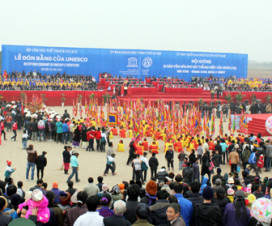
Vietnam held a ceremony on January 22 to officially receive certification from UNESCO for the Saint Giong Festival as an Vietnam Intangible Cultural Heritage.
Vietnam held a ceremony on January 22 to officially receive certification from UNESCO for the Saint Giong Festival as an Intangible Cultural Heritage.
The Ministry of Culture, Sports and Tourism, Hanoi’s municipal government and the Vietnam National Commission for UNESCO helped to organise the ceremony in Phu Dong, Gia Lam district.
UNESCO gave a notification for the festival in both the Phu Dong Temple, and Soc Son Temple (in Soc Son district) on November 11, 2010.
The ceremony drew the participation of UNESCO Chief Representative in Vietnam, Katherine Muller Marin, from 400 to 500 officials and between 7,000 and 8,000 locals.
The ceremony featured the important traditional parts of the Saint Giong Festival, staged by people of the villages.
The performance including about 500 people featured Mua co (literally translated as dancing with flags), as well as two traditional games, Cuop chieu, and Keo chu.
Source: dtinews.vn
Collected by Vietnam hotel
Posted by admin on January 28, 2011 under Vietnam Travel Info |
|
|
|
A special variety of daisies that will bloom only during Tet.
|
My uncle Quan, who was an ornamental tree planter and dealer in the southern province of Binh Duong, took me to visit the renowned Cai Mon Flower Village of Cho Lach District in the province of Ben Tre last weekend.
The dusty road from Chau Phu ferry to the flower village was made more pleasant thanks to hundreds of different kinds of bonsai, arranged in rows along the roadside. From afar, I could see the front yards of homes lined with pots of mai (apricot blossoms), marigolds and cockscomb, which will come into glorious bloom during Tet (February 2-6).
We stopped at the house of Trinh Tan Hai, renowned bonsai dealer who specializes in growing kieng la (leaf bonsai).
Hai’s wife, Dang Thi Thu Huong, whose siblings are longtime bonsai planters, said that planting bonsai and other ornamental trees began in Vietnam over 100 years ago.
Now, 90 percent of families in the village are in the bonsai business. Together with Sa Dec Flower Village in Dong Thap Province, Cai Mon Flower Village is one of the two hubs to supply bonsai throughout the country, as well as for export to South Korea and Taiwan.
The house is filled with different kinds of kieng la, yet, according to Hai, these are just a few of the display items.
We had to go three kilometers more before reaching the house of Nguyen Thi Nga, a bonsai and ornament tree artisan in Vinh Thanh Ward of Cai Mon.
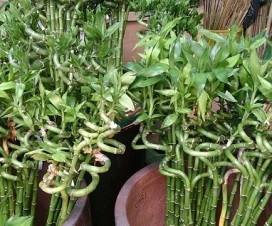
She welcomed us in her bare feet to her garden, which even at six hectares feels cramped as it is filled to the brim with different kinds of bonsai, including sago palm, lucky bamboo and daisy. She has even piled plants inside her house and built shelves to hang thousands of lan so (dischidia pectinoides), cultivated in big shells.
Pointing to rows of dai phat tai (great lucky plant) with a single red flower blooming in the center of the tree, Nguyen Thi Nga, who has cultivated bonsai for six years, said, “These and others have all been bought already, it’s a bestseller this year. I’m getting lan so ready for Valentine’s Day on February 14 because of its heart-shaped leaves.”
“Nga’s plants always sell out because she is among the few artisans who can bring dai phat tai to full bloom. I asked her to teach us but she refuses, even after we threatened to kidnap her 18-year old daughter,” Trinh Tan Hai said as he and Nga burst out laughing.
“Like other ornamental plants for the Tet holiday, I have to give them special treatment starting two to three months ago to be able to get them to bloom on time.
“The dai phat tai is among the most difficult to cultivate, but then its flower blooms for up to six months at a time,” said Nga, who seems filled with joy while looking at her beloved trees.
Huong says the job requires not only time and effort, but also a healthy dose of passion. Indeed, 36- year-old Nga has a head full of white hair. She said while preparing trees for Tet, they have to cultivate and prepare baby plants for next year. This requires them to wake up every morning at 1 a.m. to fertilize and trim the trees, and maintain the nylon roof protecting the trees from out of season rains.
Dai phat tai purchased directly at the garden by go-betweens costs just US$5-6 each normally, but the prices rise to $20-25 during Tet, Nga said.
She told us that if we had come to town even a week or ten days later, we would not have been able to see many of the beautiful trees, for they would have been shipped off to other places by then.
“See you at the Tet market in Binh Duong Province,” she told us. She has brought her plants to sell at the Thu Dau Mot market in the province for years now.
I wouldn’t miss it for the world.
Reported by Priscilla Aquila
Posted by admin on under Vietnam Beaches, Vietnam Festivals, Vietnam Travel Info |

Yacht teams from 20 countries and territories in the world will take part in the 2011 International Yacht Festival which will be held in Mui Ne, in the central province of Binh Thuan from March 17-20.
Themed “Yacht, Sea, Sand and Sun,” the second yacht festival will include interesting sports, tourism and entertainment activities such as a yacht exhibition, a yacht performance by professional athletes, plus international music performances with the participation of artists from the Czech Republic, the Republic of Korea, Australia and Russia and arts performances from Vietnam.
There will be a seminar on building a brand name for Vietnamese sea activities, along with advertising and developing yachting amusements in Vietnam.
At a press briefing in Hanoi on Jan. 20, Deputy Chairman of the Binh Thuan provincial People’s Committee Nguyen Van Thu said the organisation of the festival is to popularise Mui Ne beach attractions to domestic and foreign tourists and develop Vietnam’s sea tourism.
The event is also a chance for international yacht groups to consider investing and building yacht production plants for export in Binh Thuan to provide for the Asian market.
Boasting a 192 km coastal line, Binh Thuan province boasts abundant sea resources with beautiful beaches, historical and cultural monuments and captivating traditional festivals which are suitable for sea tourism development.
The International Yacht Association ranks Mui Ne as one of the best beaches for sailing in Asia.
Mui Ne welcomed 2.5 million tourists, 15 percent of whom were foreigners, in 2010. Binh Thuan province aims to attract 3.5 million visitors – including 500,000 foreigners – to the beach by 2015.
Source: vietnamplus.vn
Posted by admin on January 27, 2011 under Vietnam Travel Info, Vietnam tours |
Doan Thi Thanh Tra, Head of the Saigontourist Travel Service Corporation’s Marketing Department, said that as of January 26 (the 23rd day of the 12th lunar month) the company will begin to receive groups of foreign tourists who want to experience the Vietnamese people’s biggest traditional festival.
More than 8,500 visitors have booked tours to Vietnam for the occasion and this is the 8th consecutive year that Saigontourist has organised tours to serve holidaymakers from abroad as well as foreigners who are working and living in the country.
If booking a tour to Ho Chi Minh City, visitors will have a chance to enjoy the flowers at the Tao Dan Park and learn about the spiritual lives of the local people by visiting pagodas, where they can pray for good luck during the Year of the Cat.
Visitors will have an interesting experience by going on a sightseeing tour of Cho Lon market by pedicab or visiting local families, enjoying traditional dishes and receiving gifts for good luck from the owners.
Meanwhile, tours to the Mekong Delta offer holidaymakers an opportunity to experience the typical Tet atmosphere of the local residents, with exciting floating markets and Don ca tai tu (music of the talented) singing. They can join in with the hosts to pack banh tet (cylindric glutinous rice cakes) and banh chung (glutinous rice cake).
In addition, Saigontourist’s restaurants, hotels and tourist sites have also prepared menus with typical and traditional dishes to serve domestic and foreign visitors during the festival.
Other travel firms are planning to launch their own tours, alongside the traditional ones, to attract tourists during the holidays.
Duong Mai Lan, from the Vietravel Company’s Marketing Department, said that most of visitors have chosen the central ancient town of Hoi an, the central city of Da nang and the Mekong Delta as destinations.
Tours in the North will bring holidaymakers to the capital city of Hanoi, the UNESCO-recognised natural heritage Ha Long Bay, the northern mountainous town of Sapa, and the Huong (Perfume) pagoda.
Tourists can travel along the Hong (Red) river by ship and visit a number of riverside tourist sites such as Tien Dung-Chu Dong Tu Temple and Bat Trang pottery village.
According to the Vietnam National Administration of Tourism (VNAT), the country is targeting welcoming 5.3 million foreign visitors and serving 30 million domestic holidaymakers in 2011.
The tourism sector will strive to earn revenue of more than 110 trillion VND (5.5 billion USD), equivalent to 4.6 percent of the country’s estimated gross domestic product (GDP).
To reach these targets, the VNAT has mapped out plans to attract one million tourists from each of the key markets, namely Thailand, Japan, the Republic of Korea and Europe.
Source: vietnamplus.vn
Posted by admin on under Vietnam Festivals, Vietnam Travel Info |
The Huong Pagoda Festival 2011 will open on February 8 (the sixth day of the Lunar New Year), announced Mr. Nguyen Van Hau, Deputy Chairman of the My Duc District People’s Committee.
The committee set plans to manage activities of the festival, ensure social security and order, convenient transport as well as environmental and food safety to create favourable conditions for visitors to the festival.
The organizing board said that this year’s festival will have 4,600 ferry-boats, including more than 200 high-quality ferry boats to provide services for visitors.
The My Duc District People’s Committee has invested more than VND 21 billion in infrastructure, such as upgrading the road to Hinh Bong Pagoda, expanding Thien Tru Ferry-boat Station and building a medical station near the Thien Tru Pagoda.
In 2010, the festival greeted nearly 1.3 million visitor arrivals, including 26,000 foreign visitor arrivals.
Source: CPV
Collected by Vietnam hotel
Posted by admin on January 26, 2011 under Vietnam Travel Info, Vietnam attractions, Vietnam beauty |

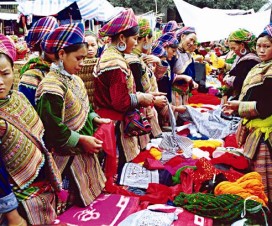
Black H’mong women sell tho cam (ethnic fabrics) in Sapa. One of the most wonderful highlands in Asia, Sapa is a magical combination of landscapes, ethnic cultures and fresh mountain air.
It was too early. I struggled to peel my eyes open, wondering what the commotion outside was all about. The clock pointed to somewhere between 4 and 5 a.m.
It was Sunday, and I was at a hotel in Sapa. Cursing the thin walls of the hotel, I walked to the window to peer into the dawning light outside.
I had expected to see a few people milling about their morning business. Instead, I saw the streets flooded with hundreds of H’mong and Red Dao people in colourful ethnic attire heading to the Sapa market.
It was an exotic orchestra of people speaking foreign tongues, children running, babies whimpering, chickens clucking and pigs snorting.
It was impossible to sleep with all the noise, so I decided to get out and experience the traditional Sunday market myself.
Love in the marketplace
The sights, sounds and smells of Sapa’s market are as distinctive as the ethnic tribes jostling about. Locals go to the market not just to buy and sell but also to unwind after a long, hard week.
I had been watching H’mong girls wearing garlands of dried mushrooms on strings around their necks, when suddenly, a H’mong man caught the arm of one of the girls and tried to pull her away.
I was alarmed, but a shopkeeper explained, “It is cướp vợ custom. When a H’mong man finds the girl of his dreams, he and his friends try to pull her away. If they succeed, they take her to the man’s house for a few days before visiting the girl’s family to ask for her hand in marriage.”
Rustic grub
Just inside the market gates were stalls full of mountain fruits such as peaches, plums, chestnuts, and Indian taro.
But the locals were eating hearty breakfasts of mèn mén (corn wheat cake), and thắng cố (horse meat soup). The better off leaned over steaming bowls of ph^, an expensive treat in these mountainous regions.
To the right are stalls full of trinkets and local products. Here you can find everything from ethnic silver jewelry to mushrooms, tam thất (notoginseng), honey, and linh chi fungus.
I bought a kilo of dried buds of the tam thất to gift friends back home. The tam thất bud tea is believed to aid good sleep.
Fabrics in Sapa
Next, I headed to the second floor of the Sapa market, which is known as the heart of the market. This is the arena of women selling brocades from their little workshops.
Many of these local artisans have been working in dimly-lit, cramped shops for decades, weaving yards of intricately designed brocades. Owing to the fabric’s popularity among tourists, a lot of the women here can converse quite well in English.
Heavily embroidered colorful blankets, pillow shams, table covers beckoned from all around. I found myself attracted to the more esoteric designs of the H’mong people.
A Sapa native told me that H’mong girls are taught to weave, sew and dye fabrics from a very young age. When they grow up, they are entrusted with the responsibility of making clothes for her family. The better her needle work, the better a girl’s prospects for marriage.
The market continues bustling until late afternoon, when locals begin to pack up their goods and head back to their homes in the terraced hills of Sapa.
Though tourism is growing rapidly in this region, mercifully, the H’mongs and Red Daos have preserved their colorful culture. In the Sapa market, the ethnic people and their cultures come alive every weekend, fusing together the simple times of the past in a traditional, but evolving market.
Reported by Amelia Pham – Thanh nien news
Posted by admin on under Vietnam Destinations, Vietnam Travel Info, Vietnam attractions, Vietnam beauty, Vietnam tours |
The green forests in the Ba Vi mountain range create a cool and romantic atmosphere, and are rich in medicinal herbs
The road was narrow and winding steeply up the mountain. Sharp bends kept me gripping the motorbike, turning my knuckles white. It was getting steadily colder as I pushed my bike into second gear and continued the climb up Tan Vien Peak.
I was in the Ba Vi National Park, just an hour and half’s drive from Hanoi’s bustling downtown.
Spread across 7,377 hectares, Ba Vi National Park surrounds Ba Vi Mountain which boasts three peaks: the highest is Vua (King) Peak at 1,296 meters, followed by Tan Vien at 1,226 meters and Ngoc Hoa at 1,120 meters.
I had followed several other nature lovers driving up Tan Vien, perhaps because of its special place in Vietnamese mythology. The peak is said to be home to the Mountain God, Son Tinh, who helped defeat the Water God, Thuy Tinh, and save the land from natural disasters.
I had just driven 50 kilometers away from Hanoi, but it felt like a lifetime away. Gone were the busy streets, the honking and the calls of street vendors.
It was hard to keep my eyes focused on the meandering road. The landscape was circled by shadowy mountains, peaks playing peek-a-boo with clouds, and streams snaking through the valley below.
About 400 meters from the foot of Tan Vien, I stopped at the Ba Vi Resort for some drinks. In a manicured lawn packed with winter blooms, Dang Van Thanh, manager of the resort, urged us to explore the park on foot.
For years, Ba Vi National Park has been considered the lungs of Hanoi. I decided to abandon my pollutant-emitting bike for a walk in the woods with a local guide.
Our enthusiastic guide Hung pointed out several rare plants and birds as I ventured deeper into the forest. The Ba Vi National Park is home to more than 800 exotic plants. More than 100 bird species make the park a bird-watcher’s paradise.
Hung said the forest is a significant source of income for the people of the Dao ethnic minority who use herbs from the forest to make medicines for local as well as foreign consumption.
Since it was the dry season, the emerald green lakes I had seen during my last visit three years ago were mostly dried up.
But there was something else missing too. I realized suddenly that the chatter of monkeys that had animated the forest earlier was conspicuously missing.
Hung said the monkeys had been chased away so they wouldn’t trouble the visitors. It was sad because the monkeys had really added to the atmosphere of the forest.
Ba Vi was developed as a hill station by the French together with Sa Pa and Tam Dao in the North and Da Lat in the Central Highlands. Along with a 1,100 kilometer road, around 200 villas, a military training center and a church were built on the mountains.
After a two hour trek in the wilderness, I hopped back on my motorbike and continued the drive up the peak. The fog thickened as I climbed up the 1,200-meter mountain.
Upon arriving at the peak, the sun suddenly brightened, its rays slicing through the mist to reveal breathtaking scenery. It was only 2:30 p.m. and there was plenty of time to climb to two mountain top temples dedicated to Mountain God, or Saint Tan Vien, and Uncle Ho (the late President Ho Chi Minh).
Some might say winter is a harsh time to visit the mountains but the misty mountains of Ba Vi are a haven for the romantic and adventurous. If you have the luxury of time, spend a night at the Ba Vi resort. I wish I had.
HOW TO GET THERE
Visitors can easily get to the site by motorbike or car. Follow Thang Long Avenue and turn right to head toward Son Tay Town. The Ba Vi National Park is about 6 kilometers from Son Tay Town. For more information or for accommodations, contact Ba Vi Resort at (09) 9 274 0055/ (09) 8 871 4696.
Visitors can book a day or two-day one-night tour to Ba Vi National Park at: Kien Thanh Tourist, 2nd floor, 381 Truong Chinh Street, Hanoi. Tel: (04) 3 568 1252.
Ami Tour, 2A Tran Thanh Tong Street,
Reported by Phong Lan
Tourists on a bike trip at Ba Vi National Park
Collected by Vietnam hotel
Posted by admin on January 25, 2011 under Vietnam Festivals, Vietnam Travel Info |
Discover Vietnam’s minority tribes in person at the Vietnam Ethnology Museum at Nguyen Van Huyen Street in Hanoi during Tet from February 6 to 8.
For the first time, Raglai people from Ninh Thuan Province, Dao and Na Mieo from Lang Son Province will all come to introduce their colorful culture, music, dances and indigenous festivals to Hanoi. Visitors will be able to see Lion dances of Nung people, gong performances of Raglai and the bamboo dance of Thai people on the same stage.
Other attractions include water puppet shows, calligraphy demonstrations and artists from Dong Ho painting village who will show you how to paint the folk characters that have made their village famous.
Many ethnic folk games will be played. Kids can have fun with traditional toys such as pin wheel, to he (figurines fashioned from colored rice dough), flowers and fruits made of dough, 12 animal designations made of clay. Guests can enjoy many kinds of food.
Source: thesaigontimes.vn