The majesty of Hue

Posted by admin on November 30, 2010 under Vietnam Destinations, Vietnam World heritages, Vietnam architecture, Vietnam attractions, Vietnam beauty | Be the First to Comment

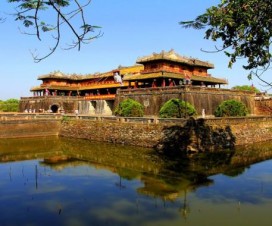
Dai Noi, which is divided into the Hoang Thanh (Hue royal citadel) and Tu Cam Thanh (forbidden citadel), is the largest most-important heritage building in the ancient capital. It was started in 1804 and finished in 1833. There are 100 different constructions inside the palaces but most of them were destroyed by natural disasters and wars. UNESCO has contributed money to restore parts of the citadel.

Hue was the capital of Vietnam during the Nguyen dynasty (1802-1945). The city which is 1,066 kilometers north of HCMC has a distinctive geography, history, culture, architecture and culture. Nowadays, Hue attracts tourists to its temples and royal tombs that were acknowledged as World Heritage by the UNESCO in 1993.

The Saigon Times Daily’s photo-journalist Kinh Luan captures some of the romantic city’s history and natural beauty that Vibeke Jensen, head of the UNESCO office in Vietnam, was speaking about, when she said Hue was “One of the few places in the world that has both global-value tangible and intangible heritages.”

The 400 meter-long Trang Tien Bridge across Huong River was designed by architect Gustav Eiffel in 1897 and finished after two years. In the war time, the bridge was destroyed twice.

Built on the banks of Huong River in 1601, Thien Mu is the city’s most famous pagoda. Lord Nguyen Hoang Lord named it Thien Mu after a legend about a woman who fell from heaven to announce a time of prosperity.

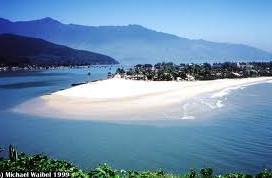
Poetic Huong river and majestic Ngu Binh Mountain in the background are icons of hue. People say they are as solemn and as unobtrusive as Hue people.

Southern tourism triangle in the offing
Posted by admin on under Vietnam Beaches, Vietnam Destinations, Vietnam Travel Info | Be the First to Comment

VietNamNet Bridge – HCMC has reached agreement with two other provinces to develop what will become a southern tourism triangle through a variety of joint product development and marketing projects from now to 2012.

In the signing ceremony in the city’s coastal district of Can Gio late last week, the three parties – HCMC, Lam Dong and Binh Thuan – will initially link their key tourist destinations.

They will also organize conferences along the way to call for investors to diversify tourism products while issuing joint marketing brochures and implementing joint promotion programs.

They will jointly participate in tourism exhibitions at home and abroad, arrange local and foreign familiarization trips and connect their tourism and travel websites, among others, according to the pact between the three provincial tourism departments.

In addition to that, the tourism associations of the three localities clinched a similar cooperation deal to develop four tourism routes between HCMC, Dalat and Phan Thiet.

La Quoc Khanh, deputy director of the HCMC Department of Culture, Sports and Tourism, said cooperation between the three provinces had been in place since 2007 and had produced some good results.

“HCMC-based travel companies now contribute around 45% of total tourist arrivals in Lam Dong and have many tours linking sites of interest in HCMC, Lam Dong and Binh Thuan,” he said.

In terms of investment, he noted, HCMC companies are also at the top in the other two provinces.

But officials and travel firms at the signing ceremony conceded the three provinces had yet to make full use of marketing activities and promotional events in and outside the country.

The relationship between tourism firms in HCMC, Lam Dong, and Binh Thuan has remained loose and this might make it hard to translate the tourism triangle goal into reality.

“We’re aware of the limitations and will try to resolve them. The three tourism associations on Tuesday signed the cooperation deal that will help us strengthen the link between travel firms,” Le Thi Thanh Lien, deputy director of Binh Thuan Province’s Department of Culture, Sports and Tourism, said last Friday.

According to reports by the three tourism departments, Lam Dong has 242 tourism projects worth nearly VND47 trillion, with investors from HCMC accounting for 100 projects capitalized at VND29 trillion, and those from Binh Thuan having three projects valued at VND90 billion. Lam Dong is famous for its hilly resort town of Dalat.

Binh Thuan, which is known for the seaside resort town of Phan Thiet, has 253 tourism projects committed by investors in HCMC with total investment capital of VND37 trillion.

Source: SGT

The tragic love story of Dam Trau Beach
Posted by admin on November 29, 2010 under Vietnam Beaches, Vietnam Destinations, Vietnam attractions, Vietnam beauty | Be the First to Comment

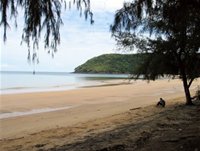
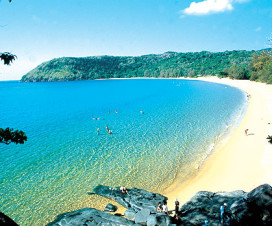
Dam Trau BeachDam Trau is a long deserted tropical beach on Con Dao Archipelago.

At one end is the Co Ong Airport runway where the occasional plane breaks the silence as it comes into land. At the other end is a rocky headland jutting into an azure sea. The white sandy beach is clean and backed by forested hills. It can be accessed from the road by a few rough tracks.

Tuan Anh, our tour guide tells us a sad love story about Dam Trau Beach where a clever, hardworking guy named Truc Van Cau who lived in Co Ong Village fell in love with a beautiful girl named Mai Thi Trau.

Everyone in the village thought they were a beautiful couple, until Cau’s father told him that Trau was actually Cau’s sister because the father had an affair with her mother many years prior. So the love was forbidden.

Knowing that they couldn’t love each other anymore, Cau left his village for a small island and lived there. People called this island Hon Cau (Cau Islet). Trau was pregnant with Cau’s child and she went to the cliffs where they used to meet and waited for him every day. Finally she committed suicide. The place where she died, people in Co Ong Village called Dam Trau Beach. Cau never returned and stayed on the island for the rest of his life.

A local saying goes, “Remember telling Cau, how far from Hon Cau to Dam Trau?”

The answer is 10km according to our tour guide.

Source: The saigon Times

Floating fish farms in Nha Trang

Posted by admin on under Vietnam beauty | Be the First to Comment

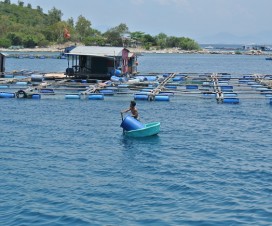
Nha Trang is known for its beautiful beaches, islands, resorts and water sports, but if you want to get a feel for local life you can take a short boat ride to visit a family on a floating fish farm.

Tri Nguyen Village Floating fish farms Nha trang

See for yourself how the families raise fish at the floating houses, and buy fresh fish at a good price.

The fish are bred in cages suspended under the floating houses on the sea. The farmers sort their stock by size into different cages and feed them anchovies and feed from the city’s markets.

The farmers, mostly men, are a relaxed bunch, listening to music, drinking beer and presenting visitors with fish so fresh they’ll slither out of your hands. They are always open to questions.

Source: thesaigontimes.vn

Sea tourism – a key element in Vietnam’s tourism development strategy
Posted by admin on November 27, 2010 under Vietnam Beaches, Vietnam Destinations, Vietnam Travel Info | Be the First to Comment

Vietnam tourism is about to finish the 5 year development period of 2006-2010 to enter a new development era. According to Mr. Nguyen Manh Cuong, Deputy General Director of the Vietnam National Administration of Tourism, in the next 10 years, Vietnam Tourism will move its focus from “quantity” to “quality”, in which tours to explore sea, culture, ecotourism, communitiy development are among top priorities.

Vietnam boasts world-class beaches, bays and islands including Halong bay, Nha Trang beach, Mui Ne, Phu Quoc island, Con Dao island, etc. The facts indicate that in recent years, sea tours have attracted a great number of overseas tourists and brought about the largest portion of total tourism income of the country, Cuong said. Nevertheless, sea exploitation for tourism development is still considered spontaneous and wasteful. Long term planning strategy is therefore needed to ensure sustainable development in the coming time.

The tourism sector will target maintaining growth rate while improve tourism income by developing high value-added products. The sector tries to earn US$ 8.9 billion in revenue, accounting for 5.2% of GDP by 2015; US$ 15.9 billion and 6.0% of GDP by 2020.

In the new development period, increasing tourism income will be the core issue. The industry aims at exploiting both domestic and international markets while giving priority to luxury clients to attract foreign currencies, maintain traditional source markets.

Vietnam will concentrate on luring tourists from ASEAN, Northeast Asia, Western Europe, North America, Northern Europe, overseas Vietnamese…; place sea tourism at the core position in the development strategy of the industry to draw tourists, earn big income and create lots of jobs.

Source: VNA

Vung Tau Beach Vietnam

Posted by admin on under Vietnam Beaches, Vietnam Destinations, Vietnam attractions | Be the First to Comment

Location. About 125km Southeast of Ho Chi Minh City, there appears Vung Tau City, which is located in Vung Tau peninsula, the curved point of ‘S’ letter (map of Vietnam). This is the border of  the South and the West of Vietland, where we can see the sun on the East Sea (or South China sea), both rising and setting.

The first beach is Bai Truoc (translated as “front beach” in Vietnamese), in the West of the city, where the sun goes down. Bai Truoc is considered the façade of Vung Tau city. It is also called by other names such as Tam Duong beach or Hang Dua bay. Besides the best location, the beach is also preferred for having many restaurants and elegant hotels. Sparking, colorful and bright light boulevard make Bai Truoc more beautiful.

Opposite to Bai Truoc is Bai Sau, Back beach (or Thuy Van beach). Back Beach is well-known for its over 10 km of fine sand seaside. The beach is always excited and busy with almost tourists both from the city itself and the world. At weekends or on holidays, there are thousands of people coming here for swimming and entertainment. In Bai Sau, there is a popular kind of entertainment: Paradis, the upgraded swimming and relaxing area, and a system of modern hotels, welcoming all tourists. Other beautiful beaches are Bai Dua and Bai Dau.

From Bai Truoc, Halong street curls to Bai Dua, pineapple beach. The reason for placing that name dated a long time ago, when the beach had many pineapple trees, thus it was called Bai Dua (or Pineapple garden). Many Vung Tau people also call the beach Lang Du, which originated from the local’s first restaurant’s name.

Right in here, the sea goes far into the land and the rock mountain goes from the land to the sea establishing romantic and hidden small beaches. The beach attracts a big amount of tourists. Nearby, the Temple of Southern sea Saint and Tinh Xa nirvana are tourist-attractive sites, which were built on one of these rock mountains.

Bai Dau, Mudberry Beach, is at the foot of Nui Lon, in the North of the city. There used to be a lot of mudberry and ratten so it is also named Ratten beach. Nevertheless, today, there is no longer any mudberry and ratten. So now, instead, when mentioning about Bai Dau, people think of a windless and rocky beach. Tourists should walk on about a few meters to see a 30m-high statue of Mother Maria shining in the green picturesque forest and sea landscape.

As not so far from Ho Chi Minh City, it is a favorite resort & entertainment destination for those who wish to hide away from the busy city and entertain themselves in a real way.

Fest spotlights heritage cultural heritage

Posted by admin on November 26, 2010 under Vietnam Travel Info, Vietnam World heritages, Vietnam attractions | Read the First Comment

The sixth Viet Nam Heritage Day festival has begun at the Viet Nam Exhibition Centre for Culture and Arts on Hoa Lu Street in Ha Noi.
“The festival is being held with the aim to celebrate the country’s rich past, respect the contribution of young people towards preserving cultural traditions and raising their awareness and responsibility to developing the national heritage,” said Ha Noi Association of Literature and Arts president Do Thi Hao.
During the festival, visitors are enjoying calligraphy demonstrations and folk games, music and dances, plus an exhibition displaying 500 items dating from the Dong Son Culture (700-100BC) to the Nguyen dynasty (19th-20th century), as well as artefacts from the Thang Long Royal Citadel ruins and photos of the 82 stone doctoral steles at the Temple of Literature).
The cuisine and craft villages of Ha Noi are also being highlighted, including such crafts as embroidery, wood carvings, copper statues and rattan furniture. Artisans from the craft villages are performing rituals to pay tribute to their ancestors who established their village trades.
Researchers also participated in a workshop yesterday, Nov 23, to discuss the preservation of Ha Noi’s tangible and intangible heritage, such as Duong Lam Village, Thang Long Royal Citadel, Thang Long folk dances, and traditional beliefs and festivals.
“To preserve the vestiges of these cultures, we need to improve the knowledge and techniques of the preservationists,” said the director of the Thang Long – Ha Noi Citadel Preservation Centre, Nguyen Van Son. “Those who join in preservation must have professional skills, technique and responsibility for what they do.”
The festival, which ends tomorrow, was co-organized by the Ministry of Culture, Sports and Tourism, the Ha Noi People’s Committee, the Ministry of Education and Training, and the Viet Nam Cultural Heritage Association.

Source: VietNamNet/Viet Nam News

Hoping for a bridge to cross stunning Pieng Lao Stream
Posted by admin on November 25, 2010 under Vietnam Destinations, Vietnam Travel Info, Vietnam attractions | Read the First Comment

By Ngoc Bang | dtinews.vn |

Pieng Lao Stream in the northern mountainous province of Lao Cai boasts breathtaking scenery and plays a significant transportation role but locals dream of having a bridge built so they can cross more easily.

Local people in Bat Xat District in the northern mountainous province of Lao Cai are very proud of their stunning Peing Lao Stream. Crossing the stream is also the only way to get to one of the district’s biggest markets, Muong Hum. On market day, hundreds of people, horses, motorbikes, trucks, etc. will wade across the stream to the market.

A village patriarch living near Muong Hum Market proudly said that this is the biggest market in Bat Xat District. “We are having more and more visitors from neighbouring districts, even foreign visitors arriving from Sapa,” he said.

According to a local teacher, Nguyen Thi Ngoan, wading across big streams like this used to be very familiar with local ethnic people in mountainous areas. “But nowadays, maybe only Bat Xat people are still having to wade across such a long stream,” Ngoan said. “We all want to have a bridge so that we can cross it more safely.”

DTiNews captures some photos of the beautiful Pieng Lao Stream on a recent market day:

Vung Tau’s temple for the drowned

Posted by admin on under Vietnam Culture, Vietnam Travel Info, Vietnam attractions | Be the First to Comment

VietNamNet Bridge – Dinh Co Temple in Ba Ria-Vung Tau Province was built after the body of a 16 year old girl washed up on Long Hai Beach 186 years ago.

Dinh Co Temple in Ba Ria-Vung Tau Province was built to worship a drowned girl, who was found on the beach after a typhoon. (Photo: SGT)

The temple on windy hilltop overlooking the beach in Long Dien District was built to honor the girl, Le Thi Hong Thuy.

People believed she was a sacred goddess, who would protect them. Her grave is still there beside it.

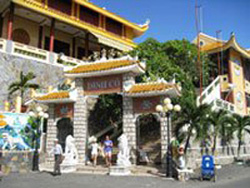
Two white lion statues guard the gate to the 37 stone steps that lead up to the main building that is a vast 1,000 square meters. Old trees and flowers fill the grounds. From the top of the stairs you can see Vung Tau City and Thuy Van Beach in the distance.

The sanctum of the temple has seven altars and a small statue of the girl dressed in red with gold lame trim.

Every year, there is a three day festival called Nghinh Co Festival on February 10-12 of lunar calendar that attracts pilgrims from around the country.


VietNamNet/SGT

Ba Be National Park registered in Ramsar List

Posted by admin on under Vietnam Travel Info, Vietnam World heritages, Vietnam attractions | Be the First to Comment

Deputy PM Nguyen Thien Nhan agreed to allow the Ministry of Natural Resources and Environment to register the Ba Be National Park in the Ramsar List of Wetlands of International Importance.

Ba Be National Park is recognized as an ASEAN Heritage Park in 2004.

The national park in the northern province of Bac Kan has an area of 500 ha with primeval forests home to 417 species of plants, 299 species of vertebrates, and 49 species of freshwater fish.

The park has met 7 out of 9 criteria for being included in the list.

In 1995, Ba Be Lake in the national park was recognized by the World Lake Conference as one of the world’s 20 special freshwater lakes in need of protection.

In 2004, the national park was recognized as the ASEAN Heritage Park.

Vietnam is proposing UNESCO recognize the park as a world natural heritage.

The Ramsar List of Wetlands of International Importance is the keystone of the Ramsar Convention. Its chief objective is to “develop and maintain an international network of wetlands which are important for the conservation of global biological diversity and for sustaining human life through the maintenance of their ecosystem components, processes and benefits/services.”
Vietnam participated in the Ramsar Convention in 1989.