The intoxicating world of Vietnam’s rice wine culture

Posted by admin on October 30, 2010 under Food and Drinks | 3 Comments to Read

Whether it’s drunk plain, combined with herbs, or even with snakes and other small animals, the Vietnamese have turned rice wine into the focal point of every party
By Adam Bray

Mot! Hai! Ba! Do! (One! Two! Three! Drink!), shout my friends and I as we lean forward to sip sweet, golden rice wine in unison through long bamboo straws in Phan Thiet City. Between rounds we tear off bits of salted, dried squid dipped in a blend of sour tamarind and soy sauce; unwrap pickled pork in banana leaf; and slurp the semi-formed fetus from hard boiled quail eggs. These and other essential drinking snacks are appropriately called moi, or “fish bait.”

When I go out drinking with other men (it’s not yet acceptable for Vietnamese girls to drink alcohol), or di nhau (go on a drinking session), it’s essential that we all drink equal portions. Unlike in the north, we pass around a communal glass here in the south. Despite the potency (40% ABV), I can’t stop anxiously recalling the high rates of hepatitis and TB here in Binh thuan Province.

There are three major kinds of rice wine in Vietnam: the conventional distilled variety known as ruou gao (literally “rice alcohol”), wine brewed in large ceramic jars called ruou can (party wine), and distilled alcohol infused with plants and animals, known as ruou thuoc (medicine wine).

Ruou gao or ruou de (plain rice alcohol)

Distilled rice wine is known as ruou gao in the north and ruou de in the south. Most rice wine is made in small home distilleries using either normal or sticky rice. The white rice is first cooked and mashed, then water and yeast is added before the mixture is left to ferment. The resulting broth is eventually distilled to produce alcohol.

Consumption of Vietnamese rice wine has serious risks. Toxins leached into the alcohol from the still, or small amounts of rubbing alcohol (added intentionally to improve appearance) often cause blindness or even death.


In Lam Dong Province, traditional home distillery owners also raise hogs. The rice mash that is left over after distillation (pictured above) is happily consumed by the animals, which as a result, spend most of their time lying around intoxicated and quickly fatten-up.

Cham men drinking ruou can in Mui Ne, Binh Thuan Province, procured from their Raglai neighbors (a sister tribe residing in the mountains).

Ruou can (party wine)

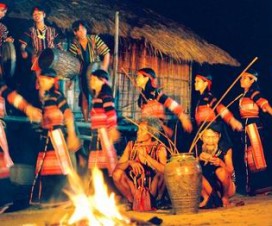
Ruou can is my personal favorite, and traditionally made by Vietnam’s hilltribe minorities for special occasions like weddings and the New Year festival. Ruou can is very different from ruou gao because it is not distilled. Instead, brown or black sticky rice, herbs, tree bark, and other natural flavorings are packed into a large ceramic jar and allowed to ferment for at least couple of weeks.

Just before the party, liquid is added to the moist mixture — often coconut juice, soda water or beer — and allowed to sit for an hour or more. For extended drinking sessions, the full volume of liquid may be replenished twice. The resulting beverage, drunk through long bamboo straws, is sweet and potent with a complex flavor. The pallet spectrum includes coffee, honey, chocolate, anise, cloves and cinnamon, all depending upon the unique ingredients added by each hilltribe.


Superstition plays a part in the production of ruou thuoc. “Traditionally, a prized wine should be buried at the northeast corner of a three-way crossroads and left underground for 100 days to obtain optimum balance with nature,” says Ha Le Hung, pictured here with snake wine — a variety of ruou thuoc at the Forest Restaurant in Mui Ne, Binh Thuan Province.

Ruou thuoc (medicine wine)

“There are more than 100 kinds of ruou thuoc,” says Ha Le Hung, a local expert and owner of the Forest Restaurant in Mui Ne. “Each is prescribed for a different ailment — one for old men with back problems, another for women after childbirth, one to aid digestion or circulation and so on.” Enhanced male sexual virility is a dominant, recurring theme.

Ruou thuoc, or medicine wine, is a potent form of distilled rice alcohol infused with herbs, fruits, spices, and wild animals like snakes, geckos and seahorses. Many endangered species are poached for use in ruou thuoc, including bears for their bile, and dear for antlers, hooves and fetuses. Some herbal varieties are indeed tasty and may have health benefits derived from traditional Chinese medicine. I find others taste horrid and most certainly provide only superstition-induced placebo effects… not that I need to boost my own virility, of course.


A broad selection of ruou thuoc, with whole geckos, snakes, sea horses, deer legs, deer fetus, birds, and baby monkeys is on display at a Buon Ma Thuat, Dak Lak Province rice wine shop. Single shots can be purchased with the addition of a beating cobra heart, spleen, or topped off with a teaspoon of warm cobra blood.

Ruou Thuoc, particularly ruou ran (snake wine), is a popular souvenir item, despite being illegal to import in some countries. These souvenir bottles on display at a Saigon shop should never be consumed, as the rice alcohol is often “enhanced” with rubbing alcohol or formaldehyde.

Source: CNNgo

20 idyllic beach getaways

Posted by admin on under Vietnam Beaches, Vietnam Destinations, Vietnam Travel Info, Vietnam attractions | 8 Comments to Read

So many beaches in Asia, so little time, so we’ve picked out our faves for their seclusion, watersport action and local flavor

By CNNGo Staff

Life’s a beach, and in Asia there’s a whole lot of good living to be had. We’ve researched and uncovered the top beach destinations to be found in the region. We’ve even broken them down into three categories — secluded beaches, action beaches and local flavor — so all you need to do is decide exactly how much coastal paradise you can handle.

For seclusion

Yunokawa, Japan

Yunokawa, Hakodate, Japan

Yunokawa may be known as an onsen (hot spring) district but there are lovely, largely deserted beaches all around town.

The true charms of the coastal city don’t show themselves until the winter months. The area is scattered with onsens directly facing out to the shore and we can think of few things better than bathing in a hot spring while looking out at a beach covered with snow. Yunokawa is largely ignored by both foreign and domestic tourists during winter, as most Hokkaido vacationeers opt for Sapporo for skiing, so shops close early, which adds to the town’s sedate ambience.

Bai Dai Beach, Phu Quoc

Bai Dai Beach, Phu Quoc Island, Vietnam

Phu Quoc is being fashioned as the ‘next Phuket’ and will soon be turning in a pretty profit for the Vietnamese government and resort operators. But if unsoiled charms are what you’re after, there’s still time for you to check out the island and find out why the government finds it bankable in the first place (the international airport won’t open until next year).

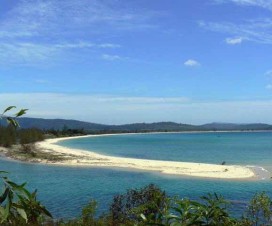
Phu Quoc is frequently touted one of Vietnam’s most beautiful islands and the Bai Dai Beach, which squats in a Viet military area, is blissfully secluded with white sands and expansive vistas stretching to the horizon.

Patnem Beach, Goa

Patnem Beach, Goa, India

Most tourists know Goa for its Anjuna beach, hippie heaven of the 1960s and now tourist magnet. If the cacophony of flea markets and tourist raves are not your thing, head down to the lesser-known shores of Patnem, which is a stone’s throw away from the increasingly crowded Palolem beach.

Patnem may be smaller than its famous neighbor but it’s also less claustrophobic, with cheaper beach hut accommodation. It’s the perfect place to kick back and enjoy the sunset while congratulating yourself on ducking the Goan tourist radar.

Tanjung Rhu, Langkawi

Tanjung Rhu, Langkawi, Malaysia

The island cluster of Langkawi is spearheading Malaysia’s bid to become the next major resort destination in Southeast Asia, and while on the main isle (also called Lankawi) most tourists flock to Pantai Cenang beach, we like the quieter Tanjung Rhu for its earthy beauty and serene atmosphere.

The two-mile Tanjung Rhu beach area is surrounded by ancient limestone caves, rippling waterways and dense mangroves. The newly opened Four Seasons resort offers boat tours around the mangrove forests led by naturalists.

Havelock Island, Andaman Islands

Havelock Island, Andaman Islands, India

The idyllic Havelock Island may be the most visited stop on the Andaman Islands circuit, but visitor numbers there are tiny compared to the throngs at other equally charming locations in Thailand.

At the low-key Havelock Island, visitors get to taste what rustic island life is all about. The buses that operate on the island look like they’re just about to fall apart, and locals, while friendly, have a charmingly disaffected demeanor. Those seeking corporate comforts will not find it here as Havelock is free of chain resorts.

Ta Pho Beach, Koh Kood

Ta Pho Beach, Koh Kood, Thailand

Thailand’s Koh Kood is possibly one of the very few places that can live up to the myth of the unpeopled Asian beachy paradise. It’s got the prerequisites — a rainforest, quaint fishing villages, coconut plantations, snorkeling spots, and a population of less than 2,000.

One of the star attractions is the immaculate Ta Pho Beach, a wide swathe of sugary-white sand fringed with coconut trees.

Pulau Derawan, Indonesia

Pulau Derawan, Indonesia

Tourists seeking to escape corporate comforts can’t go wrong with the Indonesian island of Pulau Derawan. Tourist accommodation is no-frills, and locals are unassuming and chatty. The luckier visitors will be able to spot turtles wading about on the island’s spotless silvery beaches.

The waters surrounding Derawan are known to be a top-notch spot for splashing around with mantra rays and green turtles.

For action

Phra Nang Beach, Railay

Phra Nang Beach, Railay, Thailand

With Daliesque limestone structures, hundreds of challenging cliff-side climbing routes and Tiffany-blue waters, the peninsular of Railay is the seasoned rock climber’s dream. Phra Nang, the area’s fine-grained main beach, offers a sweeping view of the area’s rugged beauty and is flanked by stalactite-rimmed cliffs that tourists can jump from.

Although Railay is only accessible by long-tail boat from Krabi and Ao Nang, it can get crowded during tourist peak seasons.

Sipadan, Malaysia

Sipadan, Malaysia

For divers, it doesn’t get much better than the beach-rimmed Sipadan. It’s been voted the best dive site in Asia with good reason — Sipadan is blanketed with lush corals and supports an extraordinarily healthy marine ecosystem, including robust reef shark and green turtle populations.

More divers won’t pass up on the opportunity to visit Barracuda Point to experience what it’s like to have thousands of barracuda milling around them. To conserve the area, only 120 diver permits are issued at Sipadan every day.

Hikkaduwa, Sri Lanka

Hikkaduwa, Sri Lanka

With its political woes apparently easing, Sri Lanka’s efforts to become known as a tourism hotspot rather than a terrorism hotbed are no doubt aided by its world-class surf spots.

Surf Mecca Hikkaduwa, one of Sri Lanka’s most popular beach destinations, has close to a dozen reef breaks that stop short of being life-threatening, and plenty of sea corals to keep snorkelers happy.

To complete the Asian getaway experience, Hikkaduwa has sumptuously spicy local fare and Buddhist cultural spectacles for vacationers to write home about.

Gaya Island, Borneo

Gaya Island, Borneo, Malaysia

Travelers will have a hard time resisting the Gayana Eco Resort, even if they’re not enviro-warriors. The luxury resort, which is erected above water on stilts, has a 130-million-year-old prehistoric rainforest for a neighbor. The resort provides guides for jungle-trekking — if you’re lucky you might even spot the Megapode, a native bird that looks like a chicken but meows like a cat.

For those looking for underwater action, Gaya Island is an excellent dive spot for its corals, warm waters and exotic fish.

Mui Ne Beach, Vietnam

Mui Ne Beach, Vietnam

Thrill-seekers will not want to miss out on Mui Ne, Vietnam’s de facto adrenalin capital. It’s famous for kite-surfing for its strong winds and clear skies, and is also generally considered a prime surfing and wind-surfing spot.

Mui Ne has looks, too — parts of the beach consist of massive sand dunes, like a section of the desert crazily juxtaposed next to the sea.

Bacuit Archipelago, Philippines

Bacuit Archipelago, Philippines

The Bacuit archipelago, which comprises of over 45 islets, is recognized as one of the Philippines’ crowning geological wonders for its sheer karst cliffs and sensational limestone rock formations. The whitewashed shores in the region — notably the excellent beaches at Cadlao Island — are also great places to get your adrenalin fix, be it snorkeling, kayaking, trekking, cliff-climbing or diving.

For local flavor

Akajima, Okinawa

Akajima, Okinawa, Japan

The islet of Akajima of Okinawa’s Kerama Islands may be popular among Japanese day-trippers during the summer, but foreign travelers are a rare sight there.

Indeed, Akajima retains a blissfully sequestered charm even during peak season. The beaches are spotless, usually with just a handful of Japanese surfers, and locals are effusive and friendly. Further inland there is a quaint Ryukyuan heritage house open to visitors. If you’re lucky you may even befriend a local and have him teach you the shamisen while you sip on cold beer.

Beidaihe, China

Beidaihe, China

Hainan Island may be China’s beach getaway de jour, but it’s Beidaihe up north that’s been amusing China’s upper echelons for decades.

Beidaihe is a few hours from Beijing and offers a fascinating alternative view of China’s bygone political intrigue. Rulers such as Mao Zedong and Deng Xiaoping hashed out national policies in their private villas here, and it’s popular among Russian tourists — an offhand reminder of erstwhile Sino-Soviet ties.

Cloaks and daggers aside, Beidaihe’s restaurants offer simpler pleasures with good seafood and ice-cold beer.

Om Beach, Gorkana

Om Beach, Gorkana, India

There’s more to Om Beach at the coastal town of Gorkana than sand and sea. Gorkana, which is the site of one of India’s most sacred Shiva shrines, is a major stop on the Hindu pilgrimage circuit and Om Beach offers a fascinating glimpse into Hindu religious life.

The craggy bay is named for resembling the Hindu symbol for oneness and peace, and is backed by coconut palms and verdant hills. Downtown Gorkana is rich with old-world charm, with bare-chested Brahmin priests wandering about, and chillum-smoking masses.

Haad Rin Beach, Ko Pha Ngan

Haad Rin Beach, Ko Pha Ngan, Thailand

Haad Rin beach’s infamous full moon parties are a once-in-a-lifetime experience. Every full moon evening, tens of thousands of (predominately Aussie) travelers flock to the island for drunken, drug-fueled revelry. Lining up for toilets and drinks can get annoying, and there’s a lot of shoving and swearing going on, but for many party fiends, the buckets of cheap alcohol, the great food and the maddening crowd makes it all worth it.

I

ho Beach, Jeju Island

ho Beach, Jeju Island, South Korea

With its Hawaii-like aesthetic, Jeju has long been a favorite among Korean domestic travelers and honeymooners, and a standout in the region is Iho Beach, famous for its mixture of yellow and grey sand. The beach is shallow and good for a swim, and when you’ve dried off, we recommend heading off to downtown Jeju-si to people-watch at the raucous student bars.

The old favorites

White Beach, Boracay

White Beach, Boracay, Philippines

Boracay may be a pimped-out tourist central but there’s a reason why it remains a superlative on travel rankings.

Tourism and development have crept up on the tiny island but it still lays a respectable claim to its “tropical paradise” name. Boracay has something for everyone, from powdery beaches to water sports and spas. And while the famous White Beach is lined with luxury resorts and kitschy souvenir shacks, watching the sun go down over the water still rates as a very special moment for many.

Soneva Gili, Maldives

Soneva Gili, Maldives

Nearly all the beaches in the Maldives are faultless, but in terms of beach-side luxury, the staggeringly expensive Soneva Gili resort reigns supreme. Each over-water villa is equipped with little indulgences that you didn’t know you needed — room service by speedboat and outdoor bathrooms, for instance — and private butlers will drop you off at deserted private beaches complete with hammocks and picnics on request.