Hill station blend of old, new

Posted by admin on October 29, 2010 under Vietnam Destinations, Vietnam attractions, Vietnam beauty | Be the First to Comment

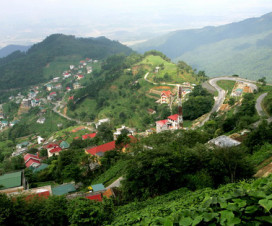
An aerial view of Tam Dao DistrictNestled high up in northern province of the Vinh Phuc, Tam Dao is perhaps the perfect respite from the heat and humidity of Ha Noi.

Tam Dao is just 86km northeast of the capital. The town, occupying 253ha, is 900m above sea level in the heart of Tam Dao National Park – the largest in the north.

The 80km mountain range has three prominent peaks, which is why it is named Tam Dao. The middle peak is called Ban Thach (Stone Table) and stands a proud 1,388m. The left peak is named Thien Nhi (Sky Market) and is 1,375m tall, while that on the right, named Phu Nghia, is 1,400m above sea level.

The French hill station is famed for the wraith-like mist that shrouds the town most mornings. By midday the fog lifts to reveal a mind-boggling panorama of hills and forests. The afternoons are typically cooler, while at night a chilly wind makes heavy clothing a must. In fact, each day in Tam Dao is like the four seasons of the year – summer, autumn, spring and winter. Leading up to the town is a thin ribbon of road 20km long rising from the plain, while a silvery stream circles the town like a silk scarf around the slender neck of an enchantress.

The town is an ideal hideout for authors, which is why an annual writing competition is held in Tam Dao.

An aerial view of Tam Dao District in the French colonialAdding to the splendour of Tam Dao are the vestiges of old French colonial houses dating from the early 20th century harking back to the days of European rule. In all, there are about 200 colonial buildings still standing, but few can remember the days of the French. Local culture official Do Dinh Chuc introduced me to Nguyen Huu Duyen and Luu Ngai. Duyen, now in his seventies, who is a descendent of one of the first families to settle in Tam Dao, some 104 years ago. Ngai used to work as a maid in one of the French’s villas.

That said, both remember only too vividly 1946 when locals applied the scorched-earth policy and destroyed the last vestiges of colonial rule during the Vietnamese war of resistance against the French.

Further information can be gleaned from the sixth volume of Indochina magazine published in June 1914. The magazine reads: “In 1904, a delegation sent by the Office of the General Governor of French Indochina sought a suitable place in the Tam Dao mountain range to build a summer resort.

“The delegation reported that they had found a suitable locality at a height of 930m. After two years of careful examination, the office began work in 1906 on the hill station.”

The French occupied the town for the next three decades before it was totally destroyed in the war of resistance. In its heyday, the town had 143 stone-built villas, some owned by wealthy Vietnamese such as Ho Dac Diem, Hong Khe and Phu My. The architecture in Tam Dao is reminiscent of Sa Pa, Da Lat and Ha Noi, a blend of the old and the new, and gave the nostalgic colonialists a taste of home.

Rustic-ruins-A-vestige-of-French-architecture-still-remains-in-Tam-DaoThe stone walls were typically 60-120cm thick. The slate for the roofs was imported from Toulouse and Marseille. Little now remains.

Duyen and Ngai said life for them and the other 6,000 Vietnamese in the region was hard. Most served the wishes of their colonial masters. They were not allowed to settle in the town. Instead they were forced to live 2km away.

Today Tam Dao has 60 hotels and guest houses that are owned by 17 families. The district received about 1 million tourists in the first six months of this year, which is a 50 per cent increase against the same period last year.

The remaining 200 inhabitants earn a living from farming and growing su su (the local name for chayote).

“Chayote here are more delicious than those in other places such as Sa Pa,” said Do Quoc Hai, a tourist from Ha Noi, while eating a bowl of chayote that had been stir-fried in oil and garlic.

Green chayote trellises laden with fruit can be seen everywhere. About five tonnes are picked each day. In fact, the unique taste of the fruit has become synonymous with Tam Dao. And when visitors reluctantly have to return to the noise and pollution of the city, a basket of the fruit is a happy reminder of the halycon days in the hills.

Source: VietNamNet/Viet Nam News

A special Khanh Hoa offering

Posted by admin on under Vietnam Travel Info, Vietnam hotels | Read the First Comment

Undulating white sand dunes all along the beautiful Doc Let Beach have made it a favorite in the central province of Khanh Hoa.

Visitors often choose to stay at highly popular Doc Let Resort, but winning the hearts and minds of increasing numbers of tourists in recent years is the White Sand Doc Let Resort & Spa, which opened in 2004.

Covering 12 hectares, the resort houses 54 bungalows with balconies opening to the sea, allowing you to sunbathe during the day, and watch the moon at night, not to mention the unforgettable early morning sunrise.

An added attraction at the resort is that it is virtually a botanical garden with many different kinds of trees and flowers. And willing to talk with you extensively about the flowers, from roses to daisies to orchids, are the resort’s owners – Chau Thi Thanh Truc and her husband, Hoang Van Hien. Both spend a lot of time taking care of the flowers and trees to make the resort an ideal destination for those who want to learn about the flora.

GETTING THERE
From downtown Nha Trang, head north to Ninh Hoa District. At the 35th kilometer milestone, turn right to Doc Let. Another 10 kilometers and you are at the White Sand Doclet Resort & Spa.

Address: Dong Cat Hamlet, Ninh Hai Commune, Ninh Hoa District, Khanh Hoa Province

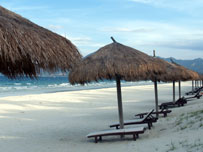
The absence of artificial decorations along the resort’s beach spanning more than a kilometer makes it a fond spot. The beach is decorated perfectly naturally and beautifully by the purple color of morning glory flowers (Ipomoea pescaprae) that grow wild at several spots.

As the sea is shallow – the water only reaches your head more than a 100 meters from the coast – even those who can’t swim can have a relaxing, fun time. When the tide is low, the sight of thousands upon thousands of sand crabs running across the beach is one of the special images that White Sand offers.

The resort also makes space for a seafood market where tourists can buy crabs, prawns and other items and then ask the sellers or the resort’s chefs to cook them. It is recommended that the seafood is steamed or grilled and eaten with pepper salt.

Tourists can rest assured that they are not paying exorbitant prices, because outside sellers are allowed to join the market for free on condition that they sell fresh food and at market prices.

The resort also has a spa, a bar with pool tables and a range of water sports for those looking for outdoor excitement.

(Reported by Khue Viet Truong, Thanhniennews.com)