Built to last

Posted by vietnamtravelblog on October 8, 2010 under Vietnam attractions | 8 Comments to Read

The Ho Dynasty’s extremely short tenure is marked by long-standing achievements including a citadel that still stands, six centuries later


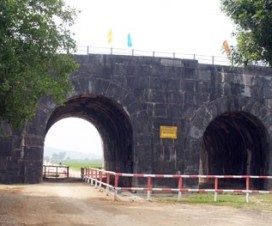
The southern entrance of the Ho Dynasty (1400-1407)’s citadel with three gates in Thanh Hoa Province

The Ho Dynasty was founded in 1400 after Ho Quy Ly (1336-1407), the highest-ranking general of the Tran Dynasty, dethroned King Tran Thieu De and declared himself the new emperor. However, his reign proved short-lived when China’s Ming Dynasty invaded and took over the country in 1407.

Although Ly has been heavily criticized for overthrowing the Tran Dynasty and letting China dominate the country again after 500 years of independence, several reforms that he initiated during his eight-year reign have stood the test of time, including the circulation of paper money.

He is also said to have brought new ideas to the construction of the Tay Do (Western Capital) citadel, in present-day Thanh Hoa Province, where he placed the central government.

The citadel is considered a “miracle of labor”, as it was built manually in just three months. After more than 600 years, the monument still stands, and the mystery of how it was built still endures.

Built with green block granite, the citadel was trapezoidal while other citadels until then were built of bricks and clay earth and bricks and were hexagon shaped.

GETTING THERE
By motorbike or car:
From Thanh Hoa Town, go northeast along the National Way No. 45 for about 43 kilometers.
Or, from Ha Trung District, go along National Way No. 217 to Vinh Loc District which is about 20 kilometers away.

By bus:
Buses to the citadel are available on both the national ways from Thanh Hoa Town.
Ticket prices: VND10,000 (US$0.51) each person.

To Thanh Hoa Town: A four-hour train journey from the Hanoi railway station; and you can get there by car, bus or even motorbike on National Highway No.1.


Round stones believed to have been used as levers to move giant granite blocks to build the citadel hundreds of years ago

The rocks, some of which are 1.3 meters high and 1.59 meters wide, were brought from many places by road or by river. How the work was done remains a mystery.

The citadel has an average height of between five and six meters, with some points reaching ten meters. Its north-south and east-west lengths are 870.5 meters 883.5 meters respectively. It has entrances on all sides, but the main one in the south, with the biggest of its three grates stretching 5.82 meters wide.

Historic documents show that Ly ordered that the citadel be built in 1397, and then coerced Kinh Tran Dieu De to move the capital from Thang Long(now Hanoi).

Three years later, he dethroned the king and set up his own court at the citadel, which has been praised by historians for its good geographical location, as it is backed by three mountains and has two rivers flowing through it.

Inside the citadel there once were palaces comparable to Thang Long’s, but all of them were abandoned and destroyed when Ly was captured and taken prisoner by Ming troops.

In recent years, the old citadel has been opened to tourists who can either make it a destination on its own or as part of a package tour that links different destinations, like Sam Son – Ho Dynasty citadel – Cam Luong Spring – Lam Kinh.

Among the interesting artifacts at the citadel are round stones that are believed to have been used as levers to move giant granite blocks hundreds of years ago.

As at other Vietnamese destinations, local culinary specialties are on offer. In Vinh Loc District, where the citadel is located, che lam and banh rang bua – different varieties of rice cake, are worth trying.

Reported by Phan Huy Tram

Travel firms offer Hanoi-discovery tours

Posted by vietnamtravelblog on under Vietnam Travel Info, Vietnam tours | Be the First to Comment

VietNamNet Bridge – Hanoi’s tourism companies have launched many tours to discover Hanoi’s culture on the occasion of the capital city’s 1000th anniversary.

The Dong Xuan JS Company introduces five tours to the Old Quarter on tramcars. Tourists will discover relics inside craft houses and artisans, learn about the spiritual culture of Hanoians at Buddhist temples, sample the famous cuisine of Hanoi and shop at Dong Xuan market.

The most special tour among these is a tour through 19 old streets. Tourists are allowed to choose three sites from the below list to stop over for 30 minutes each: 48 Hang Ngang, Dong Xuan market, Huyen Thuyen pagoda, Bach Ma temple, O Quan Chuong gate, old house at 87 Ma May, the Great Church, King Le Thai To statue, King Ly Cong Uan statue and Ngoc Son temple.

Vietran Tour offers “Hunting Ly Dynasty’s Secrets” which allows tourists to discover the history of Thang Long-Hanoi and a special tour to some martial arts clubs in Hanoi. Tourists will watch a Binh Dinh Gia martial arts show at the Tram pagoda, Vo Dang Thai Cuc Chinh Tong martial arts at Phap Van pagoda and Shaolin martial arts at Bao Long club.

“1000-year journey of Thang Long – Dong Do – Hanoi” is a collection of tours designed by Vietravel, including four tours: Hanoi – Ha Long – Trang An – old capital Hoa Lu (4 days); Hanoi – Yen Tu – Ha Long – Ninh Binh (4 days); Hanoi – Phu Tho – Ninh Binh – Ha Long (6 days), Hanoi – Yen Tu – Ha Long – Sapa (6 days).

Joining these tours, tourists will visit historical and cultural relics in these provinces and cities and participate in activities to celebrate Hanoi’s 1000th anniversary.

PV