The intoxicating world of Vietnam’s rice wine culture

Posted by admin on October 30, 2010 under Food and Drinks | 3 Comments to Read

Whether it’s drunk plain, combined with herbs, or even with snakes and other small animals, the Vietnamese have turned rice wine into the focal point of every party
By Adam Bray

Mot! Hai! Ba! Do! (One! Two! Three! Drink!), shout my friends and I as we lean forward to sip sweet, golden rice wine in unison through long bamboo straws in Phan Thiet City. Between rounds we tear off bits of salted, dried squid dipped in a blend of sour tamarind and soy sauce; unwrap pickled pork in banana leaf; and slurp the semi-formed fetus from hard boiled quail eggs. These and other essential drinking snacks are appropriately called moi, or “fish bait.”

When I go out drinking with other men (it’s not yet acceptable for Vietnamese girls to drink alcohol), or di nhau (go on a drinking session), it’s essential that we all drink equal portions. Unlike in the north, we pass around a communal glass here in the south. Despite the potency (40% ABV), I can’t stop anxiously recalling the high rates of hepatitis and TB here in Binh thuan Province.

There are three major kinds of rice wine in Vietnam: the conventional distilled variety known as ruou gao (literally “rice alcohol”), wine brewed in large ceramic jars called ruou can (party wine), and distilled alcohol infused with plants and animals, known as ruou thuoc (medicine wine).

Ruou gao or ruou de (plain rice alcohol)

Distilled rice wine is known as ruou gao in the north and ruou de in the south. Most rice wine is made in small home distilleries using either normal or sticky rice. The white rice is first cooked and mashed, then water and yeast is added before the mixture is left to ferment. The resulting broth is eventually distilled to produce alcohol.

Consumption of Vietnamese rice wine has serious risks. Toxins leached into the alcohol from the still, or small amounts of rubbing alcohol (added intentionally to improve appearance) often cause blindness or even death.


In Lam Dong Province, traditional home distillery owners also raise hogs. The rice mash that is left over after distillation (pictured above) is happily consumed by the animals, which as a result, spend most of their time lying around intoxicated and quickly fatten-up.

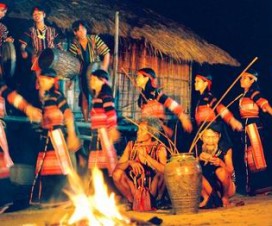
Cham men drinking ruou can in Mui Ne, Binh Thuan Province, procured from their Raglai neighbors (a sister tribe residing in the mountains).

Ruou can (party wine)

Ruou can is my personal favorite, and traditionally made by Vietnam’s hilltribe minorities for special occasions like weddings and the New Year festival. Ruou can is very different from ruou gao because it is not distilled. Instead, brown or black sticky rice, herbs, tree bark, and other natural flavorings are packed into a large ceramic jar and allowed to ferment for at least couple of weeks.

Just before the party, liquid is added to the moist mixture — often coconut juice, soda water or beer — and allowed to sit for an hour or more. For extended drinking sessions, the full volume of liquid may be replenished twice. The resulting beverage, drunk through long bamboo straws, is sweet and potent with a complex flavor. The pallet spectrum includes coffee, honey, chocolate, anise, cloves and cinnamon, all depending upon the unique ingredients added by each hilltribe.


Superstition plays a part in the production of ruou thuoc. “Traditionally, a prized wine should be buried at the northeast corner of a three-way crossroads and left underground for 100 days to obtain optimum balance with nature,” says Ha Le Hung, pictured here with snake wine — a variety of ruou thuoc at the Forest Restaurant in Mui Ne, Binh Thuan Province.

Ruou thuoc (medicine wine)

“There are more than 100 kinds of ruou thuoc,” says Ha Le Hung, a local expert and owner of the Forest Restaurant in Mui Ne. “Each is prescribed for a different ailment — one for old men with back problems, another for women after childbirth, one to aid digestion or circulation and so on.” Enhanced male sexual virility is a dominant, recurring theme.

Ruou thuoc, or medicine wine, is a potent form of distilled rice alcohol infused with herbs, fruits, spices, and wild animals like snakes, geckos and seahorses. Many endangered species are poached for use in ruou thuoc, including bears for their bile, and dear for antlers, hooves and fetuses. Some herbal varieties are indeed tasty and may have health benefits derived from traditional Chinese medicine. I find others taste horrid and most certainly provide only superstition-induced placebo effects… not that I need to boost my own virility, of course.


A broad selection of ruou thuoc, with whole geckos, snakes, sea horses, deer legs, deer fetus, birds, and baby monkeys is on display at a Buon Ma Thuat, Dak Lak Province rice wine shop. Single shots can be purchased with the addition of a beating cobra heart, spleen, or topped off with a teaspoon of warm cobra blood.

Ruou Thuoc, particularly ruou ran (snake wine), is a popular souvenir item, despite being illegal to import in some countries. These souvenir bottles on display at a Saigon shop should never be consumed, as the rice alcohol is often “enhanced” with rubbing alcohol or formaldehyde.

Source: CNNgo

20 idyllic beach getaways

Posted by admin on under Vietnam Beaches, Vietnam Destinations, Vietnam Travel Info, Vietnam attractions | 8 Comments to Read

So many beaches in Asia, so little time, so we’ve picked out our faves for their seclusion, watersport action and local flavor

By CNNGo Staff

Life’s a beach, and in Asia there’s a whole lot of good living to be had. We’ve researched and uncovered the top beach destinations to be found in the region. We’ve even broken them down into three categories — secluded beaches, action beaches and local flavor — so all you need to do is decide exactly how much coastal paradise you can handle.

For seclusion

Yunokawa, Japan

Yunokawa, Hakodate, Japan

Yunokawa may be known as an onsen (hot spring) district but there are lovely, largely deserted beaches all around town.

The true charms of the coastal city don’t show themselves until the winter months. The area is scattered with onsens directly facing out to the shore and we can think of few things better than bathing in a hot spring while looking out at a beach covered with snow. Yunokawa is largely ignored by both foreign and domestic tourists during winter, as most Hokkaido vacationeers opt for Sapporo for skiing, so shops close early, which adds to the town’s sedate ambience.

Bai Dai Beach, Phu Quoc

Bai Dai Beach, Phu Quoc Island, Vietnam

Phu Quoc is being fashioned as the ‘next Phuket’ and will soon be turning in a pretty profit for the Vietnamese government and resort operators. But if unsoiled charms are what you’re after, there’s still time for you to check out the island and find out why the government finds it bankable in the first place (the international airport won’t open until next year).

Phu Quoc is frequently touted one of Vietnam’s most beautiful islands and the Bai Dai Beach, which squats in a Viet military area, is blissfully secluded with white sands and expansive vistas stretching to the horizon.

Patnem Beach, Goa

Patnem Beach, Goa, India

Most tourists know Goa for its Anjuna beach, hippie heaven of the 1960s and now tourist magnet. If the cacophony of flea markets and tourist raves are not your thing, head down to the lesser-known shores of Patnem, which is a stone’s throw away from the increasingly crowded Palolem beach.

Patnem may be smaller than its famous neighbor but it’s also less claustrophobic, with cheaper beach hut accommodation. It’s the perfect place to kick back and enjoy the sunset while congratulating yourself on ducking the Goan tourist radar.

Tanjung Rhu, Langkawi

Tanjung Rhu, Langkawi, Malaysia

The island cluster of Langkawi is spearheading Malaysia’s bid to become the next major resort destination in Southeast Asia, and while on the main isle (also called Lankawi) most tourists flock to Pantai Cenang beach, we like the quieter Tanjung Rhu for its earthy beauty and serene atmosphere.

The two-mile Tanjung Rhu beach area is surrounded by ancient limestone caves, rippling waterways and dense mangroves. The newly opened Four Seasons resort offers boat tours around the mangrove forests led by naturalists.

Havelock Island, Andaman Islands

Havelock Island, Andaman Islands, India

The idyllic Havelock Island may be the most visited stop on the Andaman Islands circuit, but visitor numbers there are tiny compared to the throngs at other equally charming locations in Thailand.

At the low-key Havelock Island, visitors get to taste what rustic island life is all about. The buses that operate on the island look like they’re just about to fall apart, and locals, while friendly, have a charmingly disaffected demeanor. Those seeking corporate comforts will not find it here as Havelock is free of chain resorts.

Ta Pho Beach, Koh Kood

Ta Pho Beach, Koh Kood, Thailand

Thailand’s Koh Kood is possibly one of the very few places that can live up to the myth of the unpeopled Asian beachy paradise. It’s got the prerequisites — a rainforest, quaint fishing villages, coconut plantations, snorkeling spots, and a population of less than 2,000.

One of the star attractions is the immaculate Ta Pho Beach, a wide swathe of sugary-white sand fringed with coconut trees.

Pulau Derawan, Indonesia

Pulau Derawan, Indonesia

Tourists seeking to escape corporate comforts can’t go wrong with the Indonesian island of Pulau Derawan. Tourist accommodation is no-frills, and locals are unassuming and chatty. The luckier visitors will be able to spot turtles wading about on the island’s spotless silvery beaches.

The waters surrounding Derawan are known to be a top-notch spot for splashing around with mantra rays and green turtles.

For action

Phra Nang Beach, Railay

Phra Nang Beach, Railay, Thailand

With Daliesque limestone structures, hundreds of challenging cliff-side climbing routes and Tiffany-blue waters, the peninsular of Railay is the seasoned rock climber’s dream. Phra Nang, the area’s fine-grained main beach, offers a sweeping view of the area’s rugged beauty and is flanked by stalactite-rimmed cliffs that tourists can jump from.

Although Railay is only accessible by long-tail boat from Krabi and Ao Nang, it can get crowded during tourist peak seasons.

Sipadan, Malaysia

Sipadan, Malaysia

For divers, it doesn’t get much better than the beach-rimmed Sipadan. It’s been voted the best dive site in Asia with good reason — Sipadan is blanketed with lush corals and supports an extraordinarily healthy marine ecosystem, including robust reef shark and green turtle populations.

More divers won’t pass up on the opportunity to visit Barracuda Point to experience what it’s like to have thousands of barracuda milling around them. To conserve the area, only 120 diver permits are issued at Sipadan every day.

Hikkaduwa, Sri Lanka

Hikkaduwa, Sri Lanka

With its political woes apparently easing, Sri Lanka’s efforts to become known as a tourism hotspot rather than a terrorism hotbed are no doubt aided by its world-class surf spots.

Surf Mecca Hikkaduwa, one of Sri Lanka’s most popular beach destinations, has close to a dozen reef breaks that stop short of being life-threatening, and plenty of sea corals to keep snorkelers happy.

To complete the Asian getaway experience, Hikkaduwa has sumptuously spicy local fare and Buddhist cultural spectacles for vacationers to write home about.

Gaya Island, Borneo

Gaya Island, Borneo, Malaysia

Travelers will have a hard time resisting the Gayana Eco Resort, even if they’re not enviro-warriors. The luxury resort, which is erected above water on stilts, has a 130-million-year-old prehistoric rainforest for a neighbor. The resort provides guides for jungle-trekking — if you’re lucky you might even spot the Megapode, a native bird that looks like a chicken but meows like a cat.

For those looking for underwater action, Gaya Island is an excellent dive spot for its corals, warm waters and exotic fish.

Mui Ne Beach, Vietnam

Mui Ne Beach, Vietnam

Thrill-seekers will not want to miss out on Mui Ne, Vietnam’s de facto adrenalin capital. It’s famous for kite-surfing for its strong winds and clear skies, and is also generally considered a prime surfing and wind-surfing spot.

Mui Ne has looks, too — parts of the beach consist of massive sand dunes, like a section of the desert crazily juxtaposed next to the sea.

Bacuit Archipelago, Philippines

Bacuit Archipelago, Philippines

The Bacuit archipelago, which comprises of over 45 islets, is recognized as one of the Philippines’ crowning geological wonders for its sheer karst cliffs and sensational limestone rock formations. The whitewashed shores in the region — notably the excellent beaches at Cadlao Island — are also great places to get your adrenalin fix, be it snorkeling, kayaking, trekking, cliff-climbing or diving.

For local flavor

Akajima, Okinawa

Akajima, Okinawa, Japan

The islet of Akajima of Okinawa’s Kerama Islands may be popular among Japanese day-trippers during the summer, but foreign travelers are a rare sight there.

Indeed, Akajima retains a blissfully sequestered charm even during peak season. The beaches are spotless, usually with just a handful of Japanese surfers, and locals are effusive and friendly. Further inland there is a quaint Ryukyuan heritage house open to visitors. If you’re lucky you may even befriend a local and have him teach you the shamisen while you sip on cold beer.

Beidaihe, China

Beidaihe, China

Hainan Island may be China’s beach getaway de jour, but it’s Beidaihe up north that’s been amusing China’s upper echelons for decades.

Beidaihe is a few hours from Beijing and offers a fascinating alternative view of China’s bygone political intrigue. Rulers such as Mao Zedong and Deng Xiaoping hashed out national policies in their private villas here, and it’s popular among Russian tourists — an offhand reminder of erstwhile Sino-Soviet ties.

Cloaks and daggers aside, Beidaihe’s restaurants offer simpler pleasures with good seafood and ice-cold beer.

Om Beach, Gorkana

Om Beach, Gorkana, India

There’s more to Om Beach at the coastal town of Gorkana than sand and sea. Gorkana, which is the site of one of India’s most sacred Shiva shrines, is a major stop on the Hindu pilgrimage circuit and Om Beach offers a fascinating glimpse into Hindu religious life.

The craggy bay is named for resembling the Hindu symbol for oneness and peace, and is backed by coconut palms and verdant hills. Downtown Gorkana is rich with old-world charm, with bare-chested Brahmin priests wandering about, and chillum-smoking masses.

Haad Rin Beach, Ko Pha Ngan

Haad Rin Beach, Ko Pha Ngan, Thailand

Haad Rin beach’s infamous full moon parties are a once-in-a-lifetime experience. Every full moon evening, tens of thousands of (predominately Aussie) travelers flock to the island for drunken, drug-fueled revelry. Lining up for toilets and drinks can get annoying, and there’s a lot of shoving and swearing going on, but for many party fiends, the buckets of cheap alcohol, the great food and the maddening crowd makes it all worth it.

I

ho Beach, Jeju Island

ho Beach, Jeju Island, South Korea

With its Hawaii-like aesthetic, Jeju has long been a favorite among Korean domestic travelers and honeymooners, and a standout in the region is Iho Beach, famous for its mixture of yellow and grey sand. The beach is shallow and good for a swim, and when you’ve dried off, we recommend heading off to downtown Jeju-si to people-watch at the raucous student bars.

The old favorites

White Beach, Boracay

White Beach, Boracay, Philippines

Boracay may be a pimped-out tourist central but there’s a reason why it remains a superlative on travel rankings.

Tourism and development have crept up on the tiny island but it still lays a respectable claim to its “tropical paradise” name. Boracay has something for everyone, from powdery beaches to water sports and spas. And while the famous White Beach is lined with luxury resorts and kitschy souvenir shacks, watching the sun go down over the water still rates as a very special moment for many.

Soneva Gili, Maldives

Soneva Gili, Maldives

Nearly all the beaches in the Maldives are faultless, but in terms of beach-side luxury, the staggeringly expensive Soneva Gili resort reigns supreme. Each over-water villa is equipped with little indulgences that you didn’t know you needed — room service by speedboat and outdoor bathrooms, for instance — and private butlers will drop you off at deserted private beaches complete with hammocks and picnics on request.

Hill station blend of old, new

Posted by admin on October 29, 2010 under Vietnam Destinations, Vietnam attractions, Vietnam beauty | Be the First to Comment

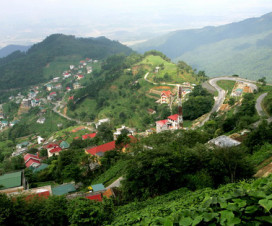
An aerial view of Tam Dao DistrictNestled high up in northern province of the Vinh Phuc, Tam Dao is perhaps the perfect respite from the heat and humidity of Ha Noi.

Tam Dao is just 86km northeast of the capital. The town, occupying 253ha, is 900m above sea level in the heart of Tam Dao National Park – the largest in the north.

The 80km mountain range has three prominent peaks, which is why it is named Tam Dao. The middle peak is called Ban Thach (Stone Table) and stands a proud 1,388m. The left peak is named Thien Nhi (Sky Market) and is 1,375m tall, while that on the right, named Phu Nghia, is 1,400m above sea level.

The French hill station is famed for the wraith-like mist that shrouds the town most mornings. By midday the fog lifts to reveal a mind-boggling panorama of hills and forests. The afternoons are typically cooler, while at night a chilly wind makes heavy clothing a must. In fact, each day in Tam Dao is like the four seasons of the year – summer, autumn, spring and winter. Leading up to the town is a thin ribbon of road 20km long rising from the plain, while a silvery stream circles the town like a silk scarf around the slender neck of an enchantress.

The town is an ideal hideout for authors, which is why an annual writing competition is held in Tam Dao.

An aerial view of Tam Dao District in the French colonialAdding to the splendour of Tam Dao are the vestiges of old French colonial houses dating from the early 20th century harking back to the days of European rule. In all, there are about 200 colonial buildings still standing, but few can remember the days of the French. Local culture official Do Dinh Chuc introduced me to Nguyen Huu Duyen and Luu Ngai. Duyen, now in his seventies, who is a descendent of one of the first families to settle in Tam Dao, some 104 years ago. Ngai used to work as a maid in one of the French’s villas.

That said, both remember only too vividly 1946 when locals applied the scorched-earth policy and destroyed the last vestiges of colonial rule during the Vietnamese war of resistance against the French.

Further information can be gleaned from the sixth volume of Indochina magazine published in June 1914. The magazine reads: “In 1904, a delegation sent by the Office of the General Governor of French Indochina sought a suitable place in the Tam Dao mountain range to build a summer resort.

“The delegation reported that they had found a suitable locality at a height of 930m. After two years of careful examination, the office began work in 1906 on the hill station.”

The French occupied the town for the next three decades before it was totally destroyed in the war of resistance. In its heyday, the town had 143 stone-built villas, some owned by wealthy Vietnamese such as Ho Dac Diem, Hong Khe and Phu My. The architecture in Tam Dao is reminiscent of Sa Pa, Da Lat and Ha Noi, a blend of the old and the new, and gave the nostalgic colonialists a taste of home.

Rustic-ruins-A-vestige-of-French-architecture-still-remains-in-Tam-DaoThe stone walls were typically 60-120cm thick. The slate for the roofs was imported from Toulouse and Marseille. Little now remains.

Duyen and Ngai said life for them and the other 6,000 Vietnamese in the region was hard. Most served the wishes of their colonial masters. They were not allowed to settle in the town. Instead they were forced to live 2km away.

Today Tam Dao has 60 hotels and guest houses that are owned by 17 families. The district received about 1 million tourists in the first six months of this year, which is a 50 per cent increase against the same period last year.

The remaining 200 inhabitants earn a living from farming and growing su su (the local name for chayote).

“Chayote here are more delicious than those in other places such as Sa Pa,” said Do Quoc Hai, a tourist from Ha Noi, while eating a bowl of chayote that had been stir-fried in oil and garlic.

Green chayote trellises laden with fruit can be seen everywhere. About five tonnes are picked each day. In fact, the unique taste of the fruit has become synonymous with Tam Dao. And when visitors reluctantly have to return to the noise and pollution of the city, a basket of the fruit is a happy reminder of the halycon days in the hills.

Source: VietNamNet/Viet Nam News

A special Khanh Hoa offering

Posted by admin on under Vietnam Travel Info, Vietnam hotels | Read the First Comment

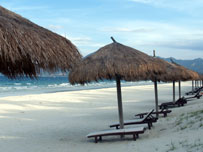
Undulating white sand dunes all along the beautiful Doc Let Beach have made it a favorite in the central province of Khanh Hoa.

Visitors often choose to stay at highly popular Doc Let Resort, but winning the hearts and minds of increasing numbers of tourists in recent years is the White Sand Doc Let Resort & Spa, which opened in 2004.

Covering 12 hectares, the resort houses 54 bungalows with balconies opening to the sea, allowing you to sunbathe during the day, and watch the moon at night, not to mention the unforgettable early morning sunrise.

An added attraction at the resort is that it is virtually a botanical garden with many different kinds of trees and flowers. And willing to talk with you extensively about the flowers, from roses to daisies to orchids, are the resort’s owners – Chau Thi Thanh Truc and her husband, Hoang Van Hien. Both spend a lot of time taking care of the flowers and trees to make the resort an ideal destination for those who want to learn about the flora.

GETTING THERE
From downtown Nha Trang, head north to Ninh Hoa District. At the 35th kilometer milestone, turn right to Doc Let. Another 10 kilometers and you are at the White Sand Doclet Resort & Spa.

Address: Dong Cat Hamlet, Ninh Hai Commune, Ninh Hoa District, Khanh Hoa Province

The absence of artificial decorations along the resort’s beach spanning more than a kilometer makes it a fond spot. The beach is decorated perfectly naturally and beautifully by the purple color of morning glory flowers (Ipomoea pescaprae) that grow wild at several spots.

As the sea is shallow – the water only reaches your head more than a 100 meters from the coast – even those who can’t swim can have a relaxing, fun time. When the tide is low, the sight of thousands upon thousands of sand crabs running across the beach is one of the special images that White Sand offers.

The resort also makes space for a seafood market where tourists can buy crabs, prawns and other items and then ask the sellers or the resort’s chefs to cook them. It is recommended that the seafood is steamed or grilled and eaten with pepper salt.

Tourists can rest assured that they are not paying exorbitant prices, because outside sellers are allowed to join the market for free on condition that they sell fresh food and at market prices.

The resort also has a spa, a bar with pool tables and a range of water sports for those looking for outdoor excitement.

(Reported by Khue Viet Truong, Thanhniennews.com)

Caravelle donate 10% – 20% of wedding

Posted by admin on October 28, 2010 under Vietnam hotels | Be the First to Comment

In the 29/10 day (17:30 to 22:00) and 30 – 31/10 (10:00 to 18:00), Caravelle inn is open up free to site visitors many types and decorations at the banquet 3rd floor celebration room.

Visitors have the chance to donate 10% – 20% discount for parties, together with a myriad of other exciting presents such being a dining table for 10 people to effort just before the wedding, a wedding room to the bride and groom try to eat together bright, MC services, violin duet, vote for dinner one year anniversary of the wedding day, …

Caravelle

Recently, a team of expert kitchen Caravelle has made many new mouth watering menu and extensive. Each variation of device has its particular unique features, while ensuring complete fulfillment for proprietors and guests. Moreover, the service attentive, expert Caravelle also enabling prospects the selection menu and drinks for your party.

7 menu products and solutions cost between 618,000 VND / person with many presents for wedding celebration preference from 250 guests.

Caravelle service wedding service with expert and attentive, wide hall with a capability of up to 700 guests, decorations different style, elegance and beautiful.Wedding 5-star Caravelle inn is sure to cause you to happy in the marriage day signifies the beginning of lifestyle lovers loving and happy.

For more information, please contact Ms. Hong Hanh – inn Caravelle by number (08) 3823 4999 ext 27516.

A quiet island get-away near Nha Trang

Posted by admin on under Vietnam Beaches, Vietnam Destinations, Vietnam attractions, Vietnam beauty | 3 Comments to Read

Chuong beach at Binh Ba islandThe white sandy beaches and coral reefs of Binh Ba Island are only a short motorbike and boat ride from Cam Ranh Township in the central coast province of Khanh Hoa.

The coral island presents a change of pace from the province’s bustling capital, the beach resort town of Nha Trang.

To get to the island, go to Cam Ranh bus station and take a motorbike taxi for VND10,000 to Ba Ngoi Wharf. From the wharf, there is a boat to Binh Ba at 10 a.m. for VND10,000 per person and VND5,000 per student. There are two boats that head back to the mainland – at 5 a.m. and 12 p.m.

BINH BA island beachNom Beach is a quiet little stretch of smooth sand and very blue water. Along the beach are some rocks, where it is nice to sit and watch the waves. Locals use the beach in summer for bathing and often go there at night when the moon is full for small parties.

The path from Nom Beach to Chuong Beach passes wild flowers, colorful snails and rocky outcrops with small caves. If you take your snorkel and goggles to Chuong Beach, you can see many colorful corals in the sea. There are also a lot of bird nests on the island making it interesting for nature enthusiasts.

A short hike up the hill there are ruins of an old French military base. The top of the hill has beautiful sunset views. Most of the island residents are fishermen. Shrimp is the main catch.

There are very few if any facilities for tourists on Binh Ba, so it’s important to prepare a good picnic lunch or take a tent if you want to stay the night. Otherwise you can eat at some small restaurants and ask one of the locals if you could stay the night. The beach, however, is a great place to camp and have a barbecue.

Source: VietNamNet/SGT

Journey Along the Road of Beauty and History

Posted by admin on under Vietnam Destinations, Vietnam beauty | Be the First to Comment

The many wonders and spectacular views cradled by Vietnam’s soil is no longer a secret to anyone. So as well as its rich culture and very interesting past. If there is one part in the country that holds the most of its beauty and history, the Hai Van Pass in National Highway 1A very much deserves the title.

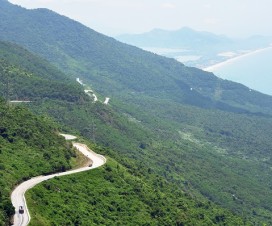
Located at the border of Thua Thien-Hue Province and Da Nang City, and known as part of the Truong Son Range, it is the highest pass in Vietnam at 500 meters above the sea level. The climb to this path is not just drenched with curves which give tourists a moment of excitement, amazement and a mix of fear and delight, but also unfolds the entire beauty form below which you could never set eyes on any other part of the country, perhaps in the world. In fact, the drive from Danang to Hue is believed to be the most scenic in all of Vietnam.

But Hai Van Pass is not just associated with beautiful landscapes. With it comes a long history, which now, is feared to be among the many historical places in Vietnam that is slowly fading behind as the country moves toward modernization. In 2005, the Hai Van Tunnel was built to give people a shorter journey from Da Nang to Hue. But why many would still choose to travel along the picturesque mountain road steep tells how the beauty of Hai Van Pass couldn’t be that easily ignored, worst, forgotten.

Hai Van means “Sea Clouds”, since the peak of the mountain where its many bending roads nestle almost touches the clouds. The history of Hai Van Pass goes all the way back to 1306 where it used to belong to the Champa Kingdom. King Che Man of Champa gave the Ulik area (the current provinces of Quang Tri and Thua Thien-Hue), including the pass, as a betrothal gift to Vietnam’s then king Tran Nhan Tong in exchange for the hand of the beautiful Princess Huyen Tran.

During the Nguyen Dynasty (1802-1945), the pass was an important military site and served as a protection for the Hue Royal Citadel. People then had to submit the necessary papers to be allowed through the guarded gate. Under the rule of the second emperor of Nguyen Dynasty King Minh Mang in 1826, French troops built a blockhouse, named Don Nhat, to protect the Hai Van Pass. This gate could not be seen as you journey on top of the pass, now taking the form of a brick gate covered with moss. It stands 10 meters high with walls as thick as five meters. It faces Thua Thien-Hue Province, and is inscribed with three words “Hai Van Gate” in Han script. On the other side, the gate is engraved with: “The most grandiose gateway in the world”, written in Han script. These words were said by King Le Thanh Ton (1442-1497) when he visited the site.

Anyone passing through Hai Van Pass could not ignore the many perilous obstacles and is the last spur of the Truong Son Range reaching to the sea. But the grandiose panorama that unfolds before them makes all the dangerous bends and curves so well worth the ride. Coming in close view with the historical sites along the pass will truly evoke old memories and feelings from the past. Hai Van Pass will satisfy anyone’s desire to conquer high peaks and be reminded of the glorious past of the beautiful Vietnam.

Quan Son lake, inland Ha Long Bay

Posted by admin on October 27, 2010 under Vietnam attractions, Vietnam beauty | Be the First to Comment

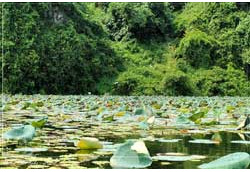
Traveling to Quan Son Lake in My Duc, Hanoi, tourists will be impressed with scenery of wild nature of the lotus lake with the mountains mirroring on the water.

The lake, about 50 kilometers southeast of Hanoi, consists of nearly 100 limestone mountains with diverse plants and historical and cultural sites. It looks like miniature of Ha Long Bay, a world attraction to tourists.

The lake, on the route to Perfume Pagoda and Kim Boi mineral stream, is an ideal place for rest, recreation and convalescence. Nature lovers can enjoy the pleasure of sightseeing, yacht cruising, island discovery and fishing.

The first destination is the ferry of Giang Noi lake, one of the three big lakes in Quan Son. Standing on the bank, tourists can see the limestone mountain ranges reflecting on the surface of the lake.

Quan Son tourist site has a surface of nearly 3,000 hectares and includes the communes of Hop Tien, Tuy Lai, Hong Son and Thuong Lam.

Visitors to Quan Son can go yachting on the 850-hectare lake which contains historical relics from the period of Vietnam’s resistance against the French.

If they prefer mountain climbing, they can take a boat to some of Quan Son’s most famous limestone mountains: Independence, Fruit and Flower Mountain, Trau Bac (Silver Buffalo), Hon Me (Fascinating Mountain), Da Bac (Silver Rock), Nui Ban Co (Chess Mountain) and Nui Chim (Bird Mountain).

On Hoa Qua Son (Mountain of Fruit and Flowers) they will have the opportunity to explore dense forests of orange, lime and mango trees and, if they come in Spring, they can even enjoy the breathtaking view of a whole plum forest in full bloom.

At Thung Mo in Hop Tien Village and Thung Cong in Hong Son, there is even a biology garden for visitors who are interested in rare medicinal plants and herbs and also bonsai plants.

The most striking cultural trait of Quan Son tourist site is its ability to keep its traditional village life almost intact, with their various cultural customs and festivities.

Pagodas are another spiritual aspect of life in Quan Son as proven by numerous pagodas scattered around the area. Among them Ham Long, Linh Son, Ngoc Linh Ban Long and Thung Phat pagodas are the most well-known.

In Quan Son tourists can also enjoy good food with dishes prepared from freshly caught fish, shrimps, crabs and a specialty of the area: mountain snails.

To serve tourists Quan Son is having 80 iron boats, one motorized boat, five residences and authorities in My Duc District are now focusing on developing better systems of communication and of electricity and water supplies, to make Quan Son one of the most attractive tourist sites in Vietnam.

Bai Dinh Pagoda

Posted by admin on under Vietnam architecture, Vietnam beauty | Be the First to Comment

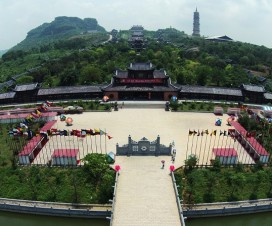
The largest pagoda complex in Vietnam, Bai Dinh Pagoda, is located at Gia Sinh Commune, Gia Vien District in the northern province of Ninh Binh, 95 kilometers south of Hanoi. Even though it is still under construction, with expected date of completion in 2010 to mark the 1,000th anniversary of Thang Long or Hanoi, it is still attracting a large number of pilgrims and tourists.

The biggest bronze Buddha statue in Vietnam
This bronze statue is 100 tons in weight. The Buddha holds a lotus flower in his hand.

The pagoda complex is being built in a hilly region near the ancient Bai Dinh Pagoda which was established by monk Nguyen Minh Khong (1065-1141) who turned the caves of the 200-meter high Bai Dinh Mountain into the pagoda. According to feng-shui theory, the pagoda, with its back leaning on Bai Dinh Mountain and its front looking down the Hoang Long River, has a very good location. Moreover, with the location site being far from any residential area in a hilly region covered with green old trees attracting nesting birds, the new pagoda has a quiet and peaceful atmosphere and gives visitors a tranquil feeling.

The pagoda complex stretches over 100 hectares with three temples (past, present, future), Tam The, Phap Chu and the temple to honor the goddess of mercy, and one bell tower. The length from the gate to the highest temple of Tam The is 800 meters. Running from low to high are two corridors of houses, placing 500 arahats at a height of over two meters.

Bai Dinh is also famous for its record-breaking works, such as the three statues of Buddha in the past, present and future weighing 50 tons per statue in Tam The temple, a Buddha statue weighing 100 tons in Phap Chu temple and two bells weighing 36 tons and 27 tons.

The pagoda, which is only five kilometers away from two popular tourism destinations of co do Hoa Lu, the ancient capital of Vietnam from 968 to 1010 and the Trang An cave area, could become the center for tourism of Ninh Binh Province when it is completed.

Pictures at the Bai Dinh pagoda

Three-door gate at Bai Dinh Pagoda

The astonishing one is the “collection” of 500 Arhat statues on the hill in the right of Dharma Temple. The 500 Arhat statues with the height of 2.3m

Bronze bell-tower where hanging the Vietnam’s biggest bell with the weight 36 tones, 3,5m width, 5,5m high.

Sanctuary and Bodhisattva Kwan Yin statue

Dharma Temple where having the Great Buddha Sakyamuni statue with 10m high and weighs 100 tons

The most important emphasizing point of these great religion works are still Tam The Temple

Three bronze Tam The statues, each statue of Tam The weighs 50 tons, 12m high

Danang: Nature’s Gift

Posted by admin on October 26, 2010 under Vietnam Beaches, Vietnam Destinations, Vietnam attractions, Vietnam beauty | Be the First to Comment

If you’re torn between the many options on which part of Vietnam to see, getting yourself acquainted to the wonders of Danang might complicate your travel plans a little bit more. But perhaps not. The beauty of this city has everything else you search for in other destinations. And if you learn more of it, a little exploration on what awaits you in Danang might solve your travel plans then and there.

With a coastline of 30 kilometers long, Danang is known to many as among the best sea-side destinations holding the most beautiful and longest stretches of seashores. Adding to its splendor is the pleasant temperature that is as equally calm and as its waters.

An ideal and huge beach at around 900 meters in length, My Khe is the most popular beach for locals in Danang, thus could get crowded. But its smooth sand and a slight slope, along with its cool water is just too inviting, and would make anyone came and join the crowd. With few waves, bathing in My Khe beach is relaxing and safe. If you want to get away from the bustling beach scene, just behind it is a dark green forest to come close with nature. Beside the greeneries is the Kinh River where you could also enjoy a quiet moment and just waddle your way around. The beach has hotels and many other types of accommodation nearby, offering abundant services. With all the convenience, any tourists’ stay would be comfortable and always pleasant.

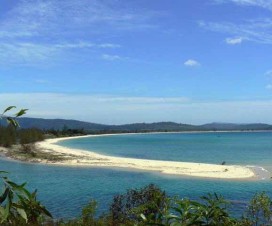
The beach on Lang Co is on a sand spit peninsula with a spotless lagoon on one side, and a long beach traversing the South China Sea on the other. It is known for its ever most beautiful natural landscapes and pure sea wildness. Many would say that this is one of the most beautiful places in the country, something you definitely would agree when you get to see it for yourself. As the country is yet to reach it potential as a tourist spot, this place is yet to become more magnificent than it is. While travelling between Lang Co and Danang, the ride through Hai Van Pass will be as equally unforgettable. With one panoramic view after the other, your eyes will feast on the most beauty nature can offer.

With an international airport available, Danang is well connected to other cities by air. But travelling by sea and as well as road and rail is equally as convenient. During the American War, it served as an important South Vietnamese airbase. But today, the French influence is more evident when you see the tree decked avenues and colonial houses. Cradling so many attractions, historical sites, natural scenes and of course, beautiful beaches, come to Danang to enjoy the holiday of your life, or simply just to enjoy dipping your toes in the sand and savor the sea-side air.