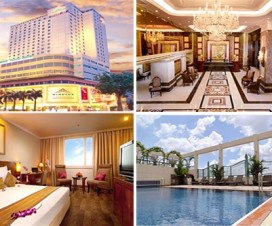
Ninh Tinh beach offers pristine beauty


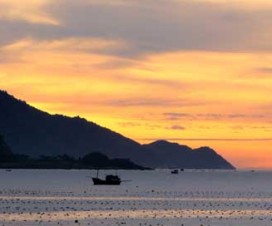
Secluded: The Wild Beach Resort is surrounded by rainforest.

I prepared for the day and followed the resort staff to go to the market.
Ha Vy – Vietnam News
www.vietnamhotels.net
www.vietnam-visa.com
Let's Discover Vietnam – Vietnam travel information and travel guide


Secluded: The Wild Beach Resort is surrounded by rainforest.

I prepared for the day and followed the resort staff to go to the market.
Ha Vy – Vietnam News
www.vietnamhotels.net
www.vietnam-visa.com
Following on from the North we left Hanoi and started making our way down the country. We took the train on what is romantically called the reunification railway. This is the line that runs from Hanoi to Saigon (Ho Chi Minh City now). We took the train down to Den Ang, the coastal town about half way down the country. Out final destination – Hoi An.
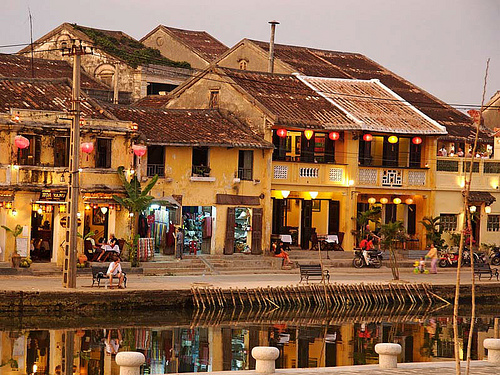
The guide books tell you it’s an old and very important trading port, which again is a world heritage site, due the amazingly well preserved French, Portuguese, Dutch and Spanish architecture. I would tell you that this is a most amazing little place that grows and grows on you, until you can’t shake it off. The old town is not that huge, but just step inside and you feel like you are on a movie set, the houses and cafes are wonderfully authentic and well preserved and the small streets accommodate foot and bike traffic only, therefore you feel so at ease while wandering the lanes. There is a river winding through the centre of town and 4km away Hoi An has an amazing and huge beach, which is totally pristine and best of all, used mainly by the locals for fun, rather than a few tourists as a sun bed.
At night Hoi An takes on an unearthly charm. the locals light religious pyres outside their shops and the streets are silent, apart from the buzz of people and the creaking of cycles.
I loved the feel of the town and the oldness of it. Of course there is an impact of the tourist trade, and on Hoi An it is that there are so many shops catering of the mainly European tourist market however I don’t think this has ruined the town and its atmosphere, in fact the busy cafes and up market eateries actually add to the allure of the town.
The other famous feature of Hoi An, are its tailors shops. The lonely planet is so right when it says travellers arrive to Hoi An looking like back packers, and they live looking like princes! Everyone seems to get something made in the town (often not needed, but hey!). The tailors have a reputation throughout Vietnam and looking at the quality of the finish it is easy to see why! Urvi was really tempted to buy a skirt, and a top and a dress and a……. !!! but in the end controlled her shopping urges and didn’t get anything, no doubt she is saving her shopping pennies for India and beyond!
I did come out with a tailored linen shirt, which I love. I have wanted to get a linen shirt for a while and to have it made to measure was really nice. It was pretty cheap too, which added to the experience. Once again we were a bit jealous of people just on vacation in Vietnam, as they could walk out with a while new wardrobe. We on the other hand had to settle for 1 item, or else risk over packing our bags to bursting point! It was nice to be able to get something ultra authentic from the town and I am sure I will remember Hoi An each time I wear my new shirt!!
(http://urvianandworldtrip.blogspot.com)

To quote just about every Hanoi guidebook, Hanoi is a “bustling” city filled with a “mix of the old and new.” It features “amazing food”, a “vibrant energy all its own” and is chock full of “plenty of sights to see”. Now we’re past the usual fluff and filler we can get to the real meat of Hanoi with three full days to do it.
But first we have to get there.
Our flight lands at Hanoi International Airport a little after 12 a.m. on a Friday morning, which isn’t the most “bustling” of times at the airport. Visa pre-approval letters in hand (check www.vietnam-visa.com for Vietnam visa information) we make our way to the appropriately marked, “Visa pre-approval counter” and present our well prepared documentation to the groggy official. He is wearing regulation government sandals and smoking what must be a government regulation cigarette. One glance at our papers and we are asked to fill out official forms which are handed to his freshly woken and sleepy eyed colleague to help with the paperwork crush at the visa pre-approval counter.
We are also drafted into the cause. He hands me a pair of scissors to clip my photos to the appropriate size. No problem, I got this. Another passenger ambles up to the counter while we are deep into our work and throws off the entire synergy of the moment, prompting our visa pre-approval man to call for more help… and more importantly, more smokes. Eventually we’re stamped and official so we begin our trip in earnest.
Hotels in Hanoi are cheap and relatively easy to find. We didn’t want to book a room for four nights without knowing what it would actually be like, so we booked online at Blue Paradise Hotel for US$28 for one night. We also ordered airport shuttle pickup service. Hanoi’s Old Quarter is about a 45-minute drive from the airport and we learn it shouldn’t cost us more than US$10, but we opt for the shuttle at US$15 as the last thing we want to do was get in a dishonest taxi late at night.Our expectations for Blue Paradise Hotel at a whopping US$28 a night are not extremely, or moderately, or even remotely high. Four months ago I looked at a flat for rent in Hong Kong that didn’t even aspire to crackhouse status. It cost US$750 a month, or about US$25 a night.
With the crackhouse memory firmly in mind, but encouraged by the prompt airport pickup, we arrive at our hotel to find a guard waiting outside. He ushers us into the dark lobby and through the bodies of hotel staff sleeping on the lobby floor, then up to the counter where we pay our driver in the dark to be on his merry way.
Once we are positively identified as ourselves (in the dark) we are shown our room, complete with waiting party of what we hear are called “clever ants” in Vietnam, cleverly relaxing in the refrigerator. Too tired to care, and feeling like very foreign foreigners, we decide to sleep despite the slutty door lock and our new clever companions.
When we wake up the next morning we discover the staff is quite friendly when fully awake. But we still check out. We want to try our luck elswhere. It takes about an hour to find the Golden Lotus, a decent hotel for US$50 a night.
One Tripadvisor customer review of Golden Lotus says, “Decided to check out the next day and found a really nice quiet room with lovely staff and a great balcony at the top of the Gia Bao Hotel. It was worth losing money not to stay at the GL Hotel another night.”
Our experience was good, theirs was bad. That’s the way it goes. The best way to find what you want is to stay flexible. Though our experience was good enough, yours might not be, so the wise thing to do is to book the first night only in advance.
If you aren’t happy with your initial choice, or didn’t book at the Sofitel Metropol Hanoi Hotel (about US$170 per night) in the first place, your first morning in Hanoi will probably be spent looking around for a hotel for the next few nights. Depending on the time of year, it shouldn’t take to long to do so.
We’d suggest in or around Hoan Kiem District and the Old Quarter. There are plenty of hotels and hostels (for the backpacker types) to choose from and most had vacancies.
What comes next is based on our full three days in Hanoi and complimented by recommendations from CNNGo contributor and editor of Vietnam Pathfinder magazine Helen Clark, and some shopping finds scored by CNNGo’s very own shopaholic and travel master Kristina Perez.
You’re in good hands. Oh, and while you’re out there keep an eye out for all of the Soviet influence.
Wander around Old Quarter and North Hoan Kiem

The Old Quarter is a great first jaunt in Hanoi with its insane energy and unique character. All manner of foods, creatures and scooters can be found in the Old Quarter. Scooter dodging is required, and the local Hanoians have it down to an art. Foreigners not so much. But with a little practice one might have only a moderate chance of significant bodily injury while crossing roads. That chance slightly increases during rush hour.A map of the area is useful, but not required unless you have somewhere specific to go. Just get your bearings for North and South by remembering Hoan Kiem lake is to the South. Having a landmark in mind is a good idea for retaining a sense of direction.
For a decent wander in the Old Quarter, you’ll need at least four to five hours, preferably in the morning to early afternoon when it isn’t so blistering hot.
Try the local coffee
Vietnamese love their coffee, and there is no lack of coffee shops offering up many java varieties. During our trip we randomly check out five coffee shops and try different kinds of iced and hot blends. Word of warning: Those that like their coffee light will need lots of sugar as many of the Vietnamese blends can be potent, eye-popping cups of dark black goodness. Tip: Don’t drink the tap water, but ice is generally OK in Hanoi as the bars, restros, and other venues tend always to use clean-water ice not made from tap water.
Catch a Water Puppet show
As a respite from the heat (or cold humidity in the winter months), drop in and see a water puppet show at Thang Long Water Puppet Theater. Water Puppetry is uniquely Vietnamese, and originated in near Hanoi nearly 1,000 years ago. Today, visiting the Thang Long Water Puppet Theater is almost as interesting for tourist watching as it is for checking out the traditional puppet performance.Rows of Germans, Americans and Canadians line the seats during our visit. The show itself features the dancing forms of puppets manipulated by their puppeteers in a shallow pond or wading pool and is quite entertaining. It is always amusing to learn random cultural facts such as fart jokes were apparently as popular 1,000 years ago as they are today. (Thang Long Water Puppet Theater info: 57B Pho Dinh Tien Hoang, admission 20,000 – 40,000 VND, shows at 6:30 p.m. and 8 p.m. Monday – Saturday, 9:30 a.m., 6:30 p.m. and 8 p.m. Sunday, Tel: 824 9494, website: www.thanglongwaterpuppet.org)
Try the street food

Hanoi is renowned for it’s street food, with some calling it the best in Vietnam, and potentially even in Asia. There are street food vendors all over the city, with a large concentration in the Old Quarter and around Hoan Kiem Lake. Sanitation concerns aside, those looking to truly delve into the local culture should definitely try digging in at one of the many barbecue stalls, noodle stands, tea and coffee stands, and corner shops. For those lacking the intestinal fortitude or gambling mentality, there are plenty of other edible options in the city. These options are very cheap as well, with many snacks and meals easily costing under US$2.Keep an eye out for some of these Vietnamese dishes which can all be had for under US$1.
Tip: We also suggest checking out Stickyrice, a fantastic foodie blog that digs deep into the Hanoi food scene.
Wrap it all up with a steak dinner
Head up to West Lake for a hearty steak dinner. CNNGo’s Helen Clark suggests Chien Beo. “Chien Beo is one of Hanoi’s best local steak houses, doing a Vietnamese take on steak and called ‘bit tet’. It’s a common enough dish but often the steaks are thin, leathery and drowned in sauce. Not here. Steaks. Steaks stuffed with cheese. Rolls of beef. The place is greasy, hot and gets very, very noisy and for most, this is part of its charm. Food is more expensive than a street side bowl of noodles, but much cheaper than ‘Western-style’ places in town. And doubly as good.” (192 Nghi Tam street, Yên Phụ, Tay Ho district, Hanoi, Vietnam.)
Time to see some history and cook some food. With the first day gone and a better grasp of the lay of the land, its time to do what all good travelers do; see some of the local museums and monuments. Most of the historical locations can be found around central Hanoi. We were able to do most of these in one day just by walking. We started at Hoan Kiem Lake and the Ngoc Son Temple, then down to the French Quarter and the Hanoi Hilton, then to Temple of Literature, then up to the Vietnam Army Museum, and finally to the Ho Chi Minh Mausoleum and Nha Tho Cathedral.
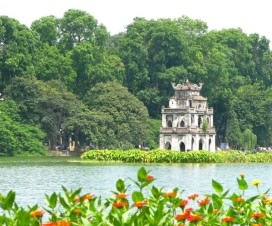
If staying nearby the lake, or venturing close to it, then you might as well stop off and see the giant preserved turtle (circa 1968) in the island temple of Ngoc Son Temple. Turtles are a large part of local lore, and the story behind the turtle at Ngoc Son Temple is no different. The giant turtles were thought to have disappeared until a photo surfaced of one in the lake a few years ago. (Hours: 8 a.m. – 5 p.m. Admission: 10,000 VND (US$0.53))
Hoa Lo Prison aka ‘The Hanoi Hilton’
The Hanoi Hilton was named thus by United States POWs during the Vietnam war, the likes of which included U.S. Senator John McCain. It’s a fascinating place, especially from an American perspective. Who knew that the U.S. pilot POWs had such a great time in the klink. They got to make Christmas murals, play chess and basketball and generally have a swell POW experience. At least that’s how it is portrayed. (Pho Hoa Lo and Pho Hi Ba Trung, admission 5,000 VND, 8 – 11 a.m. and 1:30 – 4:30 p.m. Tuesday – Sunday)Tip: It is also worth mentioning the prison is directly next to the Hanoi Towers, which has a slightly pricey yet nicely air-conditioned restaurant.
Van Mieu (Temple of Literature)
The Temple of Literature is a long, hot walk from the Hanoi Hilton. In retrospect, it is advisable to grab a taxi to cover the distance. The grounds are comprised of traditional buildings, courtyards, and gardens first founded in 1070 AD.Tip: You probably won’t need more than 40 minutes to see the entire grounds unless you have a tour guide explaining things to you.
The Vietnam Army Museum as a “tourist attraction” is somewhat of an enigma. One enters expecting to see tributes to the Vietnamese Army, only to discover more captured and wrecked American military hardware than Vietnamese. The most impressive of these displays is the “war meets art” mound of plane debris including a B-52, F-111 and a French transporter stacked high in the center of the courtyard and surrounded by other intact planes, a helicopter and artillery. At the center of the pile is a poster of a female Viet Cong soldier dragging the wing of an American plane.
Tip: Walking from the Temple of Literature to the Army Museum takes about 25 to 30 minutes and requires crossing one seriously congested roadway.
Recommended to us to see not for the embalmed body of Ho Chi Minh, nor for hulking grey grounds. No, the Ho Chi Minh Mausoleum was recommended because it is the only place in Hanoi where you can take pictures of soldiers and not worry about losing your camera in the process. (Houng Vuong and Le Hong Phong, 8 – 11 a.m. Tuesday – Thursday, Saturday and Sunday last entry at 10:15 a.m.)
Nha Tho Cathedral is Vietnam’s answer to Paris’ Notre Dame, with its twin towers and Gothic arches. (Pho Nha Tho and Pho Nha Chung, Hours: 5 a.m – Noon, 2 p.m – 7 p.m)Tip: Its a bit of a walk to here from either the Army Museum or the Ho Chi Mien Mausoleum as we found out after much scooter dodging.
Highway 4 home cooking
Time to round out the day of culture with a bit of a “how-to” with a serious glutinous reward. Helen Clark suggests Highway 4 locations as great places to learn about Vietnamese and ethnic minority specialties. Clark says, “They have been serving north Vietnamese and ethnic minority specialties for over ten years. For the pat couple they’ve been running a cooking school on the rooftop terrace of one of their outlets. A half-day group cooking lesson sees the group cook a menu’s worth of food together, in full chef outfits. You can then enjoy the fruits of your labor with a full sit down lunch and a souvenir recipe booklet to take home.”
Time to wind it down with some shopping, great eats and drinks.
CNNGo’s Kristina Perez prowled the streets for some of the top shops. Here’s what she found in her words.
Shopping
Three Trees: The exclusive showroom of the Belgian-owned Discovery Diamonds, Three Trees features unique creations combining gold, gemstones and South African diamonds. Delicate and ornate designs are inspired by nature and feature traditional symbols. You can watch the goldsmiths and diamond cutters at work upstairs and even commission your own original piece. (5 Nha Tho Street, Hoan Kiem District; Tel. +84 4 9288 8725; threetrees@vnn.vn)
Vietnam Quilts: This non-profit boutique sells delightful, high-quality patchwork quilts in classic and contemporary styles. Founded in 2001, Vietnam Quilts employs rural women in the Mekong Delta who create playful designs in cotton, silk and taffeta for bedding, children’s clothing, aprons and table sets. Shop till you drop while supporting a good cause. (13 Hang Bac Street, Hoan Kiem District; Tel. +84.4.3926.4831 ; www.mekong-quilts.org)
L’Epicerie du Metropole: This gourmet food shop offers all of the pastries and goodies served at the Sofitel Metropole’s legendary high tea, including its famous chocolates. Their delicious macaroons in raspberry, lychee and coconut flavors rival any that can be found in Paris. The shop also stocks fine foods imported from Europe such as Fauchon and Hediard. (15 Ngo Quyen Street, Hoan Kiem District; +84 4 3826 6919, ext 8702; sofitelhanoi@hn.vnn.vn)
Things of Substance: This hip Australian-run boutique stocks trendy men’s shirts à la Paul Smith and sleek women’s sundresses in Western sizes. There is also a range of shoes, belts, bags and good quality silver jewelry. Stock up on casual chic that’s ready to wear. (5 NhaHoan Kiem District; +84 4 3828 6965; www.prieure.com.vn Tho Street, )
Tân Mỹ: Established in 1968, this family-run shop is well regarded for its finely embroidered linens, silks and cottons. Here you can find top-notch handiwork on baby clothes, pillow shams, sheet sets and table runners. The napkin and place mat sets make great gifts. (16 Hang Trong Street, Hoan Kiem District; Tel. +84 4 3828 8848; www.tanmyembroidery.com)
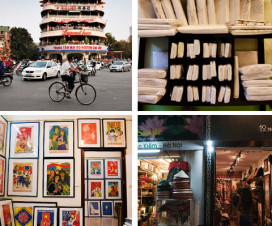
Hanoi Gallery: A must-stop shop for propaganda poster aficionados. Similar in style to those found in China and North Korea, the lively Vietnamese posters are quite arresting. Choose from idyllic pastoral scenes with slogans such as “Don’t Plant Opium Plants” or idealized depictions of Uncle Ho. (17 Nha Chung, Hoan Kiem District; Tel. +84 4 3928 7943; propaganda_175@yahoo.com)
Craft Link: Just down the street from the Temple of Literature is this excellent arts and crafts emporium. Pick up a Vietnamese water puppet of your very own or choose from a range of traditional lacquer-wares with mother of pearl in-lays. There are also brightly-colored home-wares such as jewelry boxes, silk kites and hair accessories. (43-51 Van Mieu Street, Van Chuong District; Tel. +84 4 3843 7710; www.craftlink.com.vn)
Dinner at Bobby Chinn’s
Having moved his downtown restaurant into his home at West Lake, Bobby lives upstairs and cooks downstairs. The former bus boy, trader, comedian, and now Discovery Travel & Living show host probably won’t invite customers up to use his private bathroom, but his restaurant will definitely serve some up some great food. (Website: www.bobbychinn.com, dinner for two costs about 1.3 million VND)
Hit up the bars
Maybe start off with some Jazz at Jazz Club Minh until 12 a.m then head out to get a look at — and a sip of — Hanoi’s speakeasy vibe. Clark says, “Most guidebooks to Hanoi will tell you that all bars must close at 12 a.m. This is true, but another grand example of the gulf between what’s written and what’s enforced. You might see the odd “No Smoking” sign through the cigarette haze in a bar as well.”She adds, “On occasion Hanoi’s bars do close early, or seem to. If in doubt simply listen closely at the roller door or look for the drunk expats milling around outside. A swift knock on the door should ensure entrance to that night’s speakeasy. Bars on Ta Hen street between Luong Ngoc Quyen and Hang Buom go in for this particularly.”
We found three full days just about right for a “get-out-and-see-it” trip. This may of course differ for others, and for those with a desire to get out of the city for a day, Halong Bay is about a four-hour journey. There are numerous tour companies around Hanoi that will set up a trip for the following day, with many offering luxury junk cruises.
Some fast facts
Located in the center of Hanoi, the ancient Thang Long Royal Citadel holds the remains of historical, cultural, and architectural artifacts of many feudal dynasties in Vietnam.
The citadel is a complex full of relics closely associated with the history of Thang Long – Hanoi capital city. It was built by the Ly, Tran, Le and Nguyen dynasties. The citadel is surrounded by Tran Phu – Dien Bien Phu – Doc Lap – Hoang Van Thu – Hoang Dieu – Phan Dinh Phung – Nguyen Tri Phuong roads.
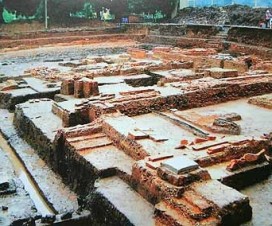
The royal palaces and most of the structures in Thang Long were destroyed in the late 19th century, and today ruins from the Thang Long Imperial City are still being excavated.
The central section of the imperial citadel, including the Flagpole, Doan Mon, Kinh Thien, Hau Lau and Bac Mon, were recognized by UNESCO as a World Heritage Site on July 31, 2010 during a session in Brazil.
Remains were found on the site of the former Ba Dinh Hall, which was ripped down in 2008 to make way for a new parliament building. Various archaeological remains were found and these artifacts were brought to the National Museum to be exhibited. It is assumed that just a very small fraction of the citadel has actually been excavated.
(Dtinews)
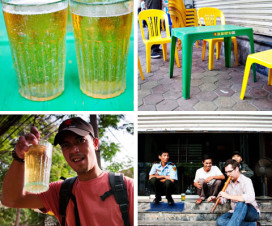
Ah Bia Hoi. No trip to Northern Vietnam is complete without at least a couple glasses of the stuff. Forget Saigon, 333, or any of the other local beers. Look instead for a small, street-side shop selling locally brewed versions of this light drink.
Bia Hoi means simply “fresh beer”. It’s unpasteurized beer made daily in Hanoi. It’s incredibly light for a beer, usually clocking in somewhere around 3%… compared to a Trappist Belgian it’s downright wimpy…. but out in the humid, congested streets of Hanoi a 3% beer seems just right.
And it’s cheap. Man is it cheap. Locals drink the stuff at some crazy low rate… around 1,500 Dong or maybe as high as 2,000. I think we were gouged with a foreigner tax and forced to pay around 3,000 Dong a glass. That’s right… less than 0.20 cents USD!
On our last trip to Hanoi, we all headed over for some Bia Hoi after our filling local Vietnamese meal. Each of us had about 4 glasses of the stuff (7 of us drinking as one in the group was pregnant) and our resident eggs benedict expert from the brunch group, Joe, fell in love with the glasses (the Bia Hoi was served to us in these interesting bubble glasses) bought a set of 8 glasses to take home…. I think all in all even with the purchased glasses we didn’t spend more than 8 USD.
We were at a local place for sure. The chairs and table were plastic and maybe 7 inches off the street. My chair nearly buckled as I sat down, obviously unaccustomed to such large passengers. Once seated near the locals though things slowed down. The busy streets seemed to make a bit more sense. Everyone was smiling at each other and moving at their own pace. The shop owners seemed happy we had chosen to join their little local watering hole and brought us snacks of boiled peanuts (nastier than they may sound). We politely choked them down and then immediately rinsed our mouth with another swig of Bia Hoi… maybe this was their cunning plan all along ![]()
After my second or third Bia Hoi I noticed some locals smoking from a long wooden pipe. During our trip, I’d seen many Vietnamese workers tucked into alleyways and side streets smoking from something similar. I don’t know why I decided I had to try it, but I did… Before I knew what I was doing I was up, extra Bia Hoi in hand, and using my best charade skills to try and trade a Bia Hoi for a turn at the wooden pipe.
Turns out, Bia Hoi is a good currency for the street… that or the locals just wanted to see a foreigner cough his lungs up… which is exactly what happened. The trade was approved and I was loaded a fresh bowl of some reddish, earthy tobacco. It was definitely some form of tobacco, but had a unique flavor from anything I’ve smoked previously. The wooden pipe offers no filtration and serves basically as staging ground for a foot and a half column of smoke. My years of study in college hadn’t prepared me for this. Soon I was coughing my lungs up on the sidewalk like a home schooled freshman. Thankfully Lyan had borrowed my camera and documented the whole ordeal so I can relive it.
I sat with the guys for a bit, sharing Bia Hoi and the wooden pipe. The four Bia Hois and coughing fit had combined to give me a pleasantly light buzz. If only the Banh Mi place had been nearby it would have been perfection. That afternoon was one of the rare (these days when everything is so commercialized and packaged) travel experiences that somehow goes past tourist traps and guidebook recommendations and actually becomes a real moment of sharing culture and experience.
Normally we’d recommend a place and give you an address, but these places are all over Hanoi. Just ask your hotel or a local restaurant where the nearest Bia Hoi can be found. They’ll point you in a direction. Find a place, have a set and start drinking. Say yes to whatever else happens around you and see where things go ![]()
http://accidentalepicurean.com
What to buy and where to buy it in Hanoi
I travel a lot and I am tempted by so many stunning Asian goods and textiles. When in a country which has a famous good, e.g. Sri Lanka’s Ceylon Tea, Chinese Silks, Thai teak, etc. it is a wonderful reminder of the trip to bring something home. However, having been in Asia for a while now I believe something must be very special in order to add kilos to my luggage and make it home into my personal collection. With that said I think there are some special shops and items in Hanoi worth checking out.
No doubt you will find the usual collection of Asian silks, fans, statues, fake designer goods, etc. I don’t need to tell you where to find these, vendors for these items are abundantly littered throughout Hanoi.
But what Hanoi uniquely offers, in my opinion, are some items that are hard to find elsewhere and still represent really good value. And a particularly good area to shop for all of these is the Nha Tho area or the Church area in the Hoan Kiem (Lake) District. Here are a few of our favorite things:
Lacquerware
This high gloss style of tableware is synonymous with Vietnam. It was introduced to the world in Paris in the 1930’s by a Vietnamese artist visiting an international trade fair. Since then, the world has fallen in love with the elegance and style of lacquerware. You can certainly find this in China and Thailand, but not with the same level of quality of variety. And personally, I think there is nothing more chic to serve champagne or tapas on that a glossy black and Chinese red lacquerware tray.
To be fair there are many stores for lacquerware in Hanoi. I tend to prefer the simple, traditional styles without a lot of flourish. No painted butterflies or infinity symbols for me….I prefer a wide of expanse of uninterrupted glossy color. And while there are several stores in the Hoan Kiem District, I like MARENA Hanoi, The Art of Lacquerware and Ceramic, located at 28 Nha Chung Street, +84 (0) 4 38285542 . The selection there is well edited and impressive.
Propaganda Posters
There are so many pieces of art, culture and communication left over from the war. And unlike many other countries who might jettison these materials with a blind future focus, Vietnam has held onto and reproduced many of the stunning examples of art and culture from this period. One of my personal favourite genres is the genre of graphic propaganda posters. These posters were a form of graphic art used to educate and inspire citizen action to align with the political and cultural agenda of the time. They were effective “weapons” to raise morale, change behaviour and direct the efforts of the citizens during the war. Most of the themes during the war center around the people’s battle and production activities.
I have always loved rifling through the posters and reading the sometimes concrete and sometimes abstract slogans such as “Save the country – save the youth” or “Breed more pigs for a Vietnam with full stomachs.” Inspired by some of the more agricultural ones, we bought a series of food posters with a view to hang them in the kitchen – one about pigs, another about vegetable farming and another about coffee production. Again like with the lacquerware there are many stores in Hanoi, but we like The Hanoi Gallery, they have several locations, and we prefer the 17 Nha Chung location, +84 (0) 4 37711956
Cotton and Linen Hand-embroidery
Sure Vietnam is famous for its silks, but did you know they also have wonderful hand embroidered cotton and linen? Since the start of the 20th century, embroidery has been passed on from generation to generation. In Vietnam this exquisite art of supremely detailed hand embroidery is top quality and surprisingly affordable. From elaborately detailed and baroque designs to simple, modern tone-on-tone linens, you can find it all here. And this work is applied on all manner of linen items from lingerie travel bags to duvet covers to dining room place-mats and napkins to pillow cases to shirts.
One of my favorite stores for this is May at 7 Nha Tho Street, +84 (0)4 38289650. I love the assortment of items…all of the best quality…and all beautifully displayed. I struggled to choose between linen napkins and must have pored over the pile for 30 minutes – they were all so beautiful. I was tempted by the duvet covers but Paul thought it would be impractical with our naughty cat who might view it as a new and attractive item to scratch. But I did also walk away with lots of lovely shoe and lingerie bags for travel that I have been giving as (much adored) presents back in Singapore.
While certainly not a complete list, this should get you started on what is special to buy and where to buy it when in Hanoi. Be sure to finish off your day with a walk around Hoan Kiem Lake and drink a Bia Hoi and you have just had a lovely day in Hanoi.
by Joanna
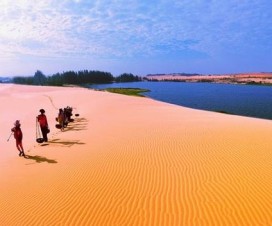
The Mũi Né sand dunes are vast, located only 10-15 minutes from the Mũi Né coastline. Mũi Né is about 200 km from Ho Chi Minh City. It is located on the coast in South Central Vietnam. White sand stretches about 22 km from Phan Thiet (the largest and nearest town in Binh Thuan province) to the fishing village at Mũi Né’s furthest point.
These mountainous peaks of sand often host troupes of little Vietnamese children waiting in droves for tourists to come by. They offer a ’sand slide’ service for those who feel the need for some sandy speed. For a mere VN$20,000-40,000 (roughly US$2-4) they will assist you up the dunes, and will then give you with a plastic board to sit on to slide down again. You can climb and slide as many times as you like and they’ll even give you a helpful push should you need it.
But be warned: these children have a tendency to horde your attention. Once you get off your car or motorbike, they will come rushing at you in waves. So pick one and get slidin’!.
There are three ways to get to Mũi Né: either by renting a car, taking a train, or a bus. The trip can usually be condensed in a three to four-hour drive depending on whether you start traveling from HCMC, or elsewhere in Vietnam.
(Source: http://www.cnngo.com)
The past decade saw a tourism boom in Vietnam, Cambodia and Laos. High on everyone’s lists were destinations like Cambodia’s Angkor temples, Laos’s Plain of Jars, and Vietnam’s Hoi An and Hue cities. Those sights are fantastic. By all means see them. But much of Indochina’s best still remains off the radar, while many old favorites have begun reinventing themselves since they were first thrust under the spotlight. Below are ten such places that should be on everyone’s must-see list for 2010.
Kampot, Cambodia
Oozing French colonial charm, this scenic town nestled on the east bank of Kampot River is Cambodia’s most under-rated destination. If the crumbling French architecture, shady boulevards and riverfront dining aren’t cause for love at first sight, visits to Kep beach resort, the ancient Funan Empire-era temple ruins or a hike in Bokor National Park will ensure you’re permanently endeared to this Cambodian beauty spot.
Hotel Recommendation: Rikitikitavi, www.rikitikitavi-kampot.com, Kampot River Road, Kampot. Tel: +0855 (0) 12 235 102. Starting at around US$25, Rikitikitavi is a popular, smartly decorated hotel, restaurant and bar right on the riverfront.

Kon Tum, Vietnam
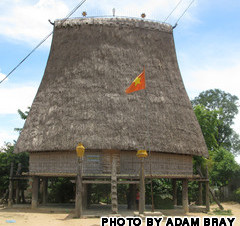
Guidebooks send tourists to Vietnam’s far northern hill station of Sapa for hill-tribe encounters, long overlooking the architectural extremes of Kon Tum’s ethnic Bahnar suburbs. The provincial capital is surrounded by minority villages; their log homes with white-washed mud walls are raised on poles that encircle towering communal lodges called nha rong.
Hotel Recommendation Duc Binh Hotel, 122 Phan Dinh Phung, Kon Tum. Tel: +84 (0) 60 386 2019. Starting at around US$9, in the absence of any upscale accommodations in town, this sensible budget option downtown provides all the basic comforts.

Phou Khao Khouay National Park, Laos
Phou Khao Khouay, or ‘Buffalo Horn Mountain’ Nature Reserve is Laos’s most accessible protected area, just 40km (25 miles) from Vietniane. Rounding out the attractions are wild elephant herds, Hmong village homestays and cascading waterfalls. The sandstone mountain range hides a further treasure-trove of biological diversity, including white-cheeked gibbons, clouded leopards and green pea-fowl.
Hotel Recommendation: Ban Pako Eco-Lodge, www.banpako.com, Ban Nabong, Pak Ngum District, Vientiane Province. Tel: +856 (0)21 45 1841. Starting at around US$29, this true eco-lodge leads treks in the park and a variety of relaxing activities.
For more information visit: www.trekkingcentrallaos.com and www.ecotourismlaos.com.

Chau Doc, Vietnam
The Mekong Delta town of Chau Doc sits like an island above endless rice-paddies, rivers, canals and flood-plains. Its atmospheric synthesis of Khmer, Muslim Cham, Vietnamese and French cultures is key to its charm. Take a ferry across the Bassac River to visit Cham villages; their wooden stilt houses decorated with little rooftop spires, crescent moons, and stars, or head to the Buddhist pilgrimage site of Sam Mountain for vast sunset views.
Hotel Recommendation: Victoria Chau Doc, www.vietnamhotels.net/chau-doc/victoria-chau-doc-hotel/. Add: No.32 Le Loi Street, Chau Doc. Tel: (+84) 437 925 079/80. Starting at around US$138, Victoria is Indochina’s premier hotel and resort chain. Their Chau Doc location is typical: luxurious and perfectly situated on the Bassac riverfront.
Phnom Penh, Cambodia
Though the pain of genocide will take generations to heal, with the ongoing Khmer Rouge Tribunal, Phnom Penh is turning a new corner and taking leaps toward the future. No longer just a transportation hub between Bangkok, Siam Reap, and Ho Chi Minh City, Cambodia’s booming capital is now a entrepreneur’s playground and a fashionable destination for boutique hotels, international cuisine and trendy shops selling some of the region’s best silk.
Hotel Recommendation: Raffles Hotel Le Royale, www.raffles.com, 92 Rukhak Vithei, Phnom Penh. Tel: +855 (0) 23 981 888. Starting at US$179. For a sense of history, atmosphere and romance, no hotel is better than Raffles.
Musicians in the Nghinh Ong Festival parade around the Ca Ty River, just West of Mui Ne in downtown Phan Thiet City. The festival combines elements of Chinese mythology and a local whale-worshiping cult.
Mui Ne Beach, Vietnam
It took a solar eclipse and 15 years to turn an isolated coconut grove into Vietnam’s top beach resort (Mui Ne was the preferred spot to observe the October 1995 eclipse). Though renowned for its kite-boarding, Saharan dunes and year-round sunbathing, the area’s cultural richness is yet unexploited by the tourism industry. Summer brings several fishermen’s whale-worship festivals, while the fall brings the Hindu Cham New Year and a Sorcerer’s festival.
Hotel Recommendation: Sailing Club Resort & Day Spa, http://vietnamhotels.net/phan-thiet/sailing-club-mui-ne/, 24 Nguyen Dinh Chieu, Mui Ne. Tel: (+84) 437 925 079/80. Starting at $72, elegantly landscaped tropical gardens afford maximum privacy. The poolside bar and elegant Sandals Restaurant offer broad sunrise views of the beach.
For more information visit www.Vietnamhotels.net.
Danang, Vietnam
Often overlooked for neighboring Hoi An, Vietnam’s third-largest city has quietly blossomed into an off-the-radar resort destination with intriguing attractions like the Museum of Cham Sculpture, Ba Na Hill Station and Monkey Mountain. Danang’s China Beach, namesake of the old ABC television series, now hosts the new Montgomerie Links golf course and the luxurious Furama Resort.
Hotel Recommendation: Furama Resort Danang, http://vietnamhotels.net/da-nang/furama-resort/, 68 Ho Xuan Huong, Danang.Tel: (+84) 437 925 079/80 . Starting at around US$195, Furama is synonymous with 5-star beach-side opulence.
Golf Recommendation: Montgomerie Links, www.montgomerielinks.com, Thon 1, Dien Duong, Dien Ban, Quang Nam Province. Tel: +84 (0) 510 394 1942
Luang Prabang, Laos
Yes, Luang Prabanag has magnificent Buddhist temple architecture and the morning monk procession has erupted into one of Asia’s biggest, and at times circus-like, photo-opportunities. This cultural epicenter’s exalted perch on the banks of Mekong and Khan rivers, surrounded by mountains, doesn’t hurt the ambiance either. What is relatively new however are all the upscale spas, boutique hotels, great restaurants and the ever-expanding handicraft night market. This UNESCO World Heritage City is ground zero for the new Indochina Chic.
Hotel Recommendation: The Chang Heritage Hotel, www.the-chang.com, 93 Unit 03, Phoneheuang Village, Luang Prabang. Tel: + 856 (0) 71 253 553. Starting around US$60, this cozy colonial inn is a sister hotel to the nearby Chang Heritage Hotel. Perfectly located in the old town near Wat Xieng Thong and overlooking the Khan River.
Quy Nhon, Vietnam
Warm, dry weather for most of the year, with deep blue skies and clear waters, makes the beach town of Quy Nhon a prime holiday destination. It’s also one of the country’s most archaeologically significant cities, with half a dozen ancient Cham temples and the Cha Ban Citadel ruins all within a few hours’ drive.
Hotel Recommendation: Saigon-Quy Nhon Hotel, http://vietnamhotels.net/quy-nhon/sai-gon-quy-nhon-hotel/, 24 Nguyen Hue, Quy Nhon. Tel: (+84) 437 925 079/80. Starting at US$40, this government hotel is the nicest in town, just across the street from the municipal beach.
Jungle Beach, Vietnam
Vietnam’s finest beach is hidden about an hour north of Nha Trang on a remote stretch of the Hon Khoi Peninsula. The boundaries of air and water are indistinct in the crystal sea, where night swimming with bioluminescent algae is on the regular activities list. The most intriguing views from this unique bamboo cabana homestay are the troupes of Black-shanked Douc Langurs, one of Indochina’s rarest primates.
Hotel Recommendation: Jungle Beach, www.junglebeachvietnam.com, Ocean Road, Ninh Phuoc Village, Khanh Hoa Province. Tel : +84 (0) 58 362 2384. Package rates include three meals and limitless lemonade.
(Source: www.cnngo.com)
CNN’s Go travel website caused a stir earlier this month when it predicted that a new generation of “Asian tourist hot-spots” would soon eclipse old guard favorites like Phuket, in Thailand. According to article author Tiffany Lam, the “new-gen” Asian attractions would include Marinduque (The Philippines), Hainan Island (China), the Ho Tran Strip (Vietnam), and Phu Quoc Island. “The sprawling, tear-shaped island of Phu Quoc is being fashioned as the next Phuket, and with good reason,” Lam enthused. In a later report, CNN Go named Bai Dai Beach as one of the top 20 beaches in Asia.
The Phu Quoc versus Phuket debate was picked up by the Phuket Gazette, and generated considerable comment and argument at Teak Door, a forum for ex-pats in Thailand. One poster, Beadle, complained: “The Vietnamese are nowhere near as friendly as the Thais and the rip-offs will start from the moment you get off the plane and continue until you leave.” Rooting for Phu Quoc, Bower from the UK argued: “Vietnam has every chance of taking the quality tourists from Thailand, at least in Vietnam you don’t get accosted by drunken ex-pats who want to moan about the place, the people etc.”
Phu Quoc is indeed taking off as a major travel destination in Asia. The Vietnamese Government is sparing no expense in ensuring that this happens. The China Global Times reported, with some alarm, that Vietnam has launched a US$8.5 billion economic and defense development plan for a string of islands in the South China Sea stretching from Phu Quoc in the southwest to Cat Ba island, off Haiphong in the north. Some of the islands included territory claimed by China.
While agreeing that Vietnam has world-class potential, many cyclists have complained about the difficult and dangerous riding conditions. It seems that local knowledge is essential here, particularly if you are cycling in the Mekong Delta and Phu Quoc. Grasshopper Tours promises to get you away from the traffic so you can see the best of Phu Quoc and the Mekong Delta (that is, by riding the back-roads!) The package tours they offer are not particularly cheap, however.
Your guide to the five must-see beaches in Vietnam.
By Justin Calderon
Vietnam, a country reminiscent of a war-torn epic that rang of rock-and-roll, decadence, and destruction was, up until recently, visited by only the adventurous traveler. Though late in its arrival as a member of part of the Southeast Asian travel belt, today this crescent-shaped land with innate tropical beauty has attracted international appeal, leading to an influx of budget tourists and luxury travelers alike from across the globe.
Cheap, tropical, mysteriously alluring — Vietnam’s climate provides the perfect beach vacation, while offering ample opportunity to peek down one of history’s infamous alleyways. Travelers will find a gamut of beaches dotting the coast including chill backpacker hangouts, luxurious resort getaways and sleepy fishing villages. From Central Da Nang to the southern capital of Saigon — north to south — lie five beaches every traveler should check out in their quest for the perfect beach in Vietnam.
1) Hoi An
Hoi An is an enclave of beautifully preserved yellow and blue buildings that makes you feel like you just stepped back in time into an 18th-century trading post. Sapphire waters lie on the other side of a 10-minute bike ride north through stagnant rice paddies, old French colonial villas, and the occasional propaganda billboard. The beachfront of the famed China Beach — the beach where soldiers were sent for R&R during the war — makes up the southern stretch. Recently named one of the most luxurious beaches in the world by Forbes, this white sand beach is home to comfy resorts and secluded swaths of sand.
Hoi An, however, has much more to offer than just a beach. Declared a UNESCO world heritage site in 1999, this coastal village was once known as the premier trading post in Southeast Asia for the Chinese and Japanese.

A bike ride around town takes you back to life in a small far-flung trading settlement. However, since the influx of visitors, shoppers are more likely to come across trinkets and “made-to-measure” one-day tailors than authentic goods.
Market life is still prevalent next to the river where you will find fishermen paddling along in their boats, stirring up their catch of the day. For a sense of life before modern times, head into select buildings in the Old Quarter where you can view 200-year-old interiors that have been preserved for public viewing.
2) Quy Nhon, Binh Dinh
If you decide to include Quy Nhon in your itinerary, expect to encounter only a trickle of foreigners stopping by on their way to Nha Trang. In a country besieged by tourism, Quy Nhon can truly be described as an authentic experience. Crowds of Vietnamese gather on the beach to play volleyball at sunset and offer hearty “hellos.” A few large hotels graze the southern beachfront, but since the Vietnamese aren’t keen to sunbathing, you’ll likely find the beach to yourself.
A relatively small coastal city in Central Vietnam, Quy Nhon embodies a relaxed tempo not likely to be found in other Vietnamese cities. Grab a bike and slip along Nguyen Hue Road where a number of grins will greet you from people sitting in colorful plastic chairs. The longer you stay in Quy Nhon, the more you will appreciate the carefree lifestyle here.
3) Doc Let Beach, Nha Trang
This tranquil and secluded beach just north of popular Nha Trang offers a few small, hard-to-find, resorts. As Lonely Planet enticingly puts it, “the resorts on the beach are fairly isolated. If you’re staying here, be prepared to do nothing but lay around.”
When I was there I stayed at Paradise Resort, a small, 25-bungalow resort run by Mr “Chere,” a French expat who has lived in Vietnam for over 20 years. You can rent a bungalow for the night, and the price includes three meals a day. The gregarious owner is very inviting and keen on getting all his guests to have a great time, making this resort seem more like a stay at a friend’s than a hotel.
The resort is flanked by a small fishing village that proves an interesting excursion when not baking on the beach. During the midday you’ll find hawkers rocking in hammocks to escape the sun while children run a-muck between farm animals and the streets.
4) Nha Trang
Nha Trang has always been popular with the Vietnamese, but lately more and more backpackers and affluent travelers have been making their way here. The busy southern strip of the city is crammed with restaurants, SCUBA schools, and tour companies ready to take you out to sea and to one of the numerous islands scattered just off the coast. For those not ready to take the full plunge into the world of SCUBA, snorkeling is a great way to get intimate with the ecological kaleidoscope beneath the surface (and even copious amounts of alcohol found on the boat ride out).
Mama Hahn’s Booze Cruise runs daily tours to four islands under the sails of their two lanky dinghies: the “lazy boat” and the “party boat.” Steadfast swimmers up for socializing with other international miscreants and an accompanying jovial Vietnamese guide should bee-line it to the party boat. As long as you stay buoyant and don’t swallow too much salt water, you’ll be sure to make it back to nurse that lingering hangover by nightfall. Don’t say you haven’t been warned.
5) Mui Ne, Phan Thiet

Mui Ne, in Southeastern Vietnam, is a notable backpacker and resort beach, especially for those interested in kite surfing. On those windy days so common in Southern Vietnam, throngs of kites can be seen making polka-dot patches in the sky. The resort side of the beach is heavily subtitled in Russian to cater to the growing amount of tourists escaping the Russian winters. A manager at one of the multitude of seafood BBQ restaurants that checker Mui Ne road astutely observed, “[The Russians] are coming here a lot. I think it’s because it’s hot and very cheap.”
Though not easy, you can still find budget accommodations on the resort side of the beach for about $10-15, which is great considering that the backpacker side of the beach has lost nearly all its beachfront to erosion. A grey, impending concrete wall is now slammed by waves during high-tide leaving any idea of beach strictly to the imagination. There are a few bars and generic sit-downs here, and the low volume of traffic makes a motorbike tour up the 6-mile street safe and the best way to scope out the rest of what the area offer.
The resort side of the beach, lying on the southern end of Mui Ne, still has its sand, and the restaurants and bars there enjoy a party atmosphere well into the night. Just remember, Vietnam is not nearly as rife as Southern Thailand when it comes to beach parties, bean bag chairs, and fire twirlers — not that you’ll miss any of those things when you’re here.
http://www.theexpeditioner.com