Tourism boom on public holidays in Vietnam

Posted by huongpr2389 on May 27, 2009 under Vietnam Travel Info | Be the First to Comment

Attractive discounts rates on package tours and the public holidays on April 30 and May 1 which help create four-day weekend at the end of this month have encouraged more people to go on tour on the occasion.

Domestic travel firm Viettravel reported an increase of 10 and 40 percent in the number of tourists booking domestic and outbound tours for the public holiday over the same period last year.

Local tour operators in HCMC reported an increase of 25 percent in bookings for domestic and overseas tours.

Saigontourist said its package tours to Europe and the U.S. are fully booked.

Only tours to Singapore-Malaysia and Thailand were still available, it said.

Tours for short holidays to south central coastal Phan Thiet City and central resort Nha Trang City are no longer available, as all local accommodation is fully booked.

This year’s holidays which fall on Thursday and Friday has resulted in the increasing number of tourists asking for longer days of traveling.

Among the popular domestic destinations are central resort cities of Danang and Nha Trang, Hoi An ancient town, northern mountainous Sapa town and Phu Quoc Island.

The primitive landscape of Ba Na tourist site also saw an increasing number of tourists thanks to the newly-operational cable car at Ba Na Mountain.

Thailand, Malaysia, Singapore, China, Hong Kong remain favorite destinations for Vietnamese. Budget package tours to South Korea with discounts of 40 percent have also been booked by a large number of tourists.

According to the industry’s insiders, the average tour prices on this occasion rose by US$30 to 40 for outbound tours while domestic tours saw little changes in prices.

But most tourists are willing to pay more on the occasion to fully enjoy their four-day weekend.

Viettravel also teamed up with national flag carrier Vietnam Airlines to offer budget domestic package tours with prices lowered by VND2 million ($112) this summer.

Sa Huynh, a pristine wonderland

Posted by huongpr2389 on May 18, 2009 under Vietnam Culture | 2 Comments to Read

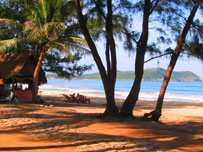
Sa Huynh is an area dotted with quaint fishing villages and sandy beaches in the central region’s Quang Ngai Province.Located off National Highway 1A, along milestones 983-987 on the coast of Duc Pho District and parallel to the national railway line, Sa Huynh abounds with golden sand.

The color of the sand changes during the day from an earthy brown early in the morning, to a shimmering gold around noon, followed by a pale blue hue on moonlit nights.

Sa Huynh is rich in local seafood and there are several restaurants offering up fresh meals from the sea.

The area is also steeped in ancient culture dating back to 1,000 BC. The Sa Huynh people are thought to be predecessors of the Cham, the founders of the Champa Kingdom.

Along with the Dong Son Culture in the north and the Oc Eo Culture in the Mekong Delta, Sa Huynh is considered one of the most famous ancient Vietnamese cultures of the Iron Age era.

Along the beach, stretching around 6km, and near the Sa Huynh Tourist Resort is an abundance of scenic highlights.

Visitors can rent motorbikes and travel around Ma Vuong Mound to see historic archeological sites.

In the culture of the ancient Sa Huynh people, the dead were cremated and buried in jars. In the early 20th century, French archeologists excavated these ‘tomb jars’ and found many were also buried with stone adornments and tools.

At Sa Huynh Hotel, about one kilometer south of the Sa Huynh Railway Station, visitors can enjoy the view of the vast blue sea, rest in the shade of green casuarinas, feel the cool breeze on their skin, swim in the sea by a sloping beach, and enjoy food specialties such as boiled crabs with salt and chili, rice porridge with sea urchins, and sour soup with groupers.

When visiting Sa Huynh, be sure to purchase a few kilos of nep ngu (a type of glutinous rice once offered to kings) and fermented urchin paste, which is only available in the summer.

Signboards at Hoi An

Posted by huongpr2389 on May 5, 2009 under Vietnam Destinations, Vietnam Travel Tips | 3 Comments to Read

It is not commonly known that the history of signboards of shops in Hoi An, Quang Nam province, is the history of the development of this ancient city.

There is nowhere like in this city where the past, the present and the future are as connected to business and nowhere like in Hoi An where signboards of shops can tell so much.

Some of the signboards in Hoi An have been around since the 18th century and they are still hanging on the doors of ancient houses like living proof of the ancient city’s history.

Culture of signboards

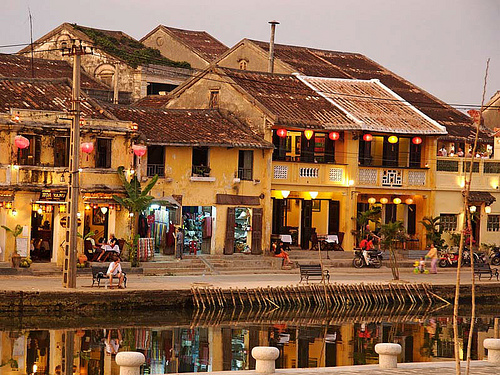
On ancient streets of Hoi An, old signboards prevail on doors, giving the ancient city a unique architectural characteristic.

Signboards of shops are very diverse and eye-catching. There are 75 old signboards on the road of Tran Phu and 40 on Nguyen Thai Hoc street, belonging to shops of Vietnamese and Chinese-Vietnamese.

According to the Hoi An Relics Preservation Centre, there are 45 signboards of 100-200 years old and 30 of less than 100 years. Many shops have been known for centuries, such as Duc Hung, Xan Thanh, Van Buu, Tan Ky, Tuong Lan, Chan Nam Hung, Thuan An Duong and Quan Thang San.

Mrs. Thai Thi Sam, 90, at No. 77, Tran Phu road, said: “Quan Thang San signboard is written in Chinese script. It has been used for more than 200 years, since the age of my paternal grandfather. It has been moved several times. Though my family doesn’t do business anymore, we still keep it because it is the brand of my grandparents.”

The old signboard Quan Thang San is now hung on the most beautiful old house in Hoi An. This house is a typical example of the architecture of Hoa Ha region in China. The house’s owner, Mr. Diep Bao Hung, is the 7th descendant of a Chinese captain named Thai Ke Trinh, who traded traditional Chinese medicines with Asian countries.

According to a survey of the Hoi An Relics Preservation Centre, most signboards were made based on the Chinese conception of prosperity and luck. However, the signboard of each house has its own special quality.

Most signboards of Chinese-Vietnamese are written in Chinese and made of wood. They are carved and gilded. Typical examples are Chan Nam Hung, Tuong Lan, and Tan Ky, which are decorated with leaves, flowers, dragons, and cranes.

There are some signboards made of concrete on walls, decorated with patterns, such as Thai Vinh Xuong, Nam Phat and Cam Thach.


Traditional values

Minh Duc Duong signboard, 120 Nguyen Thai Hoc.
The names of signboards tell the history of Hoi An, a commercial port established by the open door policy of the Nguyen Dynasty to boost trade with Chinese, Japanese, Dutch and others.

Signboards also express good things, combining with the names of shop owners.

The signboards like Hoa An Duong, Chan Nam Hung, Bao An Long, Nam Phat and An Thai express the wish to live and work in peace in this southern land by Chinese traders from Fujian, Chiu Chow, Hainan, and Guangzhou.

Annually, signboards are cleaned by a wiping cloth wet with alcohol but they are never painted again. During the lunar New Year holiday, they are decorated with red-cloth flowers. Below the signboards are scrolls of parallel lines of script: “Safe and Sound” or “Prosperous”.

Whenever a shop hangs up its signboard, the owner always chooses a good time and performs rituals with flowers, betel and areca, wine, steamed glutinous rice, boiled chicken, incense and votive paper.

At Chinese shops, there are some more offerings like a bowl of noodles, a piece of red paper on the plate of chicken and steamed glutinous rice to wish for luck and immortality.

Le Thi Tuan from the Hoi An Relics Preservation Centre said that as trade has been the foundation of Hoi An for several centuries so shop owners treasure their signboards. The position of major signboards will never be changed. Each shop has 2-4 signboards, one in the house’s centre, one in the living-room, and another hung outdoors.

“Even when a shop changes its business, the signboard is still kept out of respect to tradition,” Tuan said.

Modern meanings

The famous La Thien Thai shop.
There is nowhere like in Hoi An where signboards contain intangible cultural values. By looking at signboards and talking with signboard owners, one can learn about the life, habits and trade history of a family and the prosperity of Hoi An from the past to the present. Thus, the local government has regulations to manage signboards.

According to the chief of the Hoi An Department of Culture, Sports and Tourism, Nguyen Van Lanh, in 1997, Hoi An issued the first regulations on signboards in the ancient city. These regulations are very strict and based on the traditional way of using signboards at shops in Hoi An.

“Hoi An can both develop business, tourism while preserving its traditional values when it preserves its unique signboards,” Lanh said.

According to regulations, signboards must be clear, of standard size and suitable to the traditional style of Hoi An.

In region 1 of the ancient city, signboards must have brown, stone, dark yellow colours. The local authorities encourage traders to use wood to make signboards. The script on signboards must be Vietnamese.

Of nearly 1,000 signboards in Hoi An, around 70% are made of timber and done in the traditional style.

Hoi An will continue to introduce its culture to tourists through this system of unique signboards.

Visa to Vietnam can be applied on: Vietnamvisaexpress and Vietnam-visa