Posted by huongpr2389 on April 22, 2009 under Vietnam Travel Info, Vietnam Travel Tips |
To get visa on arrival (for those traveling by air and picking up visa at airport), what you need to do is as follows:
- Getting approved letters by clicking here for filling in the form and send to us. 24 business hours after receiving your final confirmation on payment, you will be sent a copy of the pre-approved letter with code for picking up Vietnam visa
- Print the approved letter and 2 photos size 4×6cm with you for picking up visa at the airport
- Stamping fee will be paid directly at the airport.
Notes:
- Your visa upon arrival will be automatically arranged for those who enter Vietnam by airport.
- Visa on arrival is applied for those who travel by air only.
Posted by huongpr2389 on April 14, 2009 under Vietnam Travel Info, Vietnam Travel Stories |
A trip aboard a ‘royal boat’ on the Huong (Perfume) River is a great way to discover the historic town of Hue.
The central town of Hue is well known for its dragon boat trips along the Huong (Perfume) River. It is a great way to learn about the unique culture and history of the central region. On most trips, visitors can travel via these boats to visit the Nguyen Kings’ mausoleums while enjoying ca Hue (traditional Hue singing).
The Nguyen Dynasty (1802-1945) was the last monarchy of Vietnam and for a truly royal experience, visitors can opt to take a special royal boat adapted from the dynasty’s Yen Nhu boat. This type of vessel was featured at the Legend of Huong River Festival, part of Festival Hue 2008.
Compared with ordinary dragon boats that serve tourists, the royal boat is much bigger. It is 27 meters long, seven meters wide, and nearly six meters tall with seating for 120 people. Spectacular dragons and tigers are carved into the boat’s wooden floor and railings.
The cruise begins at Nghinh Luong Dinh Quay and lasts one and a half hours from 7 p.m. every night. On the voyage, visitors travel along the Huong River, from Truong Tien to Bach Ho bridges. The boat cruises gently past several scenic areas of Hue while traditional cuisine is served with musical accompaniment.
The trip is also enhanced by drama performances including royal songs, time-honored dances and poetry readings. Visitors can also share in the fun by trying on costumes like that worn by the kings and royal family during gala dinners.
Guests are sure to enjoy an evening of floating along the peaceful river while learning about royal culture and history.
A royal boat trip costs a base rate of VND50,000 (US$2.90) with optional activities costing more.
Posted by huongpr2389 on April 6, 2009 under Vietnam Culture, Vietnam Travel Info |
The ancient village of Phuoc Tich in the central province of Thua Thien-Hue has been recognised as a national cultural heritage by the Government.
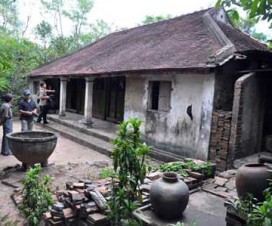
Phuoc Tich, located 40km to the north of Hue, has 117 old houses, including 27 in traditional style that are of invaluable architectural and cultural value.
Importantly, it has clung to its traditional pottery craft through the centuries.
The first villages sprung up in central Viet Nam centuries ago. During the Le dynasty in the late 15th century, especially during the reign of King Le Thanh Tong, great southward migrations were organised to extend the nation’s territory southward in the face of Chinese aggression in the north.
Later, in the mid-16th century, the Nguyen Lords, seeking to build a new royal capital in the south, set off a further migration that saw more villages mushroom in the central region.
Most of the migrants were farmers, and their foremost interest upon arrival at a new place was growing crops.
But some villages chose handicrafts and other vocations to make a living. Phuoc Tich was one such.
The founders decided to build the village in Con Duong, a sanctuary for local Cham villagers who were also the owners of the land.
The site was probably picked because it was ideal for the vocation the founders had chosen: pottery.
It was near a river, thus assuring a supply of vital water and enabling easy transport of raw materials and finished products.
Royal approval
Phuoc Tich was a famous pottery village in its heyday, supplying the entire central region. It achieved great honour when the Nguyen Court in Hue had the village produce “om ngu”, or clay pots for cooking in the Forbidden City.
Their success enabled Phuoc Tich residents to afford the renowned Hue-style traditional wooden houses that are now regarded as a cultural heritage of the village – 27 of them in an area of just 1.4sq.km, each nestling in a spacious garden.
Looking at these garden-houses now, visitors can easily picture in their mind’s eye the golden age of the village with its hustle and bustle, splendour, and prosperity.
Like in Hoi An, the village’s old structures have been preserved by a chance of history: Pottery-making gradually lost its charm and young people began to go to other places, leaving behind the old and very young, in search of jobs.
Those who stayed back had no reason to make changes to their homes, and a large number of them have survived intact.
These days the village is again receiving a lot of attention, this time from researchers in and outside the country. Its large assemblage of old traditional houses and vestiges of Cham culture convince them of its great cultural heritage.
The Government and foreign organisations are considering plans to revive the pottery art of Phuoc Tich and, to an extent, restore the vitality of this typical handicraft.
The most ambitious project is one envisaged by Belgium’s Wallonie Heritage Institute and the Viet Nam Institute of Culture and Arts to revive the village through a tourism-based project. It is expected to help research the cultural heritage of the village, preserve the old traditional houses, and revive the traditional handicraft by organising tours to the place based on pottery, holding a “Heritage Day” festival in the village, setting up a website for it, and exhibiting Phuoc Tich products in Belgium.
The project could benefit the village greatly but suffers from some drawbacks.
No paddy fields
Because of its traditional dependence on pottery, the village is one of those rare Vietnamese ones without rice paddies.
In the late 20th century, when plastic products appeared on the market, everyday pottery died out slowly.
Without rice fields to turn to unlike in most other villages, people, especially young ones, began to migrate to cities, leaving behind old people and children.
This is a reasonably common occurrence in Vietnamese villages but Phuoc Tich has taken it to an extreme: old people and children make up 80 per cent of its population.
The farm chores that give rise to the iconic images of rural Viet Nam and draw tourists are conspicuous by their absence here.
Last summer I visited Phuoc Tich with American woman Le Thi Ngoc Dieu, and her husband Daniel Mark, both university professors. We were disappointed despite being briefed about its present state.
The fields appeared withered and uncared for, the houses were deadly quiet with old people and children listlessly sitting on the doorstep, staring vacantly, and doing nothing.
We agreed that to make the village interesting for tourists, the first thing to do was to give it back its pastoral life.
Then, the planned revival of the pottery craft should be able to provide well-paid employment to persuade young people to return home.
Another issue is the value of the pottery they may produce. The craftspeople, no longer conversant with the demands of the market, should be thoroughly apprised on patterns and styles they should create.
Nguyen Huu Thong, president chairman of the Viet Nam Institute of Culture and Arts, said his agency plans to link up Phuoc Tich with two neighbouring villages – My Xuyen (famous for its carvings) and Phu Oc Dem (rush-weaving) – to make wooden statues with ceramic pedestals.
This is likely to add value to Phuoc Tich’s products and help bring young people from neighbouring villages before Phuoc Tich’s young return themselves.
It appears to be most viable project conceived yet to resuscitate the village.
Posted by huongpr2389 on April 3, 2009 under Food and Drinks |
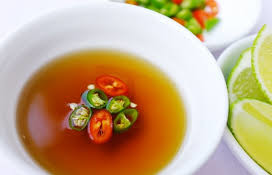
Nuoc mam, fish sauce, is the most essential ingredient for everyday meals and cooking in Viet Nam.
It is a signature aspect of Vietnamese cuisine, and distinguishes it from Chinese cooking, which is marked by its prominent use of soy sauce. This inimitable, Vietnamese sauce is obtained through the maceration of saltwater fish and their fermentation under sunny, natural conditions. The ingredients and climate are readily available thanks to the country’s lengthy coastline and tropical forecasts.
The best nuoc mam comes from the islands of Phu Quoc and Cat Hai, respectively on the southwestern and northern coasts, and from the central province of Phan Thiet.
There’s a Thai variation of nuoc mam, but it does not compare to the original Vietnamese product. Nuoc mam is rich in amino acids, sodium chloride, histamines and organic and mineral phosphors.
Nuoc mam may have a strong smell for the uninitiated, but it is no more intense than a Roquefort cheese or a gamy meat. Plus, there are ways to lighten the odour, namely by not using it when cooking over an open fire.
By flavouring it with a variety of condiments, nuoc mam can be used to enhance a number of different dishes. When ginger is added, it is perfect for boiled duck; vinegar, lemon, garlic and onion are added for fried fish; and a smashed, hard-boiled duck egg may be added for boiled cabbage.
Nem, spring rolls, require a very light sauce seasoned simply with vinegar, sugar and pepper, while banh cuon, a plain or stuffed rice wrap, goes particularly well with a wee bit of natural belostomid essence.
In Phan Thiet, home to one of the country’s most famous brands, nuoc mam is garnished with pineapple slices, while house wives in some other parts of the South boast a more exotic recipe: nuoc mam in boiled coconut milk.
But the ingredient that tops all others is chilli, fresh or powdered the hotter the better and lots of it. In addition to nuoc mam, there are paste products, generically named mam, also made from macerated marine fish and crustaceans and believed to have been introduced by the Cham and other ethnic groups of Malayo-Polynesian origin.
The most common of these other products is the shrimp-based mam tom, notorious for its strong smell but irreplaceable in regards to dog meat, pig organs, grilled tofu and fat pork. Mam tom, called mam ruoc in the central regions, is a must-have for certain Hue specialities, such as bun bo, beef noodles, and com hen, mussels with rice.
Still, there’s nothing like mam tom chua, sour fermented shrimp, the crown jewel of Hue cooking. Farmers in the Hong (Red) River Delta have their own special brew, which they make from small, fresh-water shrimp and call mam tep. It’s unforgettable once you’ve tried it with a little fat pork, noodles and some aromatic herbs.
Posted by huongpr2389 on April 1, 2009 under Visa to Vietnam |
You need a visa to enter Vietnam before you travel to the country. It’s easy to organise a Vietnam visa in Bangkok if you know where to go.
The first way is to go directly to the Vietnamese Embassy in Bangkok. Once inside, fill in one of the application forms and then submit it at the window along with the appropriate fee. It’s around 1000 Baht ($30 US) for a one entry visa – make sure you request a multiple entry visa if you intend to exit and re-enter Vietnam during your travels, otherwise you’ll have to apply for a second visa all over again. You need to submit the visa application between 8.30am to 11.30 am and 1.30pm to 4.30pm. You can collect it 3 days later or pay a little more and get express service to collect it the next day, but make sure you drop it early in the morning if you want to be sure of this. You can find more info on the quite helpful
The second way is to order visa online. It will take you about 2 days to receive the approval letter from the Vietnam Immigration Department via e-mail after filling in the application form. All you have to do is to print it out and bring it to your Vietnam arrival airport to get stampted. This way is rather popular now because of its convenience and cheap price.
You can use either of these methods to ontain a visa to Vietnam. It is so easy.