Posted by huongpr2389 on March 25, 2009 under Visa to Vietnam |
A Vietnamese entry visa is required for all foreigners wishing to visit Vietnam except for citizens of countries having bilateral agreements on visa exemption with Vietnam.
There are two ways to get visa to Vietnam
1. Visa getting up on arrival
* Arrival visa means the visa that you can collect upon arrival at the airport. The advantages of arrival visa is you will not need to go anywhere to apply for the visa and it is convenient for people who really want to save their valuable time in business.
* You will need to have a letter of visa upon arrival which is issued by Vietnam Immigration Department. Airlines accept this letter and you can get visa upon arrival at airports in Vietnam easily. You can apply visa on approval here
2. Visa getting at the Embassy
* Visa getting at the embassy means the visa that you collect at Vietnam Embassy in the country you are living.
* You will need to have a letter of visa getting at the Embassy which is issued by Vietnam Immigration Department. Vietnam Embassy accept this letter and you can get the visa toVietnam easily.
Posted by huongpr2389 on March 20, 2009 under Vietnam Culture, Vietnam Festivals |

Artist HA THI CAU
Professionalism
Xam is a genre of folk songs in northern Vietnam. Xam is also a word used to call blind people who sing xam songs to earn money so hat xam is considered a job.
Many equate xam with beggars but they are different. Xam don’t live on free food or money but they live on offerings from people. Before receiving tokens, they have to win people’s hearts with their voices and music.
In the first half of the 20th century, xam grouped up to travel everywhere. Each group was often led by a group leader, who was a blind man.
The word “professional” is needed to describe xam, who earn their living by singing. The professionalism of this job is also shown through the organisation of xam groups, which are linked with each other under the control of a leader.
Normally, each xam leader controls an area. If a xam group wants to sing in another area, it needs the agreement of the xam leader who controls that area.
It is also professional in the way xam choose sad or merry melodies to be appropriate to the circumstance and the attitude of listeners.
Hat xam’s founder is a prince?
Normally, only jobs related to production have founders, but hat xam also has a founder. And the founder of hat xam is a dignitary, Prince Tran Quoc Dinh.
According to legend, in the Tran Dynasty, there were two princes, Tran Quoc Toan and Tran Quoc Dinh. As both sought the crown, a power struggle ensued. During an altercation, Tran Quoc Toan tore out Tran Quoc Dinh’s eyes and threw him into the forest.
Tran Quoc Dinh couldn’t do anything but cry. He fell asleep. In a dream, a Buddha appeared and gave him a musical instrument which was played with a bamboo rod. Upon awakening, he made the musical instrument based on his dream. It was odd that the instrument created sweet sounds. Hearing the sound, birds brought fruits to him. Some lumbermen heard the sound and took care of him.
Prince Tran Quoc Dinh taught poor and blind people how to play the instrument and sing as well. He became famous, even in the capital. He was invited to sing in the royal palace, where his father recognised his son. Even after returning to the palace, the prince continued to teach poor and blind people.
Hat xam was born then and Tran Quoc Dinh was honoured as the founder of hat xam. Xam consider the 22nd day of the second lunar month and the 22nd day of the eight lunar month as the prince’s death anniversary and the founding anniversary of hat xam.
The Vietnam Music Art Development Centre has an award in the name of Tran Quoc Dinh for artists, collectors, researchers and journalists who make great contributions to traditional music
Based on the characteristics of this job, the anniversary is often organised on wide plots of land, not in a temple or a fixed place.
Restoring hat xam anniversary
Hat xam and hat xam anniversary was popular in the 1950-1960 and it disappeared after that. In 2008, the Vietnam Music Art Development Centre resumed the anniversary for the first time at Van Mieu – Quoc Tu Giam (Temple of Literature). This is part of a programme to restore hat xam art conducted since 2005.
Restoring the anniversary is also the aspiration of the living treasure of hat xam, artisan Ha Thi Cau.
This year, the second anniversary will be held at the communal house of Hao Nam village, on Vu Thanh street. According to musician Thao Giang, who initiated the resumption of this anniversary, as of 2009, this anniversary will be organised annually at this communal house.
It is pity that this year artisan Ha Thi Cau will not attend the anniversary because she is very weak now. After the anniversary, some xam singers will go to Ninh Binh province to visit the latest famous xam singer of the 20th century, Mrs. Ha Thi Cau.
Posted by huongpr2389 on March 9, 2009 under Vietnam Beaches, Vietnam Destinations |
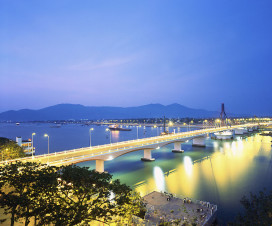
Setting off from the North and stop at the central of Vietnam, located a great coastal city named Danang with hills, moutains, islands and seas where you can feel the fresh air filled all around. This is one of the most stunning places worth visiting in Vietnam. 
The city of Danang is situated close to plains, hills, mountains, islands, and the sea. Its climate is temperate and there are many historical and cultural sites in and around the city. The tourism sector of Danang offers a variety of tourism products.
Approximately 13km east from the center of Danang is the large Son Tra Peninsula. From a distance, the peninsula looks like a mushroom that sits 693m over the water. The cap of this mushroom is the Son Tra Mountain, and the stem is the Son Tra Beach with smooth, white sand – an ideal place to play sports and enjoy fishing or swimming.
The Son Tra Peninsula is a national park where many species of wild animals and plant varieties are preserved and fresh water is available. On the Son Tra Peninsula there’s a 4,370ha primeval forest. With the green of forest trees and the blue color of seawater, the Son Tra Peninsula has a romantic but imposing beauty.
On the Son Tra Peninsula, one can enjoy the fresh air and contemplate the wonderful natural landscape of this place, and learn about the lives of fishermen here. They can also enjoy various kinds of seafood.
Not very far from the Son Tra Peninsula to the south is the Ngu Hanh Son mountain range, which is a special attraction of the entire central region.
The Ngu Hanh Son mountain range consists of six limestone mountains, each with its own name. The legend is that there was a sea dragon that flew to the seashore and laid some eggs. After 1,000 days the eggs hatched and out of one came a beautiful girl. The egg shell became the five mountains, which were then named by Lord Nguyen after the five elements: metal, wood, water, fire, earth.
The northern-most mountain is called Thuy Son (Water Mountain), the one to the east is Moc Son (Wood Mountain), to the west is Kim Son (Metal Mountain), to the south is Hoa Son (Fire Mountain) and in the middle is Tho Son (Earth Mountain).
Hoa Son is actually two small mountains, Duong Hai Son and Am Hoa Son. So, you can say that the Ngu Hanh Son mountain range consists of six mountains – your choice. But regardless, it also has many caves.
At Ngu Hanh Son there is also a famous pagoda, named Chua Khong, and the Tang Chon Cave. The six Ngu Hanh Son mountains are adjacent to the Non Nuoc Beach, one of the six most beautiful beaches in the world.
Not far to the west of Danang is a large mountainous area that is adjacent to the Truong Son mountain range. In this area there are primeval forests with various animals and plants. There are also old houses built in the French style.
In the area of the Ba Na Mountain Range there are adequate tourist facilities, including villas, restaurants and a modern cable car to take visitors from Vong Nguyet Hill to the highest mountain, 1,400m above the sea. From the top of this mountain one gets a panorama view of Danang – the city on the banks of the charming Han River.
When it’s not raining at the Ba Na mountaintop, one can perhaps watch it raining below. At the Ba Na mountaintop, the weather keeps changing so that people can see and feel the four seasons, spring, summer, autumn and winter, all within one day.
The Museum of Cham Sculpture, in the center of Danang, is enjoyed by almost every visitor to the city. This museum was built in 1915. It preserves and has on display thousands of Cham sculptures that are from between the seventh and the 15th centuries.
Leaving the center of Danang and going to the north one can see Hai Van Pass – an imposing picture created by nature. From the top of the Hai Van Pass one can see an overview of Danang – a young city that is changing everyday.
Posted by huongpr2389 on March 6, 2009 under Vietnam Destinations, Vietnam Travel Stories |

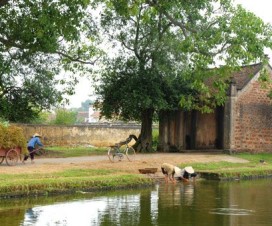
A view of Duong Lam ancient village
For every tourist who comes to explore the Northern Vietnamese culture, Duong Lam ancient village is a good suggested destination. In addition to the hallmarks of a traditional northern village, Duong Lam also offers visitors the heartfelt welcome of its country people. We guys have had a chance to experience this wonderful village.
We can see it in the smile of a tea-shop owner near Mong Phu communal house, which we visited with a local volunteer acting as our tour guide.
Duong Lam is located 50km to the west of Hanoi. The unique village, which was recognised as a National Cultural-Historic Relic, has houses which are around 200 years old.
Of the nine hamlets within Duong Lam Village, Dong Sang and Mong Phu have maintained the most ancient houses: 441 and 350, respectively, among the total 956 traditional houses.
The old Duong Lam Village is famous for its homes made of laterite, a type of red soil. Most of these houses have their own courtyards surrounded by a laterite wall.
We stayed at Nguyen Van The’s house, which was built in 1703 and is one of the three oldest houses in Duong Lam. We ate a delicious lunch with his family of boiled chicken, vegetables and fried tofu, prepared by The’s wife and daughter-in-law.
“We inherited the house from our parents. We are making an effort to preserve the house although it is deteriorating,” The said. “We get a lot of foreign visitors and often talk with them about the life of the country people.”
The country is experiencing a general trend towards modernisation not only in the urban areas, but also in the rural regions, but the people of Duong Lam have preserved the customs of the rural people.
The village didn’t have the restaurants and souvenir shops of tourist destinations. Instead, the owners of the old houses were hospitable and ready to spend half the day talking with their visitors.
The’s wife introduced us to a soy sauce, peanut candy she made and told us about herself while we munched away.
Liked many women in rural areas, she got married when she was young, only 19, and had three children. She has been so busy taking care of her children, then her grandchildren, that she has only visited Ha Noi once, 18 years ago. “On TV, I see tall buildings, big supermarkets, shops and large roads with bright lighting. I can’t even imagine how the capital city has changed,” she said.
Both The and his wife are concerned that the old houses will disappear in the future if owners knock them down to build new cement homes.
Duong Lam also lures visitors to see its architectural relics, including the Mong Phu hamlet gate, the Mong Phu communal house, the Ngo Quyen imperial tomb and Mia Pagoda.
Attractions like the 500 year-old communal gate, the century-old banyan tree and the river wharf all bear the characteristics of Viet Nam’s northern countryside, but their unique characteristics set Duong Lam apart from other villages.
While many northern villages have hamlet gates, Mong Phu’s ancient gate was built to look like a house with a sloping roof.
On our one-day trip, we were able to visit four of the village’s 16 historic relics: Mia Pagoda, Ngo Quyen Tomb, Mong Phu communal house and Phung Hung Temple.
The communal house, built in 1684, combines the architectural style of the Kinh people (majority population in Viet Nam) with the timber floor of the Muong ethnic minority group. Festivals and folk performances usually take place in the large yard in front of the house.
The 73-year-old keeper told us that the restoration of the communal house was part of an ongoing VND200 billion (US$11.4 million) project to preserve historic monuments in Duong Lam, including the restoration of ancient wells and houses and a shrine dedicated to Chinese philosopher Confucius.
If Ha Noi’s old quarter and Hoi An’s ancient town are relics of an ancient urban lifestyle, then Duong Lam’s old village is a valuable relic of rural village life, said the keeper of the Mong Phu communal house.
Mia Pagoda, with 286 statues made of bronze, wood and clay, is one of the most beautiful pagodas in the north, said Tran Van The, our volunteer guide.
At the end of a day spent enjoying the historic relics of an age-old culture, we enjoyed some Duong Lam specialities: Mia chicken, Mong Phu soy sauce, Cam Lam tea and Dong Sang peanut candy. Visitors often bring these specialties home as gifts.
More and more young couples are flocking to the village to capture its traditional beauty in their wedding photographs. “We chose the location for its ancient houses and consider it a chance to both escape the stress of the city’s dusty streets and to feel the Vietnamese soul through the culture here,” said Nguyen Khanh Linh, a bride-to-be.
To know more about Duong Lam, you can check out this website:
Posted by huongpr2389 on March 5, 2009 under Vietnam Culture, Vietnam Festivals, Vietnam Travel Stories |

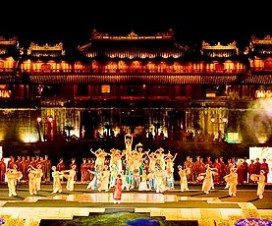
Hue festival
Am Sac Viet (Vietnamese Timbre) – a program that brings three musical styles from the North, the Central and the South of Vietnam - is attracting thousands of people in the Hue festival.
Am Sac Viet is a combination of ca tru (choral chamber music) from the north, ca Hue (Hue singing) and cai luong (renovated opera) from the south.
Three troupes, one from each region, got together for their first one-hour performance inside Dien Tho palace on Sunday night.
The four-member Thai Ha group from Ha Noi, Hue-based Phu Xuan with seven artists and two artists from Bach Tuyet and Thanh Hai from HCM City each performed a 20-minute item.
“I love the atmosphere of this music which feels like a trip back in history to the time of the mandarin or the court of the Vietnamese kings, when there was nothing electronic, only music, architecture and simple things,” French tourist Alain Thomas said. “It is extremely emotional music and has a very unique timbre.”
The audience was welcomed through the three entrances of the wooden palace by young women in ao dai (traditional long dress of Viet Nam) and were shown to their seats on embroidered pillows around a slightly raised stage.
In front of each pillow was a porcelain flowered tray on which sat a pottery tea set, a small pottery plate plus a white or pink lotus flower.
The show’s director said three sweet bean candies and three sugar-coated lotus seeds were laid out for audience members to allow the fine fragrance of the lotus flower to circulate during the performance.
“I have no idea about the programme but its name absorbed me,” said a Viet kieu (an overseas Vietnamese), home from the US for one month.
“As a Viet kieu living far from Viet Nam for such a long time, I am very interested in this music,” the middle-aged woman said. “I know it is something very original.”
Seventy-year-old Nguyen Van Mui, the leader of the Thai Ha troupe, said the combination in such solemn surroundings helps the audiences better understand the typical features of each style of music.
“I am happy to see not only middle-aged and old people, but also young people show respect for traditional music.”
Sitting silently from the beginning to the end of the show, 19-year-old Nguyen Le Minh, a student from the Hue, was one of the youngest members of the audience.
Minh had only come inside Dien Tho to shelter from the rain, but then decided to stay.
“But it is not easy to enjoy the three typical kinds of music at the same time and in a such a serious atmosphere.”
Am Sac Viet programme is performed every night at Dien Tho Palace throughout the Hue Festival.
Posted by vnb73 on under Vietnam Beaches, Vietnam World heritages |
|

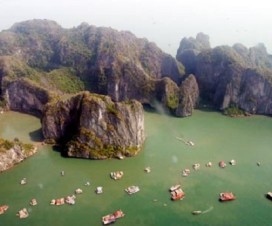
Vinh Ha Long considered as Bay of the Descending Dragon is often touted by proud Vietnamese as the world’s Eighth wonder. One of the main attractions of Ha long is the bay’s calm water and the thousands of limestone mountains dotting the seascape. The Bay’s water is clear during the spring and early summer. Some of the islands are quite large and there are small alcoves with sandy beaches where swimming is possible. Ha Long bay lies in the northeastern part of Vietnam and is 165 Km from Hanoi.
Ha Long literally means descending dragon(s) and according to local myth, the story goes as follows:
Long ago when their forefathers were fighting foreign invaders from the north, the gods from heaven sent a family of dragons to help defend their land. This family of dragons descended upon what is now Ha Long bay and began spitting out jewels and jade. Upon hitting the sea, these jewels turned into the various islands and islets dotting the seascape and formed a formidable fortress against the invaders. The locals were able to keep their land safe and formed what is now the country of Vietnam. The Dragon family fell so much in love with this area for its calm water and for the reverence of the people of Vietnam that they decided to remain on earth. Mother dragon lies on what is now Ha Long and where her children lie is Bai Tu Long. The dragon tails formed the area of Bach Long Vi known for the miles of white sandy beaches of Tra Co peninsula
This myth is in line with the Vietnamese myth of their origin Con Rong Chau Tien. This myth describes the union between a king (representing the dragon) and his bride (representing a goddess) giving birth to 100 children which are the ancestors of the Vietnamese people. The Ha Long myth illustrate the Vietnamese belief of their origin and the fact that throughout their history, they are aided by their ancestors, the dragon and the gods, in the defense of their land.
| If you like and want to see the bay of descending dragon, visit this site < click here>
to get the easiest way to get visa to Vietnam
|
|
Posted by vietnamtravelblog on March 4, 2009 under Vietnam Destinations, Vietnam Travel Info |
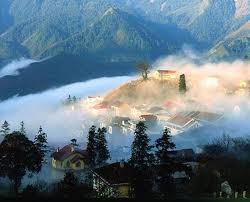
Lao Cai Province authorities are preparing for this year’s Culture and Tourism Week to be held in Sa Pa from April 30 to May 3.
A wide range of events are scheduled for the week, including the “Love Market” in Sa Pa town and “Cloud Festival” on Ham Rong Mountain that will spotlight traditional ethnic minority cultures.
There will also be a photography exhibition titled Sa Pa – The Land and Its People, a musical programme, and a cookery fair.
Saigontourist takes care of cruise visitors
The Saigontourist Travel Service Company received 1,200 tourists who arrived on board the 5-star cruise ship Costa Allegra which has visited Ha Long, Da Nang, Nha Trang and HCM City since February 24.
During their six-day stay, the cruise tourists, mainly from France, Germany, the UK, Spain and Italy are scheduled to visited Ha Long Bay, cultural sites in central provinces, HCM City and My Tho.
Saigontourist has so far this year served 22,500 foreign tourists and crews arriving by sea, 40 per cent more than last year.
Travel firms unveil Dubai, East Asian tours
The HCM City-based Vietravel has launched a new six-day tour to Dubai which will take in the Grand Mosque Temple, the ancient town of Bastakiya, Dubai Museum, and a trip through the desert by cars or camel to the opulent seven-star hotel Burj Al Arab. Tourists will also visit Abu Dhabi, the capital of the United Arab Emirates, and participate in some symbolic festivals of this legendary region.
The tour costs US$2,499 and there are departures scheduled on March 22, April 26, and May 24.
Ben Thanh Tourist has launched an eight-day tour of Japan for the Sakura (cherry blossom) festival. The tour, which begins in April, includes a pilgrimage to Asakusa Kannon Temple, the Royal Palace and Tokyo Disneyland.
There is also a visit to the hot springs in Hakone city where tourists will climb up to the mouth of a volcano, sail in Ashinoko Lake, and take a cable car to see Mount Fuji. The tour is priced at $2,790.
Ben Thanh also has a five-day tour to Kao-Hsiung and Taipei in Taiwan priced at $1,099.
European travel agencies scout Viet Nam
Representatives from 12 international travel firms, mainly German, Austrian and French, were pleased with a Viet Nam familiarisation (FAM) trip arranged by Vietravel as they got to know about the destination and the products and services it offers travellers.
They have arrived on a three-day trip and visited Ha Long Bay, Hoi An, the Mekong Delta and other destinations.
Four of the 12 firms are already bringing tourists to Viet Nam together with local operators.
Vietravel said the FAM trip is meant to keep international tour operators informed about the services and prices in Viet Nam. – VNS